
💡New park on Castlenau - WIP Proposal
Story 157

Welcome to Bridged2050: ideas for living well in a climate-ready Barnes.
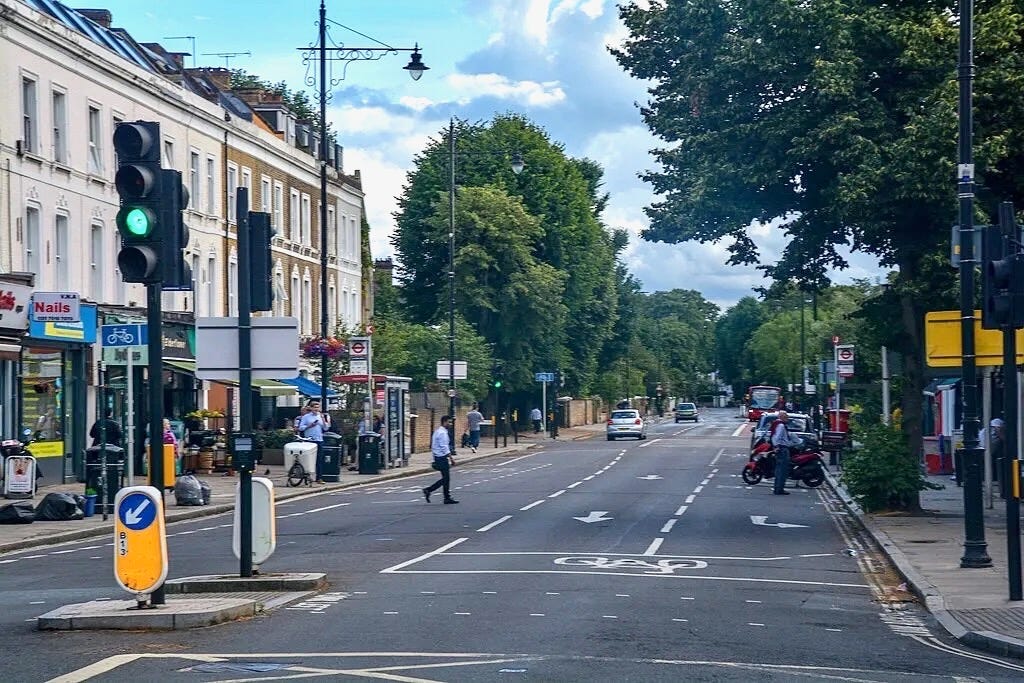
A new urban park should run the length of Castlenau, from the Holy Trinity church to the Red Lion pub. A narrow, planted spine down the middle of the A306. This new green ribbon would be called Castlenau Park.
For now this 0.6 mile stretch of tarmac has become a hostage in a political stalemate. And the paralysis shows no sign of ending.
Hammersmith Bridge still isn’t a priority for the UK Government (UKG) or for the Mayor of London and other boroughs in any meaningful, deliverable way. Whatever their rhetoric. Bridged has argued that the councils and the Mayor should say—plainly—what would need to happen for this to end.
Until they do, expect this grim pause to continue. Politicians from all parties and several layers of government find it useful to maintain this limbo. Residents are right to be skeptical about claims of heated disagreements between the Chancellor and Mayor.
So rather than leave Castlenau in limbo, we should do something more serious and useful: stimulate a public discussion about what kind of place this corridor should become if cars are not to be restored to Hammersmith Bridge.
This is potentially one of the most spectacular approaches to Barnes. It deserves better than paralysis.
History of Castlenau
Castelnau today is recognised for its distinctive and historic character but it started as a connecting road called Upper Bridge Road between the then new Hammersmith Bridge and Barnes village. It was laid out across what had been flood-prone fields. This road was later named Castelnau, a name derived from the estate of a French Huguenot family, the Boileau family, who had settled in the area in the early 19th century. Major Charles Lestock Boileau, whose father had bought land locally, astutely acquired property along the new road and became the prime developer of Castelnau in the decades after the bridge’s opening.
(Bridged will publish a longer history of this road later this year)
By the late 20th century, Richmond council designated the Castelnau Conservation Area to protect the road’s distinctive townscape. This area was later extended in 1982, 1983, and 1991 to include surrounding sections such as Lonsdale Road.
The designation reflects the cohesive heritage of Castelnau: the grand early-Victorian villas, the avenue of mature trees and gardens. Dozens of individual buildings on Castelnau are statutorily listed by Historic England for their national importance.
The conservation rationale was to protect the road’s 19th-century layout and architecture, which together tell the story of Barnes’ mid-1800s urbanisation following the opening of the Bridge.
It was not to preserve the experience of tens of thousands of vehicles using it as a fast urban thoroughfare every day.
Castelnau’s development – from marshy fields, to a speculative Victorian villa avenue, to a busy 20th-century thoroughfare - is unfinished. It is time to consider how to restore this distinctive townscape in a 21st-century context.
The proposal
The central section of A306 between pub and church should become a new park.
Not a token verge. A proper, continuous green ribbon: trees, planting, paths, crossings, benches, shade. A living walkway from the north of Barnes.
Castlenau Park is part of a wider Manifesto for a better Barnes: a collection of ideas grounded in local insight, climate responsibility and a people-first approach.
You’ll find the full list of proposals, along with the thinking behind them, throughout this section.
Case for change
There are several strands to this argument:
Political leaders must offer a credible alternative to set against one which sees cars restored to Hammersmith Bridge
Planning for a post-car future is inherently valuable and should start as soon as possible
The new park would make a pedestrian-first Barnes more plausible
It would provide a boost to local Barnes retailers
The park would allow more shade and seating on a key walking route
A planted corridor would add soakaway capacity and surface-water resilience
Political leaders must present all alternatives
Politicians at local, regional and national level have spent six years suggesting the choice for Castlenau is between what you had or what you have.
2019 with over 20,000 cars roaring down Castlenau.
Or 2026 with a mile of largely unused A-road connecting to a Barnes road network that is also unchanged. This ‘limbo landscape’ south of the Bridge is part of a wider problem.
Politcal leaders have chosen to keep the roads empty without redesigning them for people. They have chosen to keep traffic signals working as if the vehicles are still there. They have chosen to make crossing the Thames harder for older residents and those with limited mobility. They have chosen to pretend this is an outcome rather than a pause.
This is not good enough.
Political leaders should be clear there are three options for Castlenau:
Flood with cars having restored them to Hammersmith Bridge
Maintain the current limbo landscape with no cars and no changes
Design a new urban landscape built around people. Castlenau Park is an attempt to do that.
Face with these real alternatives, Barnes residents make a measured decision as to how best use the area where they live.
Planning for a post-car future is inherently valuable
If the Bridge remains closed to private cars - by necessity or choice - what follows cannot be ‘empty tarmac forever’. It should trigger a redesign of the whole catchment area south of the river: how people move, where they cross, what the public realm feels like, how local access works, and what that means for local trade.
Designing a post-car Castlenau is not a minor undertaking. It is at least as complex as restoring vehicles to Hammersmith Bridge and that effort has consumed six years, with very little to show. So start thinking about the alternative now. Leaders need to help residents conjure what a car-free Bridge could offer. Some will never be persuaded, but most people will engage once the idea is explained honestly and treated as real.
Plans made through a long, open, properly argued process will be better and more credible. Begin now, and Castlenau Park should be ready by 2050.
Pedestrian-first Barnes
Walking is key to the future of transportation mix in Barnes and beyond.
Every tier of government wants more of it. Just read the Richmond’s transport strategy, the Mayor’s transport strategy, or the UK Government’s latest travel frameworks like CWIS3.
Bridged has already argued for a coherent pedestrian network on the peninsula including a spine that runs Thames to Thames. The BCA Travel Barnes proposal for a Mill Hill Road crossing would add another crucial spur.
Castlenau Park would extend that network, linking the Bridge to the area around the Olympic Studios area and so connecting two of Barnes’ four shopping parades.
Economic boost to Barnes retailiers
The walking economy is a powerful force. People spend, cars passing through at 30mph do not.
A linear park running south from the Bridge would funnel more people into Castlenau Parade and - crucially - encourage movement between Barnes’ parades rather than leaving them isolated as separate islands.
Nicki Maini is his survey of Hammersmith Bridge, talks about
Create the destination, invest in the approaches.
(Hammersmith & Fulham council, Richmond council and the Mayor of London) also need to invest in regenerating areas at either end: the retail outlets, cycling infrastructure, public realm upgrades, drainage improvements
(Maini’s blog post, Where did 25,000 vehicles go? is the clearest single account of the Hammersmith Bridge saga currently available)
By connecting to Castlnau to Church Road, the High Street and White Hart Lane, Barnes would be whole again. For everyone, not just drivers.
More shade and seating
Castlenau Park would also offer something sorely missing - shaded seating on a key pedestrian route.
That matters in a future where heat becomes more dangerous than we are culturally prepared to accept. Bridged has already made the point that Barnes’ anxieties about water, though rational, can distract from the rising risk of heat. Heat is more of a problem than rain, especially for our older residents.
Castlenau Park would provide shade, rest points, and a more forgiving microclimate: trees, planting, and seating designed for ordinary daily life in the mid twenty first century.
Another soakaway
Barnes is right to be water-aware. When high tide coincides with heavy rainfall, river communities face compound risk. That is the logic behind Richmond’s Community BlueScapes and projects like the award-winning Kitson Road scheme. They emain focused on flood resilience, including recent winter preparedness updates such as this.
A planted median park is, in effect, a long soakaway. It would add permeable surface area and water-management capacity on a corridor currently dominated by impermeable hardscape.
Practical considerations
Linear parks are not a novelty; they are a known urban design pattern. Even very narrow ones work. Here are four parks which are less than 4m - or two SUVs - wide:
Parkland Walk - Islington, London
Precollinear Park - Turin, Itally
Queens Boulevard Median Park - New York, USA
There are others such Gyeongui Line Forest Park in Seoul, South Korea which is wider in parts and follows an old rail corridor. Or Rose Fitzgerald Kennedy Greenway in Boston USA which is a linear park created by removing an elevated highway. Even the most famous linear park in the world, the High Line in New York City is relevant.
The point is not to copy any of these. Rather to show urban designers are capable of creating magical places that enhance the public realm. Castlenau is an opportunity is to add to the list of landmarks that make Barnes special - WWT, Thames Towpath and Barnes Green.
Castlenau also sits within a conservation area. That adds constraints, but it does not make change impossible; it simply raises the bar for design quality and evidence. In practice, it should be easier to make the case for a carefully designed park than for the return of high-volume motor traffic through a heritage townscape.
Is this idea bonkers? Possibly.
But nothing matches the madness of leaving a long, largely unused A-road as a tarmac memorial to political avoidance.
Bold ideas often look strange before they look obvious. Take them seriously even if you do not take them literally. If you have a better proposal to sit alongside a linear park—something that is deliverable, climate-aware, and improves daily life—send it to me.
This proposal sits alongside other major proposals fromBridged:
What a rejuvenated Terrace could become
And unlocking this new version of Barnes, a permanently car-free Hammersmith Bridge.
Imagine living in south west London in 2050. Much will be familiar but we have the chance to make generational changes to make Barnes climate-ready whilst maintaining, if not improving, the quality of our life.
Bold ideas have benefitted Barnes for decades. So why not Castlenau Park?