
More on the disappearing cars in south west London
Closure of Hammersmith Bridge prompted forecasts of widespread traffic chaos. Story 145

Welcome to Bridged2050: creating an even better Barnes during this climate crisis
Six years later despite those grim forecasts, it is clear there is ‘less traffic and congestion on nearby Thames crossings than before the closure’.
That quote is from a new analysis by Nick Maini. His insight tracks with the data from Department for Transport and Transport for London which was released earlier this month. Putney’s persistent delays, for example, appear linked to its junction redesign rather than the loss of a river crossing.
Across south-west London, Maini finds:
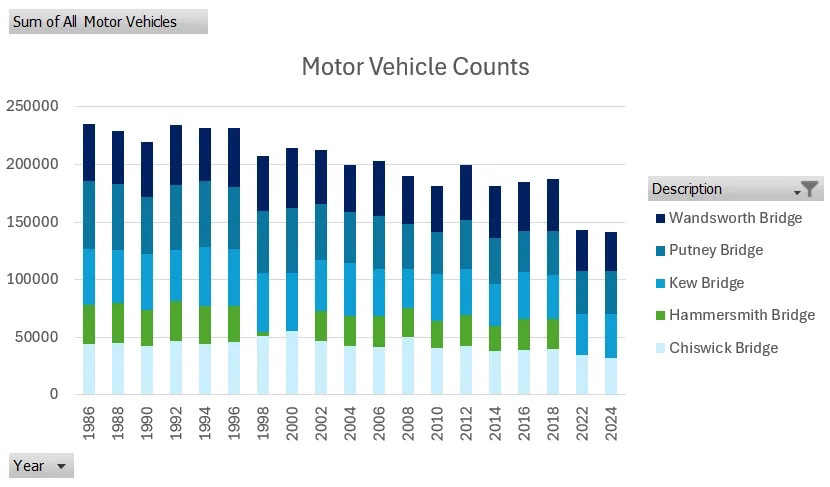
The data shows traffic has reduced in almost all the locations where increases were initially recorded.
By 2024, overall motor traffic volumes across the affected region had fallen by around 10% more than in the rest of London (25% overall).
Likewise, total traffic counts on neighbouring road bridges are lower than pre-closure.
Nick Maini’s blog post, Where did 25,000 vehicles go? is the clearest single account of the Hammersmith Bridge saga currently available.
He covers the key parts of the story - its history; why it was closed in 2019; what repairs have been done to date; the proposed long term solution; why demolishing is not an option; funding; social and economic impacts of closure; who has suffered from closure; local opinion; other solutions; and finally, a ‘call to action’.
Maini explains how
.. Of the original 25,000 daily trips, most shifted to cycling, walking and public transport, and some moved to other bridges.
Roughly 9,000 vehicles appear to have vanished from the network altogether. A familiar pattern when road capacity changes. As Maini puts it:
.. people tried new transport modes and often found they were better.

Notes & thoughts
Nick Maini’s survey pulls together threads thave been appearing regularly on this blog.
Unsurprisingly, he settled on similar demands of political leadership. Maini says, end the pretence. Bridged asks politicians to make clear what needs to happen for them to do this.
Without this change, the stalemate will continue. Restoring Hammersmith Bridge is not a priority for the Mayor of London or the UK Government. Even its owners seem more keen on restoring the Hammersmith Flyover.
Two insights in Maini’s article could be usefully updated.
He quotes economic data from 2020. N Anecdotal evidence suggests that business and commerce are thriving. Footfall is up on the high street. The four parades - Castlenau, Church Road, High Street and White Hart Lane - look to be in rude health. Updated economic data would allow for a better informed debate about the nature of our local economy.
Similarly it is now two years since there was a credible opinion poll on the future of the Bridge. The vacuum allows all parties to make (at times outlandish) claims. Yet we know public sentiment about any changes to the transport network evolves over time. Richmond council should be tracking this sentiment, ideally yearly if not every other year. This insight would allow our leaders to make better informed comments, frame a more useful public debate as well better understand public sentiment before they make critical decisions. This polling needs to track several aspects of the Bridge’s future including willingness to pay a toll. As Maini reports, even in 2023, the trade-off between toll bridge or toll-free was was clear.
If the alternative was a toll bridge, 50% of respondents would prefer a car-free bridge with cycling, walking and electric shuttles, with 36% in favour of tolling
One other point.
Maini is right to call on the local leaders to
‘Create the destination, invest in the approaches’ .. need to invest in regenerating areas at either end’
The impact of Hammersmith Bridge stretches beyond its north and south bank. We need to imagine the next generation of Barnes. One that is fed by a Bridge serving only pedestrians and cyclists. Curiously Transport for London have done more than most in this regard. The latest proposed changes to the Barnes bus routes show a willingness to fashion and re-fashion one element of the transport network in response to this new, different reality.