
What sort of weather can we expect in Barnes over next 25 years?
And why we need to take heat more seriously. Story 149

Welcome to Bridged2050: ideas for living well in a climate-ready Barnes.
Climate change often hides in plain sight. Its effects accumulate quietly: increasing the cost of food, nudging up insurance. It’s easier to understand if we look ahead to 2050, and think about how it might feel to live in Barnes by then.
Start with the basics. In Paris in 2015, almost every government on earth pledged to limit global heating to 1.5°C above pre-industrial levels.
We’re set to miss that target.
Independent analysis from Climate Action Tracker suggests 2.7°C of warming under current policies, with a one-in-three chance of hitting 3.1°C or more.
What the Met Office says that means for Richmond
The Met Office has published a detailed climate report for Richmond borough, setting out what the borough can expect as the climate warms.
This Climate Report provides high level, non-technical summaries of climate change projections for a local authority area. It uses scientific research to provide robust climate information to help decision makers plan for the future.
The familiar climate stripes for Southern England show the direction of travel: rising temperatures since the late 19th century, with the warmest years clustered in recent decades.

Richmond council has used this evidence to inform its own modelling in the draft Nature and Climate Strategy, previously covered on this blog.
What happens as global temperatures rise
This is the most interesting chart.
Global Warming Levels (GWL) are a simple way of showing how local climate shifts as global temperatures rise from the pre-industrial baseline (1850–1900).
If current trends continue and temperatures rise by 2.7°C our local climate will be somewhere between the final two columns.
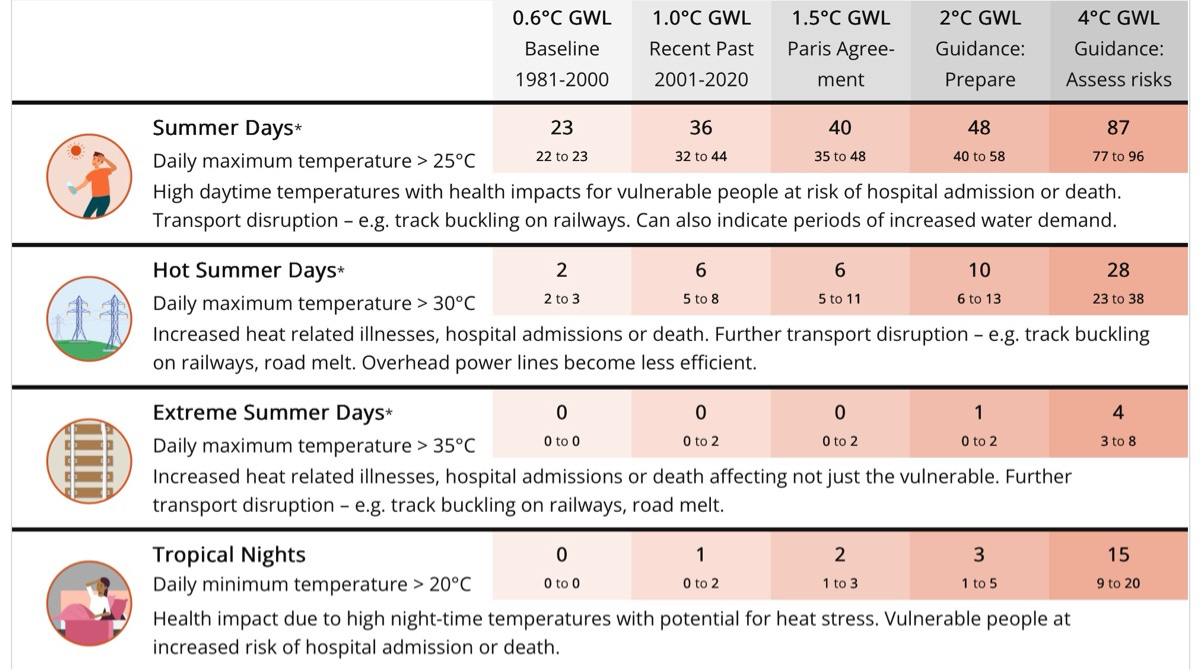
In practical terms, that means:
by the 2050s, more years like 2023, with warmer overall baseline temperatire and more seasonal extremes of heat and rain.
Barnes could experience 13–23 ‘hot summer days’ each year defined as a daily maximum above 30°C
and every other summer could resemble the record-breaking heat of 2018, which was the joint hottest on record (with 2003, 2006 and 1976), with mean temperatures across the UK well above average.
Notes & thoughts
Most climate conversation in Barnes focuses on flooding. Understandable — we live between a river and a wetland. But nationwide, heat is already killing more people than water.
The UK recorded 4,507 heat-related deaths in England in 2022, the hottest year on record. Even in 2023 — a milder summer — there were 2,295 heat-related deaths. By comparison, around 400 people drown accidentally each year in the UK, with a further 200 taking their own lives in water.
Bridged remains committed to Community BlueScapes. We need to adapt land and water to a changing climate.
But we also need to face the quiet threat of heat.
Barnes has an older population. ONS and UKHSA data show that older people face a steadily rising risk of death as temperatures climb. The risk for over-65s begins to increase once temperatures rise above 22°C this band, according to the ONS climate-related mortality analysis. When temperatures exceed 30°C, the danger becomes acute.
Recognise odd writing this in chilly December with any summer clothes properly packed away. Our urban landscape needs to change, Take for example the new seating on Barnes High Street. Anecdotally, these seats are well used as you’d expect positioned close to bus shelter.
But where is the shelter?
Richmond council have an opportunity to course correct. The plans for the pedestrian pilot project on The Terrace includes this commitment
Seating and shelter: Providing frequent opportunities to sit and take shelter improves accessibility and comfort for all users, particularly older adults, people with disabilities, and those with mobility issues.
This includes at bus stops as comfortable waiting environments encourage greater use of public transport, helping to reduce private car dependency and associated emissions.
Seating also contributes to perceptions of safety and dignity in public space.
The phrasing is important: ‘seating and shelter’. Barnes has started to master the first. The second remains patchy.
Heat resilience is now a design issue. The old assumption — that shade is optional because this is England — no longer holds. Shade, tree cover, canopies, water access, materials that don’t amplify heat — these are no longer lifestyle upgrades. They are essential if we are to live well in Barnes.