
💡Car-free Hammersmith Bridge - WIP Proposal
Story 117

Welcome to Bridged2050: ideas for living well in a climate-ready Barnes.
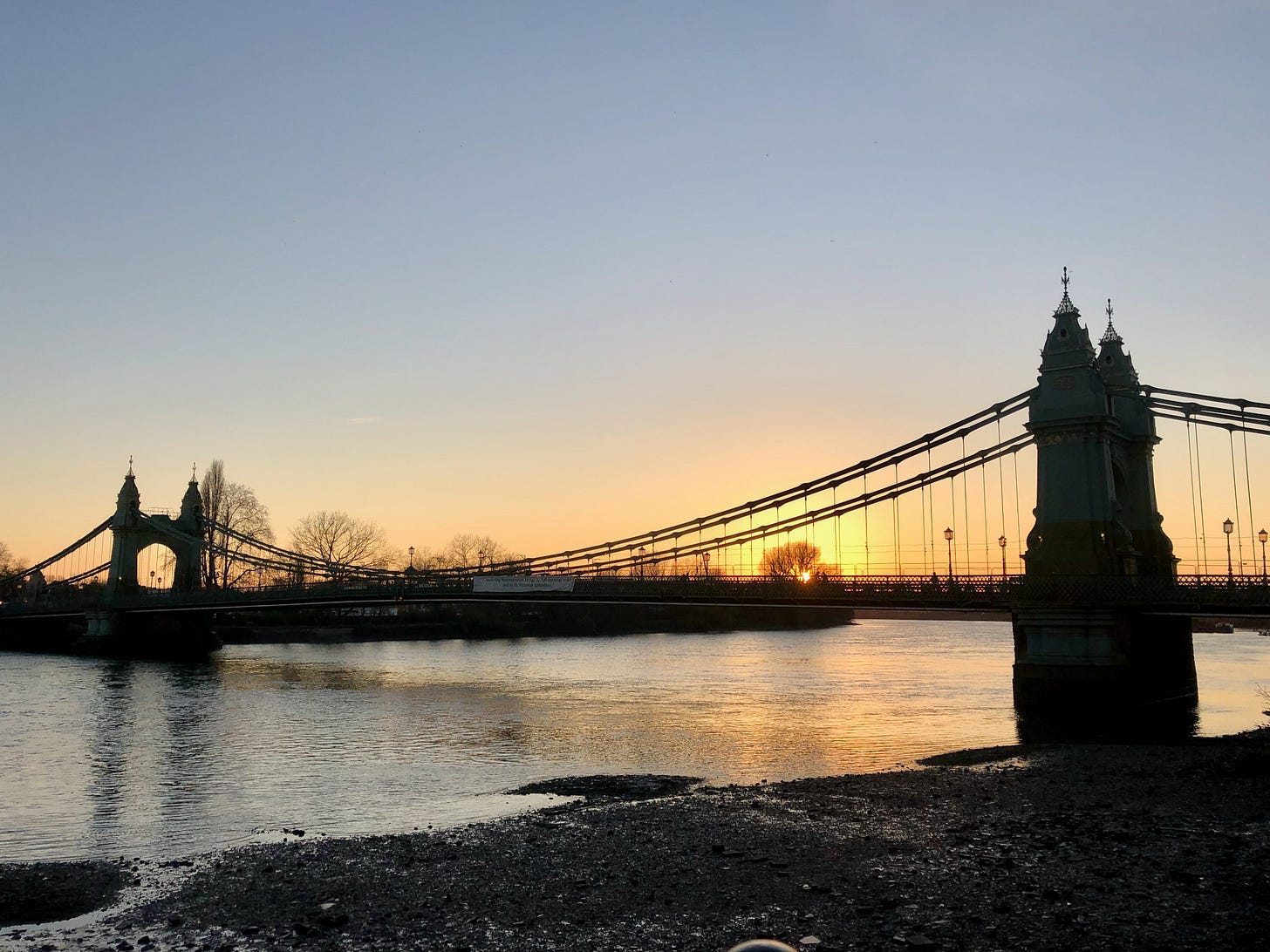
Hammersmith Bridge should stay car-free. Permanently
The Bridge closed to cars on April, 2019. Its future has been subject to local, national and international attention. Hammersmith & Fulham (H&F) council own the the Bridge and wants it restored for cars but only if others fund most or all of the work. The UK Government (UKG) has, until now, refused to stump up the cash. Similarly the Mayor of London. The UKG created a Hammersmith Bridge Task Force but it is unclear if, when, or how it will set out a way forward.
The result, as Nick Maini sets out in the clearest account of the bridge’s status in 2025, is a stalemate.
This proposal is one half of a pair. Here, the argument is simple: the bridge should remain car-free. The companion proposal asks what happens next: how we get everyone across the river, regardless of mobility or fragility, in a way that fits a climate-ready city.
This proposal is part of a wider Manifesto for a better Barnes: a collection of ideas grounded in local insight, climate responsibility and a people-first approach. It replaces the original draft which you can find here.
You’ll find the full list of proposals, along with the thinking behind them, throughout this section.
Case for change
The case for a car-free crossing is based on the following and strengthening:
Climate
Place
Health
Geography
Adaptation
Climate emergency
Transport produces roughly 24% of greenhouse gas emissions in Richmond borough, the largest share coming from cars.
Re-opening Hammersmith Bridge to private vehicles would be, in climate terms, like building a new road across the Thames. New road capacity brings new traffic. This is induced demand: if you give more space to cars, more cars appear.
Of course, you could in theory reopen the bridge to cars and still push ahead with climate measures elsewhere. But it would make everything harder: every new motor journey here would have to be clawed back somewhere else.
A better approach is obvious: reduce the number of cars and car trips, while giving walking, cycling and public transport the advantage.
Both the Mayor of London and Richmond Council say they are committed to precisely this ‘modal shift’. In south-west London, that shift is already under way.
Nick Maini has analysed the impact of the closure on local traffic. His work tallies with data Wandsworth Council published in November. Together, they point in one direction: there are fewer cars in south-west London than there would have been had Hammersmith Bridge remained open.
Faced with extra friction on their old routes, many drivers have tried alternatives and stuck with them.
Keeping Hammersmith Bridge car-free would lock in this climate gain and build on it.
People-first Barnes
Inside every car there’s at least one person; in the case of Hammersmith Bridge, often there was just one person. But the physical nature of cars - their bulk, their speed, the demands they place on the landscape collectively - mean much of the built environment has been sculpted around the needs of drivers rather than residents.
Cars now dominate our physical world.
The Bridge is part of an area regularly placed high on lists of most desirable places to live in the UK. Yet even in south west London, focussing on the needs of car drivers has, over the years, made walking and living much less desirable than it could be.
The balance between people and cars has tipped too far in favour of drivers. A car-free bridge is a chance to reset that balance and design from a different starting point: people first, vehicles second
Healthier residents
Before the closure, around 22,000 vehicles a day were funnelled through this corner of Barnes and Hammersmith, generating noise, pollution and risk.
The draft Richmond Air Quality Action Plan explicitly notes improved air quality after the bridge closed to cars. The air got cleaner, quickly.
What is not clear is how, if the bridge reopened to private cars, the council would maintain those gains – or whether it even could.
Reopening is not just a transport decision. It is a public health decision.
Geography can be destiny
We need to learn how to live a climate-friendlier way.
Not just decarbonised. But at least decarbonised.
Richmond council wants us to walk, bus and cycle more; replace our gas boilers; and recycle more of the things we no longer require.
The best way to explore a new way of living is to experiment. Trials need controlled conditions. In Barnes, geography provides them.
The river bend which so frustrates car drivers - the only Bridge north, broken like the country which hosts it, some riff - becomes a source of strength. Like a moat of old, it provides protection on three sides.
It throws a protective arm around the Barnes peninsula. It changes from constraint to enabler.
That quirk of topography could be a gift for us. Barnes is a self-contained unit. It’s walkable. It’s neighbourly. And it’s wealthy enough, by and large, to absorb change and lead the way.
If a lower-carbon lifestyle does not work here, where will it work?
This is a rich corner of a rich city. Not all of Richmond borough is rich. There is a pocket of North Barnes, a few hundred metres from the southern end of The Bridge, that is poor by any and all London standards. We should transition to a climate-friendlier future and help those fellow residents.
No-one ever won fighting nature. Work with it and the bend in the Thames.
We’ve done the hard part
The hardest part of persuading anyone to adopt a new way of doing something, is to ask them to forgo the familiar. Stop doing the thing which have you had done for years. Instead try something new that will be as good or even better. People are always very reluctant to do this. The bird in the hand.
I want my kids to enjoy a better future. I know that means we need to make some changes to fight climate change. But I don’t want to do that just yet. It’s not convenient.
That, more or less, is the position of the “driver-first” group.
In the case of Hammersmith Bridge, the decision has already been made for all of us – including drivers. The cast iron and concrete, damaged by the very climate pressures we are slow to confront, tipped the balance. That moment of rupture did what no climate policy ever could: it forced a change in behaviour.
Nick Maini referenced research on this topic. The title hints at the learning, ‘The Benefits of Forced Experimentation: Striking Evidence from the London Underground Network’. When disruption closes one option, people try alternatives and often discover they are better, so they do not go back.
That is why the wider Barnes area still functions, and why it remains desirable. People have adapted. Businesses have adapted. Life has gone on.
We’ve done the hard part. We’ve adjusted to the closure of the Bridge.
Why unwind all that hard-won adjustment?
Why not build on it instead?
Maini takes this last challenge literally. His call to action includes opening a competitive tender based on the current limitations.
Offer clear requirements: passengers per hour, Oyster-integrated, delivery timeline.
Let the market find the most cost-effective solution.
Fast-track regulatory approval for the winning proposal. No multi-year planning inquiries for a bridge that’s already been closed for six years.
In other words: we should start from the reality we have, not the one we used to have.
Practical considerations
‘Car-free Hammersmith Bridge’ is not a phrase I love. It defines the bridge by what is missing rather than what is present. But for now, it is the least worst shorthand.
There are alternatives. Active-travel is accurate but steeped in jargon. Zero-car is punchy but also negative. People-first is the next least worst, probably.
I looked for inspiration to our European neighbours. The ever-practical Dutch have a phrase. Brug voor langzaam verkeer is a ‘Bridge for slow traffic’. They even have a compound - the Dutch love compounds even more than their bikes - Langzaamverkeerbrug. Imagine that in the Bugle.
The Danes talk about ‘soft road users’: people outside cars such walkers, cyclists, prams, wheelchairs. It’s people-centred rather than mode-centred, so more what I had in mind. But Bro for bløde trafikanter is too much, even for cosmopolitan corner of SW13. Also ‘Bridge for soft road users’ might sound like a dare to some.
Whatever label we settle on, the principle is the same: design the crossing for people, not engines.
One other thing.
We need to do so much more than build a car-free Hammersmith Bridge. As Nick Maini puts it,
Create the destination, invest in the approaches. (Mayor of London, H&F council and Richmond council) need to invest in regenerating areas at either end: the retail outlets, cycling infrastructure, public realm upgrades, drainage improvements
Yes and.. The area beyond the southern end needs to be re-imagined for a world with a car-free Bridge.
Transport for London, the ambulance service and the fire brigade deserve credit for re-routing buses and emergency access. But that is the bare minimum.
We should stop thinking in terms of a ‘car-reduced Barnes’ and start planning for a people-first Barnes. That means new patterns of movement, new priorities for street space, and new expectations about what it feels like to live here.
More on that soon.
This proposal is a work in progress
It be reviewed and improved on a regular basis.
This story was last updated on 09 December 2025.
You can find all the current proposals listed here.