
💡New Barnes Pier enabling daily river buses - WIP Proposal
Story 131

Barnes Pier should be restored, enabling daily commuter and visitor traffic east and west along the Thames.
This is an ambitious proposal. It is also barely formed. But it is credible because it is important.
The Thames is a huge part of who we are; the row about the crossing at Hammersmith Bridge shows that. We tend to look at the Thames. We need to use it. Regular river buses would do that.
This is not an engineering or product problem. Getting passengers on and off boats on a tidal river is a solved problem. London’s river piers use floating pontoons and gangways to accommodate tides of several metres.
The idea is not new. Temporary river taxis were discussed in the immediate aftermath of Hammersmith Bridge’s closure. Boosting river traffic featured in the Mortlake Mash-Up round tables. This proposal goes beyond that. It looks to a time when there are many fewer cars and those that remain cannot use Hammersmith Bridge but even more people. Richmond borough’s population is forecast to grow by 5% from 198,000 in 2019 to 207,000 in 2041. They will need to travel up river or down, into central London.
History
We live in unusual times. For hundreds of years it would have been normal to walk the Thames in Barnes and see working docks or wharfs. (For clairty I am ignoring mooring in Mortlake. That will be covered in other stories.) As recently as 1937 there were roughtly 1,700 working wharves between Brentford and the sea. By then Small Profit Dock (strictly Small Profit Draw Dock) had been infilled for nearly a decade. The smaller wharves along The Terrace had gone too. Harrods Wharf built in the late 19th century to 'reflect but not not outdo' the grandeur of the store it served, would closed soon afterwards. It fell into neglect as the railway and containerisation changed how goods were moved.
Today, just 70 wharves remain active on the Thames, most of them far downstream. In Barnes, the river is for rowers, not residents.
Much of the river traffic that remains today is organised by Transport for London (TfL). And yet .. look at this TfL map of river services in 2025,
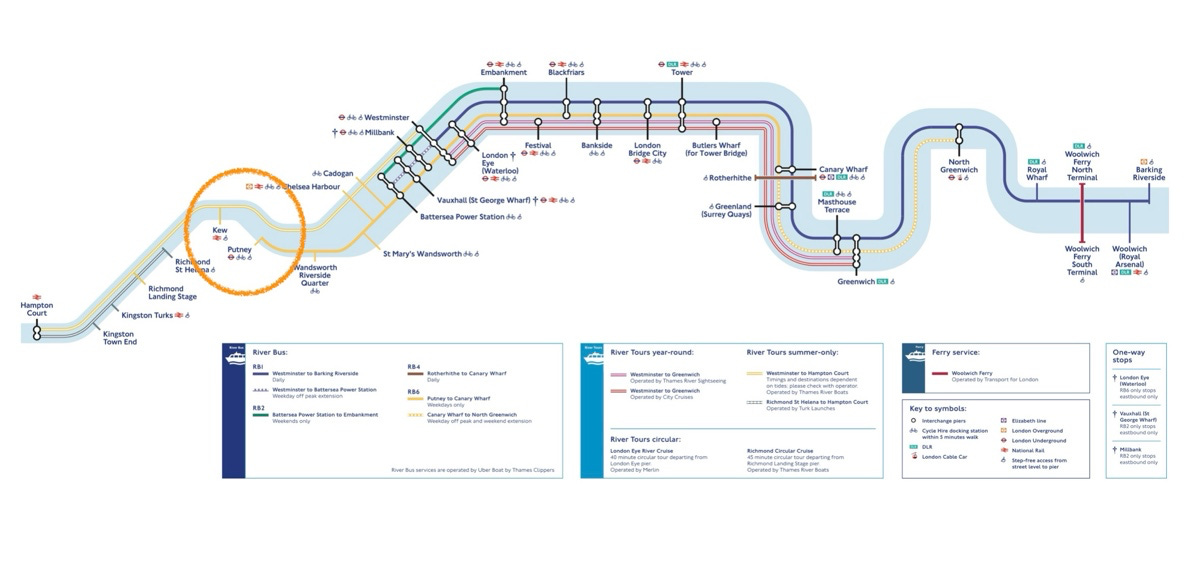
You can see the gap, ringed. There is one service stopping nearby and that is a River Tour
TfL’s services are characterised as either River Buses or River Tours. The latter includes five sightseeing services inlcuding Thames River Boats which are stopping, occasionally, at Chiswick Pier. There are also two speedboats and daytime and evening dinner cruises.
Of more interest are the River Buses. They stop or start at Putney meaning when the Boat Race passes Barnes each spring, those two craft are typical of all the others. They do not stop here.
This proposal is part of a wider Manifesto for a better Barnes: a collection of ideas grounded in local insight, climate responsibility and a people-first approach. You’ll find the full list of proposals, along with the thinking behind them, throughout this section. I will return to the proposals regularly to update and refine.
Case for change
The usual benefits of sustainable transport apply here - river buses are better for the environment that a fleet of private cars, they are better for residents’ health etc.. I am going to return to those another time. Instead, I want to highlight three particular reasons why we need to prepare for a Barnes river bus service.
Live. Work. Play. Belong in Barnes, 2050
There is more than one way to create our future. We should incrementally create the next version of Barnes, one small step at a time. But we should also look make larger leaps, too. Our predecessors in Barnes did this. Think of the Wetland Centre or The Olympic Cinema or when the Barnes Community Association bought Rose House. Barnes Pier is another landmark opportunity.
Any version of a future which has less reliance on cars is going to need an enhanced transport network to move a growing population. That will mean many smaller improvements to our transport systems such as better bus services, more e-bikes, more taxis, more trains. It also demands a greater reliance on the river. That is why Barnes Pier is a serious proposal.
Mayor’s Transport Strategy
Sir Sadiq Khan launched his Transport Strategy in 2018, then updated it in 2022. It’s framing ambition is to get people out of private cars and onto sustainable travel. It aims 80 per cent of all trips in London to be completed on foot, by cycle or by public transport in 2041.
TfL published London’s Passenger Pier Strategy in 2019 to explain how it’s surface fleet would contribute to this goal.
(Sidebar - does this imply TfL could launch a submersible service?)
TfL working with partners such as Port of London Authority wanted to see a doubling of annual traffic to 20million passengers by 2035. This was a stiff target with plans for ;optimising pier utilisation’ and ‘maximising river capacity’.
At first glance this strategy is bad news for a restored Barnes Pier,
A recent joint TfL/PLA study identified capacity limitations to the west of London due to the river depth, bridges and tidal range.
But this strategy must be seen in context.
In 2019 TfL were focussed on delivering results by 2035. That meant using existing technology inEast London where there were immediate gains to be had. This was the right thing to do.
Barnes Pier should feature in the next version of TfL’s Passenger Pier Strategy, the one that runs from 2035 until 2050.
By then we can expect new technology to match our changing weather patterns. Different social habits will mean new business opportunities. Look at this another way, twenty five years ago how many traffic planners accurately forecast the current range of social habits and mobility options: working from home; home delivery; Ubers as well as black taxis; e-bikes and scooters; many more bikes; and a Elizabeth Line exceeding all expecations. By 2050, there will be new catregories of craft with different economic models. That is the context for a restored Barnes Pier.
Changing transport mix
The transport ecosystem has many parts. The trick is getting the right blend. When Hammersmith Bridge’s future is confirmed as car-free, other parts of the transport network need to be adjusted.
We need to adopt a pedestrian-first approach to our space planning. We need to support our younger residents with a progressive view of e-bikes. And if the capital is serious about shifting trips away from cars, then the river must play a bigger role.
We need weekday sailings including peak-time frequency with pricing pitched not just at visitors with cameras but at residents who might otherwise drive.
River buses are (relatively) cheap
There’s no need for detailed costings at this stage. The bill for restoring cars to Hammersmith Bridge is so high - officially £250m but likely higher, a year on from that forecast - the cost of creating a new river bus route will be much smaller.
We have a sense of what a new Pier might involve.
In 2021, temporary ferry including a Barnes Pier was considered as after the closure of Hammersmith Bridge,
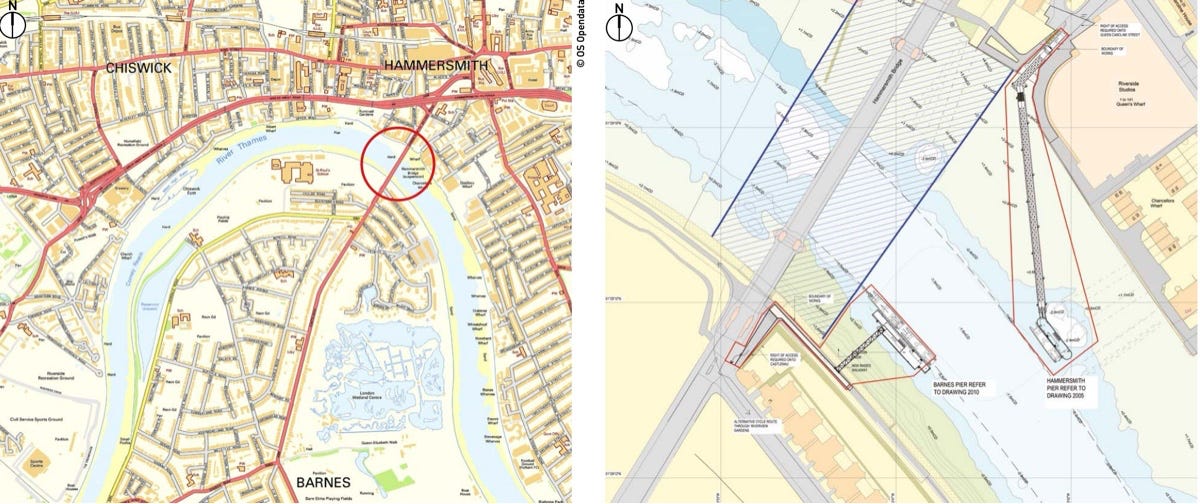
This is a different use case but the design gives some indication as to how a new Barnes Pier might work. The 2021 model repurposed a floating pontoon, secured by piles with an aluminium link-span bridge connecting to the towpath. The design was a lightweight, open structure in-keeping with other piers along this section of the River Thames.
In terms of scale and cost, two recent Thames developments provide useful context.
Barking Riverside Pier in East London was opened in 2022 at a cost of c£7.3 million and saw over 100,000 passengers in its first 10 months of operation. This development is much more complex than the one required in Barnes.
Further afield and much simpler, in early 2025, Medway Council installed Limehouse Landing in Rochester, a modular floating pontoon and gangway boarding platform at Rochester Riverside on the River Medway. Funded via the Local Transport Plan, the installation cost under £1 million. Barnes would need something more substantial than this.

Together they provide a sufficiently useful sense of the capital cost at this stage of creating a new Barnes Pier.
Practical considerations
What’s in a name?
I am not sure what to call this proposal. I know it is not a dock, at least technically since that involves an enclosed body of water. Is this a Wharf or a Pier? The difference comes down to whether the landing area is in parallel or perpendicular to the shore. Since Mortlake bagged Wharf, I have avoided using that term.
Work with Mortlake Mash-Up Mortlake Wharf
The economics of such a service would benefit from scale. Were a river bus to run beyond Putney to say Richmond it would make sense to add stops at both Barnes and Mortlake, at least. Both areas boast significant number of potential passengers.
Future scenarios
Richmond council needs to start planning for how the most western part of the borough—Barnes—will function if cars are not restored to Hammersmith Bridge. I made this exact point during their Transport Strategy consultation, asking them to explain under what circumstances they would start planning for a future with only pedestrians and cyclists on the Bridge. The alternative is for our area to be caught in a decades-long state of political gridlock. Asphalt aspic with pro-car politicians from one party or another hoping for a political alignment that would unlock hundreds of millions of pounds.
When we do start this process, we need to have the same confidence as our forebears. They built thousands of homes alongside nationally important palaces, bridges, breweries, wildlife sanctuaries, entertainment centers, and tapestry factories. What can we do?
Some of us are going to have to dive in. Forgive the pun. Establishing a new pier would attract a whole dictionary of acronyms: the UK Government, the Mayor of London, TfL, and the Port of London Authority (PLA), which issues river works licenses. Then, an array of studies—environmental, hydrodynamic, and more—would be needed during the planning phase. And at some point, Richmond Council would need to consult with its residents.
I look forward to that day.
BCA Ponder 5, covering the years 2045-2055, you have your first volunteer.
This proposal is a work in progress.
It will be reviewed and improved on a regular basis.
This story was last updated on 09 September 2025.