
Why changing our street environment is so hard
Wisdom from Wandsworth. Story 161

Welcome to Bridged2050: ideas for living well in a climate-ready Barnes.
People dislike change. All change.
Even when the current situation is plainly not working, the prospect of doing something different can trigger anxiety, hostility, and a kind of defensive imagination.
This is true of changes to our street environment. They generate anxiety and hostility. Bridged has seen this pattern up close. Proposals to make Hammersmith Bridge car-free permanently, renew The Terrace and create Castlenau Park can land, among some residents, not as civic improvement, but as threat.
And yet the odd thing is this,
We also know from decades of research, that once changes have become established, people love them and do not want to go back
That quote is a from Wandsworth Bridge Road Association (WBRA), a nearby bridging community group, trying to reclaim their corner of London for everyone, not just drivers. Their article, The Hill of Hysteria, is one of the clearest explanations I’ve seen of why street change feels so hard in the moment—and so obvious in hindsight.
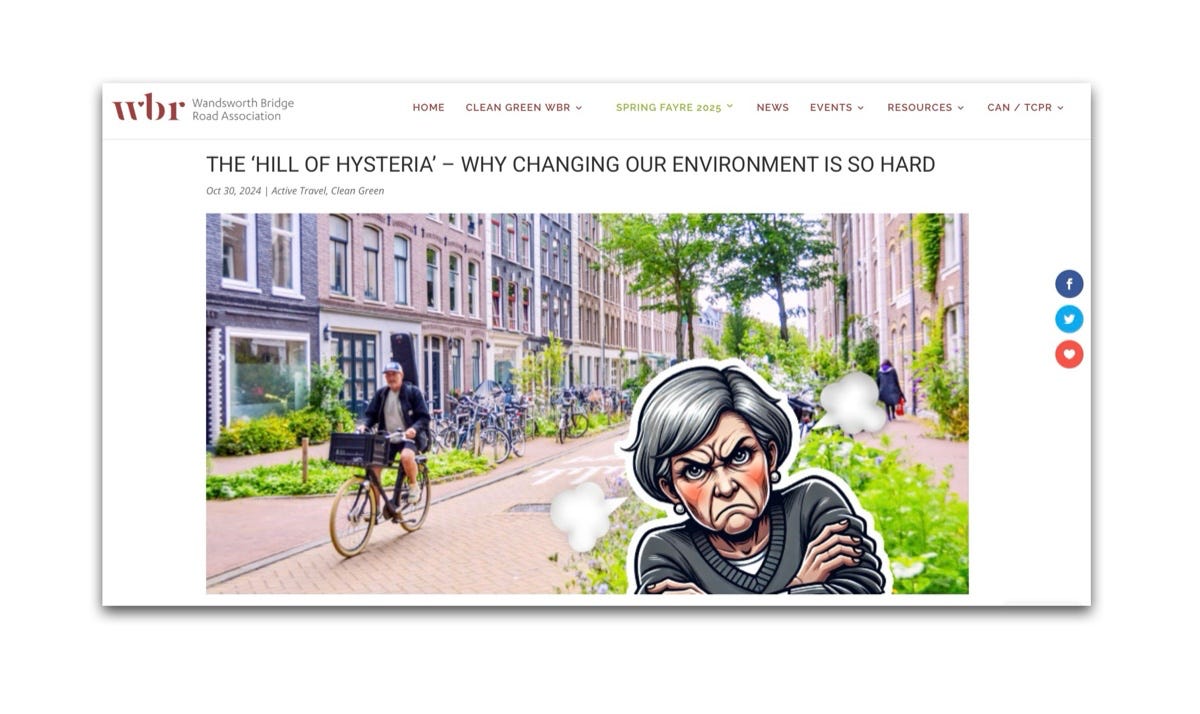
The article is worth your time. Here are three ideas from it that seem relevant to Bridged’s ambition for the future of Barnes.
Motonormativity
WBRA begin with motonormativity. the deep, shared assumption that motor traffic is the default—and everything else is a compromise.
Motonormativity means we reject the sensible conclusion,
.. that vehicles should be designed out of our urban space, or at least significantly restricted and slowed down to minimise the danger to society.
On first read, that can sound extreme. Then you start looking at the evidence—injury, intimidation, space allocation, pollution, noise—and you realise what’s extreme is how we currently run cities.
This deep-seated shared mindset is real. It is alive in Barnes. It explains some of the responses to Bridged. There’s a longer explanation of this and its cousin, car brain, on this blog. Or you could watch this video that explains how we’ve been brainwashed
Businesses need cars
This objection appears whenever anyone suggests traffic calming, fewer parking spaces, or changes tostreet design.
WBRA describe this as the ‘the biggest myth of them all’.
People shop. Cars don’t.
The best concise summary remains The Pedestrian Pound from Living Streets research in 2024 that showed,
.. people who walk or wheel to do their shopping spend more money and pedestrianised high streets see bigger sales.
That logic shows up locally, too. Nick Maini’s survey of Hammersmith Bridge, made the same point using real-world data. Mastercard shows spending in Barnes increased by twice the London average after the Bridge was closed.
The economic benefit goes beyond Barnes High Street. White Hart Lane retail offer are more diverse and more robust than a decade ago.
The deeper point is cultural as well as economic: when you design streets for people, you don’t just get different “footfall”. You get different behaviour—more lingering, more casual visits, more chances to bump into someone you know. That is what makes local places resilient.
It’s too late - we can’t change the way we are
This is the resignation reflex. It’s a cousin of panic, dressed up as realism.
The best time to plant a tree was 30 years ago, the second best time is now.
It’s a useful line, even if its exact origin is debated. There is never a good time to change anything, just less worse. And it is never too late.
WBRA include a compelling image to show how dramatically a city can re-route its future:
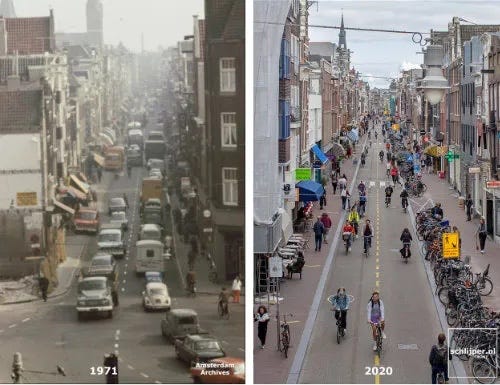
Bridged will be running a series later this year about lessons from other cities that have made significant changes. Paris, Barcelona and Amsterdam. None are perfect, all are still negotiating trade-offs. But all demonstrate that what feels impossible is often just politically difficult and so unattempted.
A parallel example tends to be forgotten because it now feels normal: banning smoking in indoor public places. Big Tobacco fought it for decades. They delayed, obfuscated, and lied. Then the cultural weather changed and the rules followed. If you want the anatomy of that doubt-making machine, try bthe BBC series How They Made Us Doubt Everything.
Notes & thoughts
To be clear, Bridged is not proposing to ban all cars from Barnes. Rather it wants to reduce the number of private cars and the trips they make while making it easier for public transport, emergency and commercial vehicles to move through the area.
That requires us to confront a simple, uncomfortable fact about space.
This photo perfectly encapsulates the lunacy of our space allocation. We have given over 90% of our public realm to the moving of and storage of metal boxes.
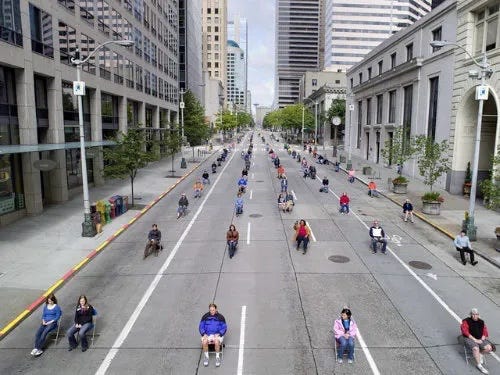
Everything (other than cars) must squeeze into the remaining 10%; pedestrians, buggies, wheelchairs, bins, bike parking, bikes, phones, EV chargers, BT boxes, trees, seating ..
This is why street change produces conflict. We are trying to cram modern urban life into the leftover margins, while reserving the main event for driving and parking. The scarcity is structural. The resentment is predictable.
That tension creates the Hill of Hysteria, below.
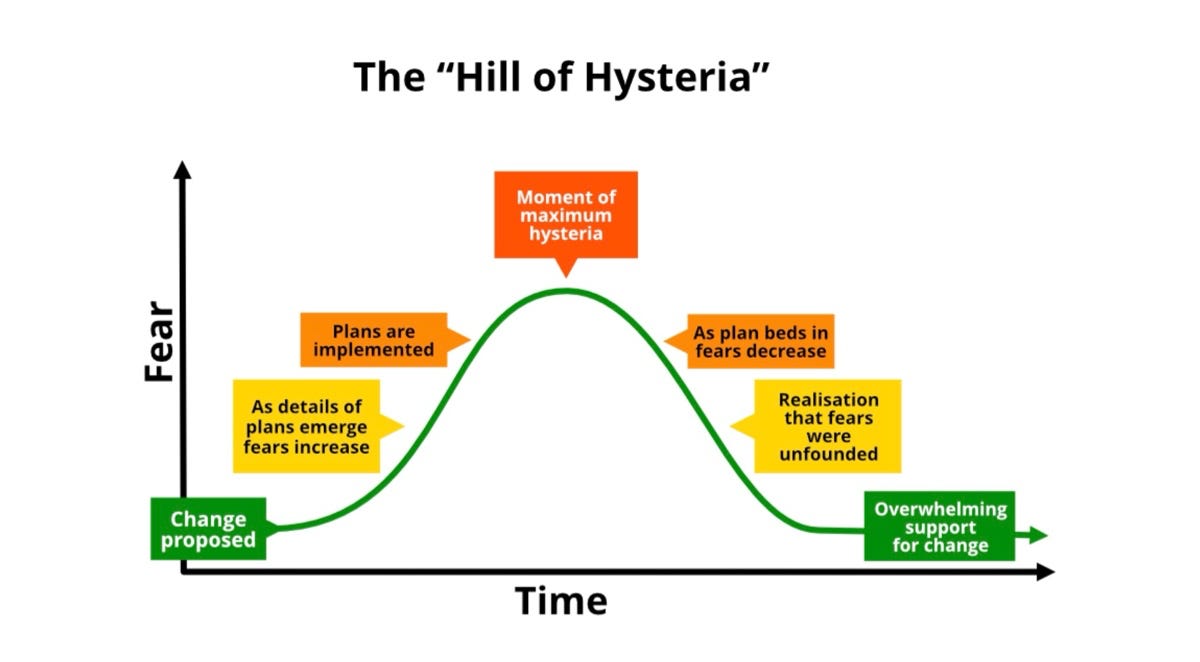
This chart also points to the role of role of political leaders and other influential members of community. And when they are required to act.
They need to be able to see past the short term anxiety and help find a route to the long-term satisfaction. They need to frame the disciussion to enable more people to get through. Occasionally, they need to make the right deicison, the hard one, as soon as possible.
Easy to say, harder to do. Just look at the ‘Hammersmith Bridge stalemate.’
Which brings us to the opportunity in front of us.
Barnes needs to sieze the moment presented by the closure of Hammersmith Bridge. We’ve done the hard part. Thanks to climate change and engineering reality and now sustained by politics and finance.
Politicians - with our support - should treat the peninsula as a place to run thoughtful trials: discussions, pilots and experiments to help us see how we might choose to live, work, play and belong in Barnes.