
Car brain and motonormativity
Overlap in meaning but not interchangeable. Story 160

Welcome to Bridged2050: ideas for living well in a climate-ready Barnes.
Spend any time reading about transport, and especially traffic, in London and you will come across these two labels.
They are related, but they do not mean the same thing:
Motonormativity is the system-level bias: the background assumption that car use is normal, neutral, and broadly non-negotiable.
Car brain is the person-level expression: someone who may be considerate in most contexts but becomes selfish, reckless, or even hostile as soon as a car enters the interaction (as described by Andy Boenau).
Motonormativity: the invisible default
The term motonormativity is associated with research led by environmental psychologist Ian Walker, along with colleagues Alan Tapp and Adrian Davis. It describes a shared, often unconscious ‘blind spot’ that makes societies judge driving by softer moral standards than comparable harms elsewhere. Cars are so pervasive, so ingrained that many of us struggle to imagine how life could be not just possible, but better, with less reliance on cars.
Motonormativity is what lies behind statements like:
‘Of course the main road is for through-traffic; everything else must adapt.’
‘Some deaths are inevitable; that’s just roads.’
‘If you feel unsafe cycling, wear brighter clothing and take a different route.’
‘Parking is a basic right; reducing the number of spaces available is anti-car’
This is not about bad drivers. It is about norms which influence road engineering conventions, media language, goverment consultation processes and conversations with friends and family.
With this default in places measures which evidence suggests essential - such as speed reduction, speed enforcement, space reallocation - are treated as radical.
A practical test: when you hear a claim that treats road danger or car dominance as normal, ask yourself: Would we accept the same logic if the harm came from any other source? If the answer is obviously not, you are probably looking at motonormativity.
If you want more on this, watch this report from the Global Cycling Network on the Bridged2050 YouTube channel.
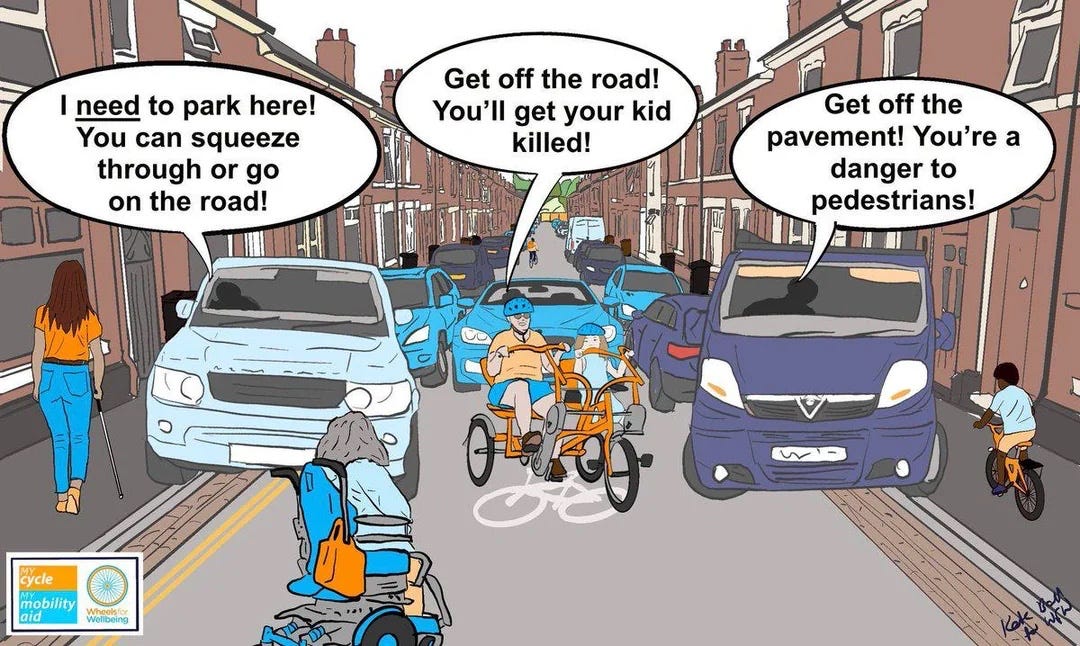
Car brain: loaded mindset label
Car brain is slang. It describes a person who treats the car as the superior, obvious mode of transport and struggles to recognise the costs imposed on everyone else.
You can usually spot it in the same recurring arguments:
equating mobility with driving
treating any reduction in car priority as an attack on freedom
minimising externalities such as danger, noise and air pollution
holding pedestrians and cyclists to higher behavioural standards than drivers
But car brain is heard and understood as an insult. That is why I have used the term car-first.
Car brain is rhetorically sharp but strategically noisy, and it can undermine a people-first argument by making it feel like a culture war.
The term invites defensiveness and shifts the argument from outcomes (safety, emissions, place quality) to identity (drivers versus cyclists).
Notes & thoughts
In a place like Barnes — where daily street life is shaped by through-traffic, school runs, bus reliability, and the unresolved future of Hammersmith Bridge — the temptation is to personalise the conflict. It feels like it is about individual behaviour because individual behaviour is what you see: the close pass, the impatient honk, the aggressive overtake.
But most of what residents experience is not individual psychology. It is the design and management of the network.
Bridged is striving to focus on that systemic view: getting more of us to notice:
the default is vehicle throughput rather than safe local access for all
why parking is treated as a baseline entitlement, while crossing the road safely is framed as a nice-to-have
why consultation often starts from ‘how do we keep traffic moving?’ rather than ‘what is this street for?’
Car brain might describe the loudest voices. Motonormativity explains why those voices so often sound like common sense.
If Bridged is trying to do anything, it is to surface these defaults and then ask, plainly, what we would choose instead?