
Lessons from Richmond town centre
Story 169

Welcome to Bridged2050: creating an even better Barnes during this climate crisis
Viewers of Ted Lasso might assume Richmond Green is Richmond town centre: leafy, cinematic, politely perfect.
The Green is lovely but the town centre is a larger area and has its problems:
Shifting lifestyles and behaviours, exacerbated by the Covid-19 pandemic, have challenged the town centre’s ability to meet the evolving needs of its residents, workers, and visitors.”
That is taken from Richmond council‘s review of the town centre, which identified six potential areas for improvement:
Diversity of use on the high street
Movement
Heritage and identity
Public spaces
Spaces for young people
Culture, leisure and sport.
You can read the council’s online project page.
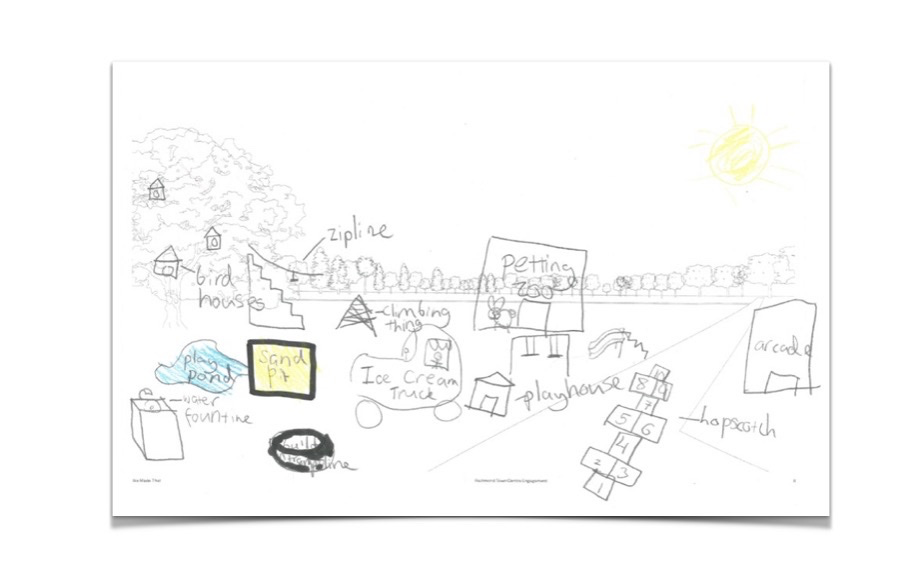
My favourite moment in the report is not a chart. It’s this child’s drawing on page 44. A zipline, a petting zoo, a playhouse: the hopes of someone quietly redesigning the Green into a place they’d actually want to be.
That, in miniature, is the whole point.
Notes & thoughts
A straight read across from Richmond to Barnes doesn’t work. Different geography. Different catchments. Different pressures.
But that’s not the right comparison anyway.
The better question is: what can Barnes learn from the method and the nature of the results this work? Here are five takeaways.
Understanding local sentiment
Bridged is sceptical of the council’s usual consultation choreography. Budget constraints result in a town-hall meeting, a survey link and often the loudest voices winning by stamina.
This report does something more serious. It explicitly tries to hear from people who don’t self-select into engagement: working through schools, community organisations, pop-ups, drop-ins, interviews plus the survey.
That doesn’t make it perfect. It makes it better
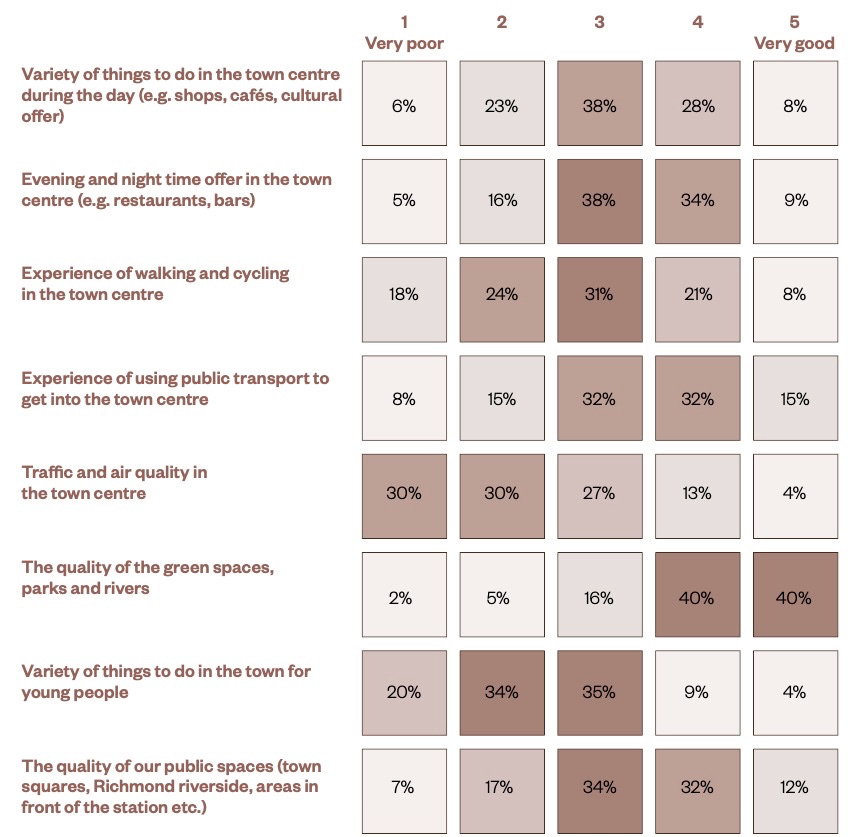
Over the course of 12 weeks, 1482 people participated in this project.
Credit to Richmond council for commissioning We Made That for taking this approach. More, please.
For example, if Barnes is going to argue for change, whether on the high street, on road space, on public realm, it needs this calibre of listening first. Not because everyone will agree. Because disagreement is easier to work with when you can map it.
Does Barnes care about Richmond?
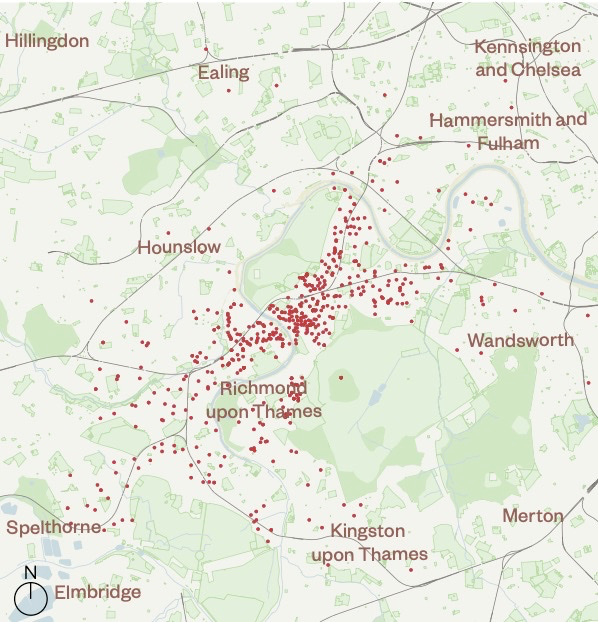
The report includes this map of where respondents live. Look at the spread and you can almost feel the gravitational pull across the borough
A glance on the map above and I realise my view of Richmond is likely shared by many others in Barnes.
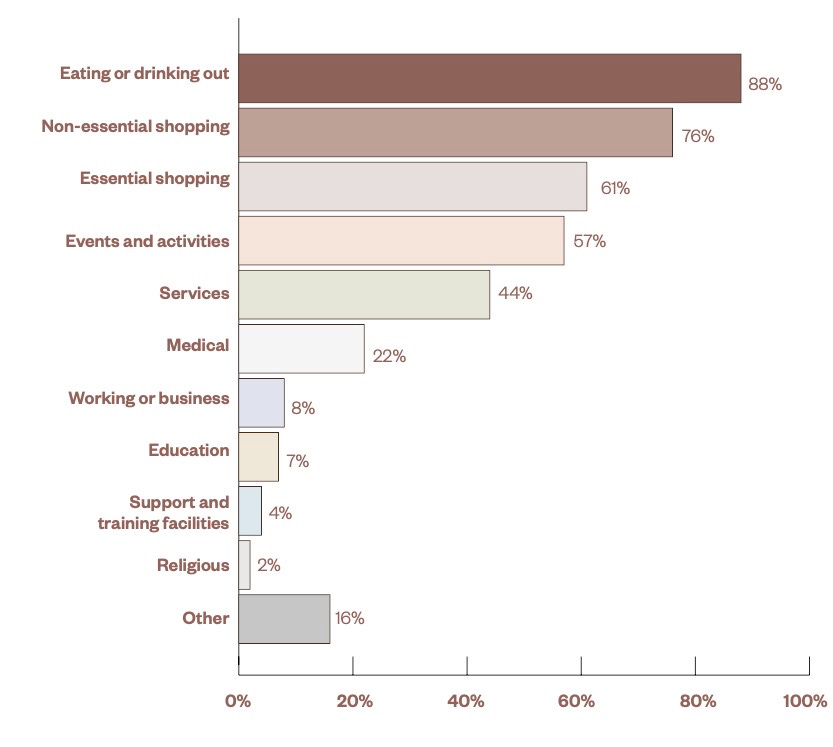
I head east to Richmond occasionally. II mainly look north and west. When I do visit, my behaviour - I visit Richmond to eat and for events - is typical of others.
What does this have to do with Bridged?
Let’s start with who decides the future of Hammersmith Bridge. The practical answer is the Chancellor given the investment required. Only the UK Government can afford to restore the Bridge. Alongside that there is an interesting discussion to be had about the weight given those impacted by the Bridge’s availability. Fleur Anderson MP says Putney residents need to be considered. Sarah Olney MP talks about all her constituents in Richmond Park wanting the restoration. Richmond council demands something similar. And yet, this data suggests there are subtleties to this relationship. Ones which all politicians should better understand and reflect.
Meanwhile, each part of Richmond borough possesses a distinct identity. Barnes is the most inner-borough like, in that wider area. The boundaries with Hammersmith and Putney play more of a decisive role in the resident’s lives. We need to better understand what makes Barnes distinctive.
(Much) More emphasis on walkers and wheelers
A quick assessment of the four commercial parades in Barnes using these categories would llikely result in two lists. On some aspects, they fare quite well.
Heritage and Identity - although Barnes’ experience suggests that having a ‘style guide for new shops and their frontages’ wont solve the problem. Enforcement matters
Diversity of use on the High Street
Public Space - whether street, green or blue
Culture, Leisure and Sport
There are two categories where there is a real need for improvement in Barnes:
Movement
Spaces for Young People
Much of this blog to date has been about how we can walk, bus cycle, wheel and drive the area including the parades. This theme runs through the report too. There was a resounding call to reduce traffic congestion, with many advocating for pedestrianisation strategies,
Residents have many detailed (and sometimes conflicting) ideas regarding ways forward.
But there is broad agreement that there needs to be a sustained focus on reducing barriers to walking, cycling and using public transport, that traffic needs to be reduced, and that practical solutions are in place to support the mobility of people with disabilities.
What the report calls the ‘tension within Richmond’s current travel infrastructure’ is familiar. Over the longer term, there is a shift underway from car-centred design to human-centred one. More and wider pavements. Occasional bike lanes. Better bike parking. But others - presumably drivers - urge caution and (wisely) suggest ‘doing nothing without small time-limited pilots’.
The report’s language could have been written about parts of Barnes:
Despite its seemingly straightforward layout, the combination of traffic, poorly organised and “confused crossings”, and inadequate infrastructure can make navigating the high street an unpleasant experience.
This description of the ‘canyon-like’ Richmond high street immediately made me think of The Terrace. And yes: if you want a small, practical step, you can still sign the petition to ban heavy goods vehicles from this road.
Under 25s see things differently
During Mortlake Mash-Up playback last summer, it was clear younger residents saw a different area to the one described by the (older) others in the room.
The same is probably true in Barnes.
We now know it is true in Richmond.
The under 25s have different priorities. Overall 65% of respondents want to increase the town’s retail and leisure offering, 53% enhance our public spaces and 49% protect our natural spaces. The 15 to 25 year olds
.. are particularly interested in active travel, with 33% deeming it a top priority. They also highly value expanding opportunities for young people (27%) and providing more cultural offerings (27%).
90% of the survey respondents between the ages of 15-25 ranked the variety of things to do in the city for young people as very poor or poor. The report does point out
As a borough, Richmond has a strong youth-offering. However, this offer does not translate in Richmond town centre.
Is that true of Barnes’ parades, were to you ask Younger Barnes residents. Isn’t it worth finding out in a structured, meticulous way?
Satisfying the needs of this younger demographic will be difficult, if only because there is a risk the local leaders who created the problem reach for the same levers again trying to fix it.
Mental maps
One of the smartest choices in this research is also one of the simplest: asking people to draw their mental map of a place — not the official version, but the one they carry around in their heads.
I first encountered the exercise in New York City in the late 1990s. On my first day as a visitor, I was handed a plain map and asked to mark the places that already meant something to me. Two years later I did it again, and the change was the lesson: the city hadn’t moved, but my relationship to it had. The new map revealed my true feelings about the city.
I have returned to that method ever since — in radio, publishing, research labs — because it gets beneath the surface. A mental map reveals what people notice, what they avoid, and what they think counts. It is a way of measuring belonging without using the word.
Bridged aims to do something similar for Barnes in the coming months. Not as an academic flourish, but as a practical tool: a way to see the place as it is experienced, not as it is described.
💡New park on Castlenau - WIP

A signature proposal from Bridged. Why the area to the south of Hammersmith Bridge should not be left as a tarmac hostage to politicians. How might be this short stretch of road be turned into yet another extraordinary corner of Barnes