
Double demo day at Hammersmith Bridge
Politicians, crowds, hopes and fears. Story 166

Welcome to Bridged2050: creating an even better Barnes during this climate crisis
Two groups came Hammersmith Bridge on Saturday, and told two different stories about what it is.
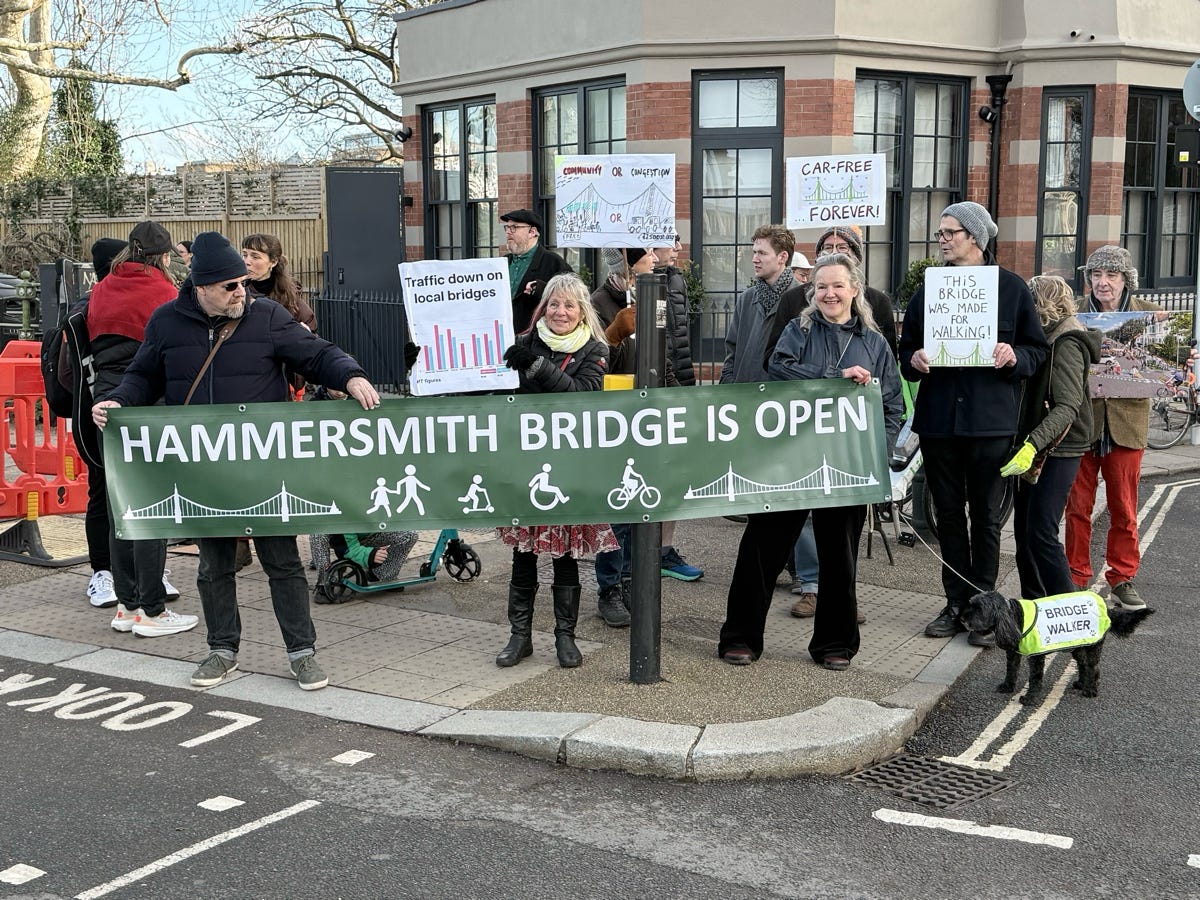
At noon, the first - mainly from Barnes - declared the Bridge open: for pedestrians and cyclists and demanded it remained that way, permanently.
Two hours later, the second crowd - including a large contingent from Roehampton and Putney - said the Bridged was closed and demanded it be restored to carry vehicles.
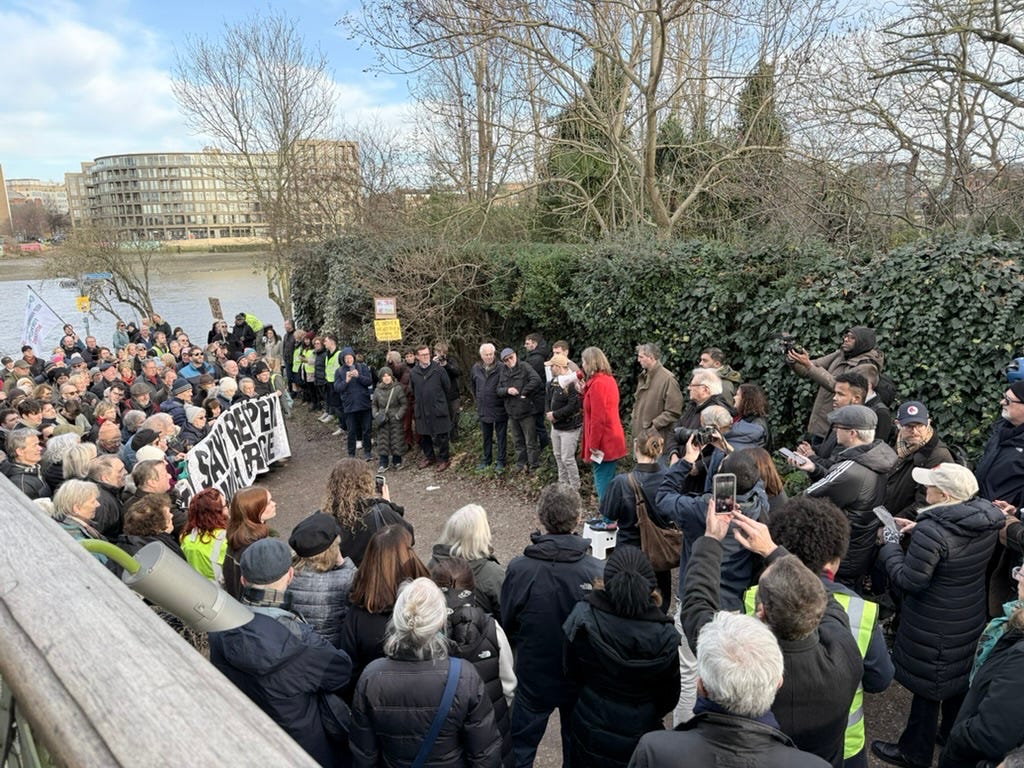
The arguments were familiar.
BBC News reported on the events. Putney News had a more nuanced report by Kieren McCarthy. Search your preferred social media feed for Hammersmith Bridge to find a partisan view.
Notes & thoughts
The discussions during — and after — the two demonstrations threw up a few revealing themes.
George Osborne was ‘ere
Kieren McCarthy provided useful background on how we’ve ended up in this situation. He quotes London Assembly Member Leonie Cooper (Labour, Merton and Wandsworth) as saying part of the problem lies with Boris Johnson’s mayoralty,
Under pressure from the Cameron government to contribute to austerity, Johnson surrendered London’s share of Vehicle Excise Duty from April 2018 onwards. ‘Londoners are basically funding the trams in Manchester,’ Cooper said. ‘And until you fix that, which the current government hasn’t, you can’t ask anyone to fund this.’
The consequences of austerity are felt in every corner of this country, even this affluent one.
Whose opinion matters most?
The contrast between the two groups was stark. The second was bullish about its membership. Barnes residents were in the crowd but the presence of people from two particular areas was explicit.
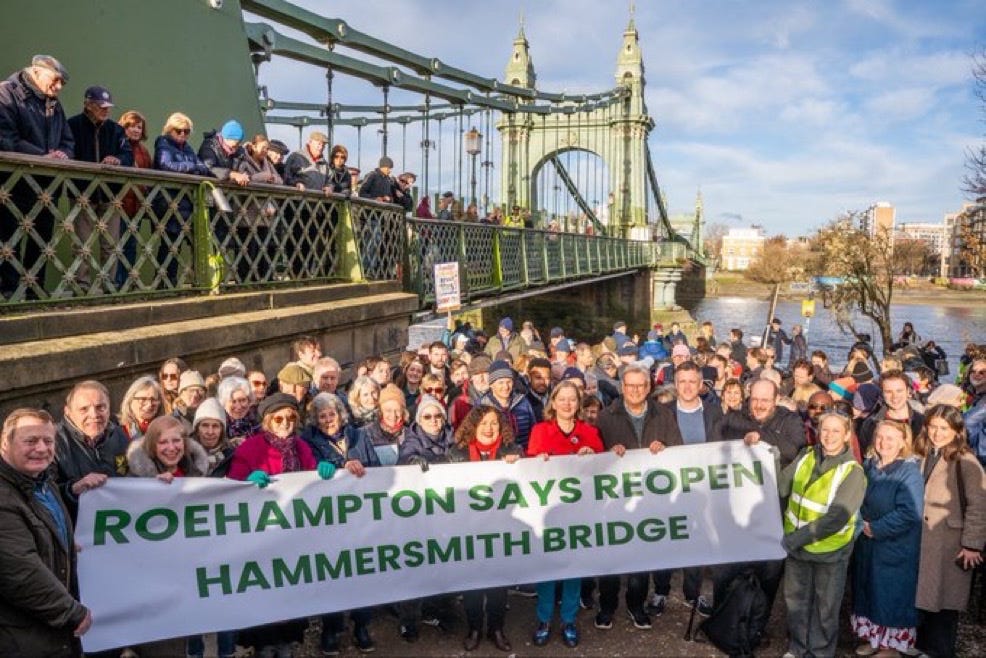
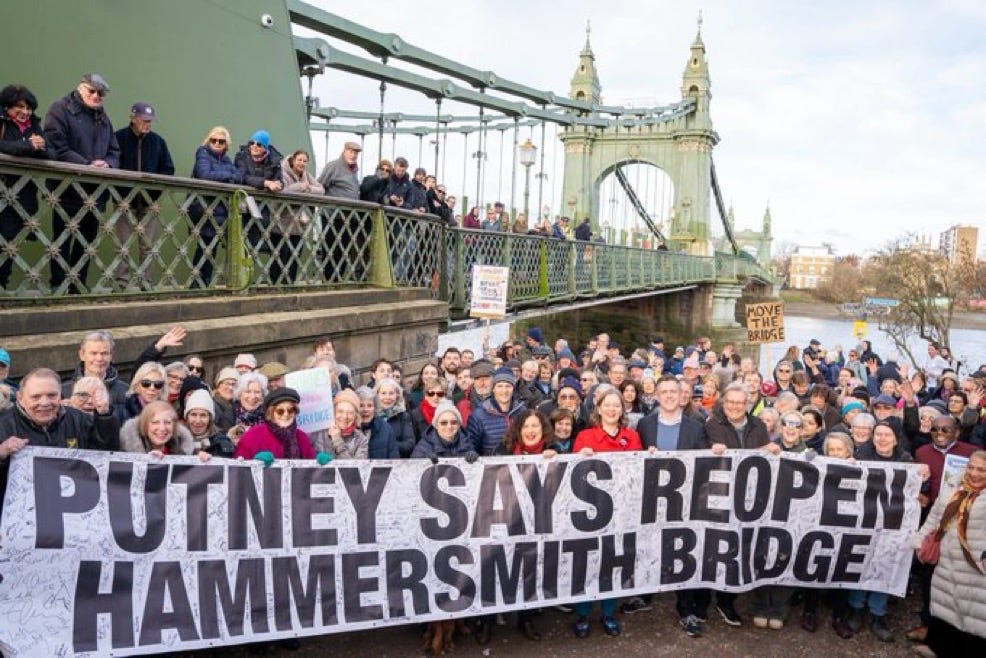
So how much say should they have on the future of this bridge?
Most of the 20,000 plus cars came from beyond Barnes, many beyond Richmond borough. How much weight should be given to their demands compared to the wishes of Barnes residents?
This is a moot point.
Neither local nor regional government can afford the rebuild. That makes Hammersmith Bridge, in practice, a national infrastructure question, despite the fact that it is not a priority by the UK Government or by the Mayor of London and neighbouring boroughs in any meaningful, deliverable way.
This has implications for Simon Lightwood MP, the Minister for Roads and Buses who convenes the Hammersmith Bridge Task Force (HBTF). He needs to release the official dataset on Bridge and surrounding road usage that is being shared at the next HBTF meeting, with a commentary so people in south west London to understand it mans and it does not mean. He also needs to explain the logic behind his final funding decision, which us due in the coming weeks. As the senior politician he needs to help us navigate a way through this.
Case for Putney
If Putney’s problems are to be addressed, the case needs merit.
Fleur Anderson MP says closure created Putney congestion, especialy on Putney High Street at peak times.
Supporters of a car-free Bridge, point to data from the Department for Transport (DfT) and Transport for London (TfL) that says there’s less traffic in 2026 than before 2019, when the Bridge closed.
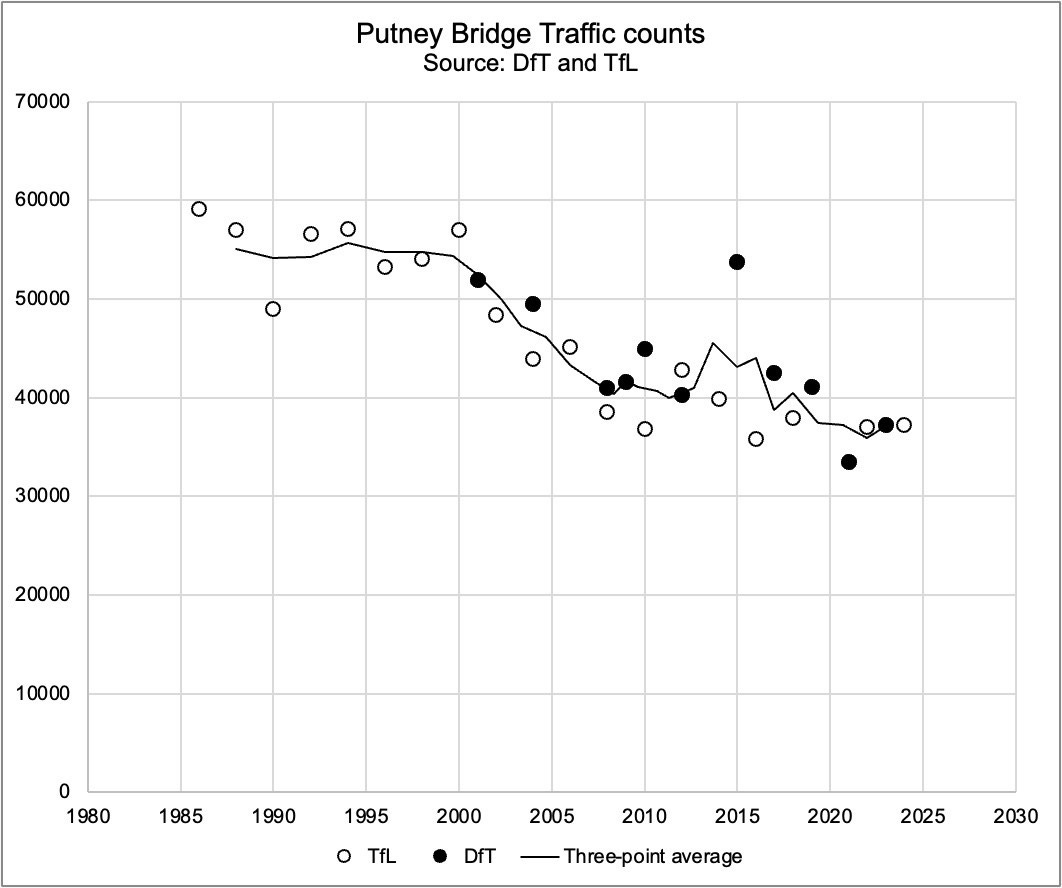
Kieran McCarthy says both these can be true. There can be fewer cars overall but there is more congestion.
Bridged tested this opinion at the pro-car rally by asking a small number of attendees, if Putney had £250m to spend on sorting the congestion, would you spend it all on restoring vehicles to Hammersmith Bridge?
Among roughly half a dozen people asked, nobody said yes. Two said ‘maybe’. That hesitation matters. It suggests that even within the pro-restoration camp there is an unspoken recognition that Putney’s problem may not be solvable by one expensive fix and may not even be primarily about Hammersmith Bridge.
What would Fleur Anderson MP say in response to that question?
One other thing.
Full restoration could take until 2035, according to Ms Anderson. By then the Bridge will have been closed to cars for 16 years. It would function less like ‘reopening’ and more like creating a new road connection.
New road capacity tends to generate new traffic. Induced demand. Some portion of that traffic would, inevitably, end up on Putney High Street. Any relief a restored Fridge might provide (and it is not clear it would) could begin to erode immediately. That is especially true if restoration comes with tolling, which would shift behaviour in unpredictable ways rather than neatly “solving” congestion.
South west London, divided .. but by how much?
Both sides claim to speak for many others, often the majority. A nonsense. None of them (none of us) can say with confidence what level of support exists for either outcome, because we have no structured, trusted way of measuring opinion locally.
Hammersmith Bridge remains divisive. We simply do not know how divisive.
Bridged’s hunch is that a majority still favour restoring vehicles, but that majority is shrinking — as often happens once a contested change becomes lived reality. People adapt. Assumptions get tested. New routines take hold.
It would be in the interests of the councils — especially Richmond and Hammersmith & Fulham — to measure sentiment properly. It would help leaders explain choices honestly, and design mitigations that are rooted in reality rather than noise.
The next proxy poll are the local elections due in March 2026. In Richmond, all 54 seats are up. The Liberal Democrats, Conservatives and (presumably) Reform all favour restoring the bridge to cars. The Greens want the bridge to remain open for walking and wheeling, with the addition of electric people-movers or buses. Even so, local elections are often a referendum on national politics. They will offer signals, not clarity.
Hello, Hammersmith. Hello?
One group was largely missing at the double demonstration.
There were few Hammersmith residents in the crowd. Very few.
The Bridge is owned by Hammersmith & Fulham Council, and it will have to shoulder some portion of any eventual bill. Yet it is easy to see why local residents might rank other big-ticket projects higher. For example, replacing the Hammersmith Flyover (or burying it) may feel more urgent, more visible, and more directly ‘theirs’ than restoring a river crossing that many do not use daily.
Liberal Democrats on buses and blue lights
At the second rally, Sarah Olney MP and Councillor Alexander Ehmann spoke in support of restoration, placing emphasis on “buses and blue lights”.
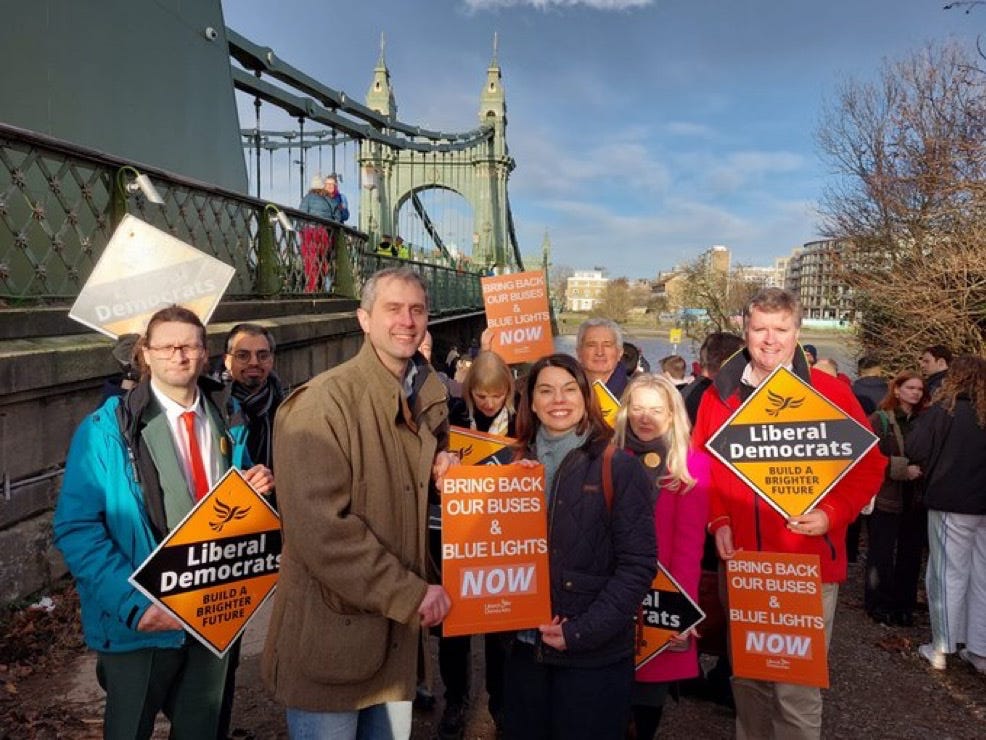
The Liberal Democrats want to restore more than buses and blue lights. Both the MP and Councillor want the full restoration including private cars. So why campaign using this particular phrase?
The Liberal Democrats have shown little interest in the proposal to run electric people-movers, or pods, across the Bridge for residents who cannot easily walk or cycle. Those vehicles are, in modern terms, buses: accessible, lightweight, and potentially far cheaper than full restoration.
And none of the emergency services - police, fire or ambulance - have blamed the closure of Bridge to vehicles for operational problems.
Bridged remains committed to keeping Hammersmith Bridge remaining car-free, permantly. Local political leaders have a responsibility to present a credible third option alongside ‘restoring 2019’ and ‘coping with 2026’: how might we organise our lives in Barnes were the Bridge to remain open for pedestrians, cyclists and people movers?
A ‘final decision’ on future Department for Transport (DfT) funding for Hammersmith Bridge will be taken ‘over the coming weeks’, according Simon Lightwood MP, the Minister for Roads and Buses.
Updates
Sunday 25 January
Added links to Kieren McCarthy, Putney News
Significant rewrite of Notes & Thoughts after reflecting further on the day and other online comments with changes including
Added financial background courtesy of Putney News
Added Case for Putney
Added South west London, Divided
Added Hello, Hammersmith
Separated Liberal Democrats
Original story Saturday 24 January 2026