
That was the week that was
Story 189: From Paris to Putney, a reminder that the future of Barnes is shaped by choices made near and far

With more than 150 stories now published on how Barnes might be improved, it is easy to forget that so much of this place is already, well, wonderful.
That thought prompted a new series, LoveThis!, which has so far celebrated the changes to Barnes Green and the sign outside Nest café. Dominique Afacan, another Barnes resident, struck a similar note on her Substack, Nesting. The full piece sits behind a paywall, but the opening gives you the gist.

Still, however good, some things could be better. And some things will have to change by 2050.
Transport - Councils take different route with e-bikes
Richmond council has decided to stick with a single dockless e-bike provider. Hammersmith & Fulham council has chosen to increase the number of operators from two to four.
That contrast is striking. Two neighbouring boroughs. Two different readings of the same market.
Why this matters
Bridged2050 remains unconvinced, on the evidence currently available, that Richmond was right to remain with a single provider for this next phase.
Some councils have gone down the single-provider route. But many others have not. Competition, if well managed, may yet prove the more resilient model.
Transport - Richmond council’s 2040 strategy says the quiet part out loud
So much attention went to the Forest versus Lime decision that it was easy to miss Richmond council’s new transport strategy.
That is a shame, because this is one of the more important local documents published this year. It tries to explain the borough as it is, and the direction of travel the council wants from here.
A few lines give the flavour:
[Richmond borough] enters 2026 with a transport network that too often feels closer to the last century or earlier than to the demands of a modern London borough.
While infrastructure across the whole Borough requires improvement, neighbourhoods such as Ham, Hampton and Heathfield experience structurally lower public transport accessibility and fewer alternatives to private car use.
The council does not control most of the transport system that shapes residents’ daily lives.
This Strategy will result in less private motor traffic.
[Richmond council is committed] to transport infrastructure outcomes that reflect a Borough of fairness, ambition and modern connectivity.
Hammersmith Bridge appears here as a warning about what happens when maintenance is delayed for too long. Heathrow appears too, with support for improved rail access.
Here’s the strategy,

Why this matters
This document fulfills the need of political leaders owe to their voters an explanation to explain at least broadly what they want to achieve and why
It is a navigational aid for Liberal Democrats and their supporters
For everyone else including Bridged2050, it usefully frames the local transport debates to come
Transport - Cutting traffic harm
The Mayor of London has launched a new Vision Zero action plan aimed at reducing road deaths and serious injuries still further. London has already made substantial progress.
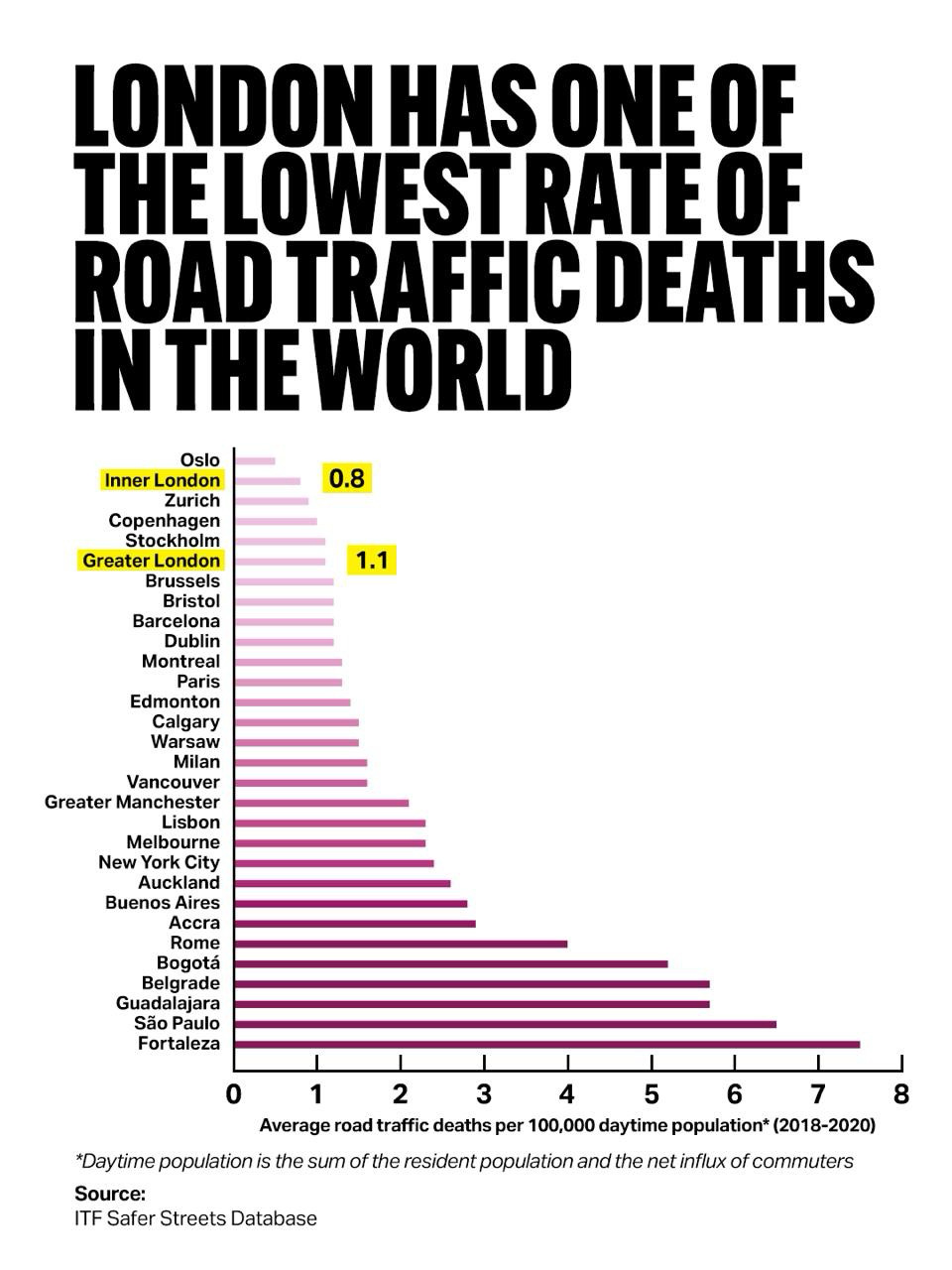
The fuller story is here. Among the measures the Mayor is proposing
stronger enforcement of 20mph limits
more School Streets, like the one being trialled at Barnes Primary School
further expansion of London’s cycle network
a trial of side-road zebras on main roads
Why this matters
It is a serious package, and broadly a welcome one.
One idea in particular stood out: a possible SUV tax. BBC News sets out the argument here. Given that the Mayor does not control most borough parking policy, London Centric speculated that any workable scheme might instead draw on the ULEZ camera network.
Transport - Lessons from Paris
Emmanuel Grégoire is the new Mayor of Paris, succeeding Anne Hidalgo. The result was a win for the left, certainly. It also looked like an endorsement of the direction in which Hidalgo has taken the city: less space for cars, more for bikes, walking and public life.
As the Financial Times argued last weekend, Paris has demonstrated that reducing car dominance does not mean economic decline:
Banishing cars doesn’t hurt an urban economy.
Retailers often worry it will deter their customers. Studies repeatedly show it doesn’t. More broadly, French Hidalgo-haters need to explain why Paris is in the global top four of business-focused rankings of cities by Oxford Economics, the Mori Memorial Foundation and Kearney.
Hidalgo remains a compelling political figure, as this interview suggests.
Why this matters
Paris is ahead of London in changing how residents move around. The chart below captures part of that difference.
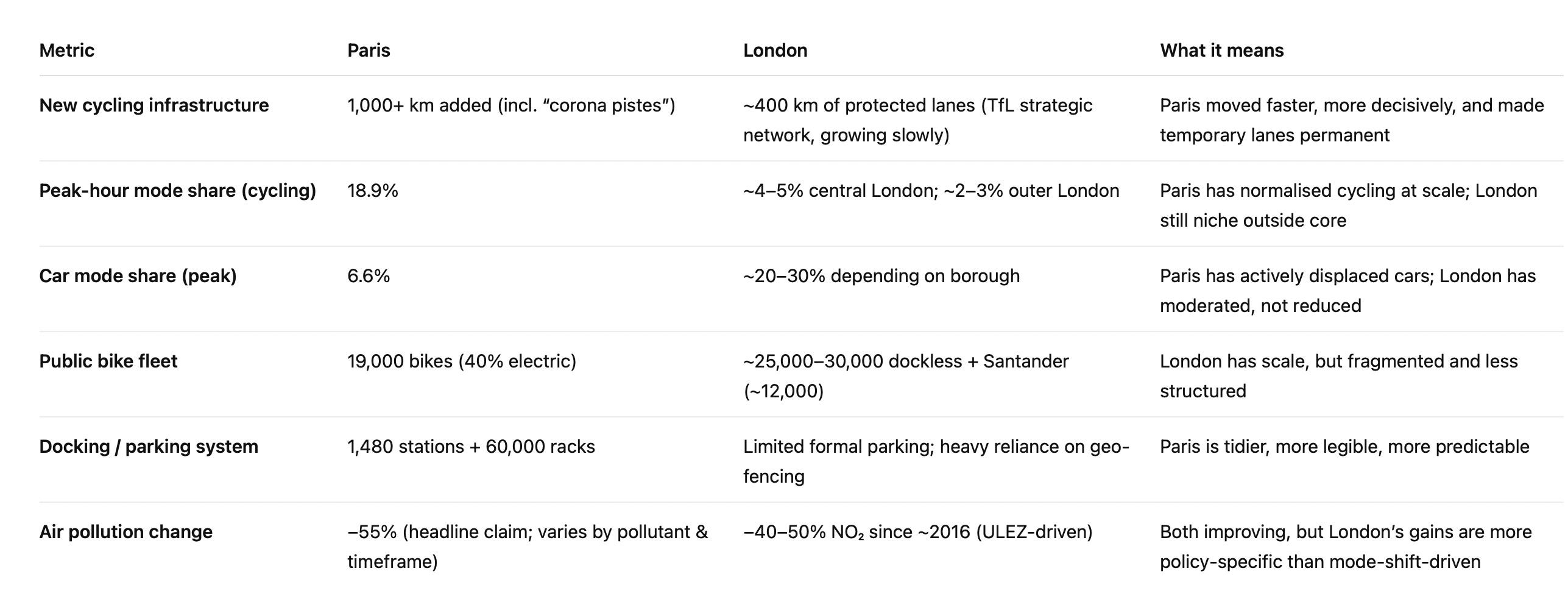
Bridged2050 keeps making the same case: political leaders at every level should show more confidence on transport and public space.
Mayor Grégoire’s victory is not proof that boldness always wins. But it is a reminder that timidity is not the only available strategy. No surprise then, how Mayor Gregoire celebrated.
Transport - Lessons from Malta? Maybe
BikeIsBest reported
Young drivers in Malta are being offered an eye-watering €25,000 to quit driving, in a bid to cut car traffic on the Mediterranean island. Those under 30 who have held a driving license, and lived in Malta, for a number of years, will receive €5,000 instalments for handing in their license, and for each year they abstain from driving.
Why this matters
There is always value in watching how others respond when a system is under real strain. Malta’s roads are now among the most congested in the world.
As we grapple with how we make our lived environment more pleasant and un-gum our traffic, it is worth bearing in mind these fringe events. If sensible change is ducked for too long, stranger remedies eventually start to look reasonable.
Transport - New Forest is .. nearly full?
It was sobering to read that one of the country’s most beautiful landscapes is feeling overwhelmed. The New Forest appears to be running up against the limits of a visitor transport model still built, overwhelmingly, around the car. Its guardians are working on solutions.
Why this matters
As with Malta, so with the New Forest: if more walking, cycling, buses and trains do not take hold, tougher forms of access management may follow.
This is a useful reminder that both green and grey places can become degraded by too much traffic.
Transport - AV worries
Another subject likely to feature on Bridged2050 in the months ahead is autonomous vehicles (AVs). One recent report raised the prospect that AVs may increase congestion rather than reduce it. At the same time, London’s transport leadership seems decidedly cautious about whether these services will benefit the capital.
Why this matters
There is still work to do in aligning the approach of the UK Government and the Mayor of London on how these services should operate in practice.
The Mayor’s position, set out here, looks sensible: innovation, yes, but not at any cost.
While we want London to be the global capital of innovation, enterprise and creativity, this must not be at the expense of jobs and livelihoods, and I am committed to working with industry and unions to ensure this technology is introduced in a way that works for all Londoners.
Transport for London must consent before APS [automated passenger service] permits can be issued in London and this consent would be based on APS permit applications supporting the objectives of my transport strategy.
Infrastructure - Albert Bridge fix is a bargain
Kensington and Chelsea council has confirmed that Albert Bridge could close for up to a year while it completes an £8.5 million repair project.
This from BBC’s Tom Edwards summarises the latest on Thames’ bridges.
Why this matters
Bridged2050 believes having two west London bridges closed to traffic makes it more difficult politically for the UK government to do nothing.
The Standard’s reporting did raise one smile. If the £8.5m cost of fixing Albert Bridge is ‘whopping’, wait till they see the cost of restoring Hammersmith Bridge.
Hammersmith Bridge - Money, money, money
An intriguing sub-plot from the ever excellent Putney News.
Department for Transport (DfT) documents, released after a Freedom of Information request and published here, suggest that Wandsworth council declined to contribute to repair costs just three days after a public rally calling for action.
Why this matters
Bridged2050 has long baulked at the secrecy surrounding the Hammersmith Bridge Task Force (HBTF). It is hard to see what public interest was served by keeping these notes private.
It was also good to see Councillor Gareth Roberts, leader of Richmond council, make the active-travel case plainly:
Biggest win for Richmond residents use of active travel. Designing in car based approach would be retrograde.
There was, again, disagreement over the effect of the closure on local traffic. That is why a shared data set was promised. While HBTF has yet to produce it, evidence from Transport for London, DfT and Wandsworth council has emerged in the meantime. It has not, however, shifted the position of Fleur Anderson MP (Labour, Putney).
The importance of the Spending Review also became clearer. Without a firm commitment
.. the Bridge would be outside of the decision making process for a few more years
There was no dedicated Hammersmith Bridge commitment in the 2025 Spending Review.
Wandsworth council’s reluctance to contribute makes sense in one narrow respect: it does not own the bridge. Beyond that, though, Hammersmith Bridge remains what it has often been for surrounding authorities — important, but not quite important enough. On Double Demo Day, Bridged2050 found a similar mood in Putney and Roehampton. Asked how they would spend £250 million to reduce congestion in their area, none chose restoring Hammersmith Bridge.
Economy - Richmond council wants 5,500 new homes by 2036
That is one of the ambitions of the new Growth Plan. Others include a 20% increase in jobs, support for 1,500 new businesses, and action to raise incomes, particularly for lower-paid residents.
The plan identifies the need for delivering sustainable housing while protecting the borough’s green character.
Why this matters
Every part of Richmond borough will be affected differently by this Plan. Barnes has about 6,700 homes and has done for years. This is one of the defining characteristics of the area. Short of building several large twenty first century mansion blocks, Barnes will add only a small number of properties
Other parts of the plan may be more consequential. More from Bridged2050 to follow.
Housing - Smarter Homes
Richmond council also launched its impressive Smarter Homes initiative, designed to make our homes more comfortable, ealthier, greener, and cheaper to run.
Timely then the Mayor is drafting London’s Heat Risk Delivery Plan in an effort to cool the city. The London Assembly heard,
Londoners face a unique overheating risk in their own homes due to climate change affecting a densely built environment and an outdated planning and design system.
Also related, Ed Milliband, UK government’s Energy Secretary has set out plans to make rooftop and balcony solar easier to install. These are common in parts of Europe. The expectation is major retailers will be stocking them soon.
Why this matters
Domestic buildings are resposible for 46% of Richmond’s total greenhouse gas emissions. Retrofitting that stock will take years, perhaps decades, even in relatively affluent Barnes. These actions by local and central governament are essential.
Meanwhile, as Met Office forecasts for this borough suggest, much hotter summer days are likely ahead. Homes are no longer just a housing issue. They are a climate adaptation issue too.
Lifestyle - waste and recycling
What we can put in our bins about to change, though not by much.
The annual Big Plastic Count was chastening. Just 32 items of hard plastic went into the bin during the week under review. That sounded almost respectable. Then came the online estimate: if every UK household did the same, the result would be 61 billion plastic items a year.
Bridged2050 tracked the lifecycle of a cigarette butt.
What it matters, in order
Good
Gulp
Grim
Finally - the Boat Race
Here’s a useful summary of events on and around the river next Saturday, from Putney Bridge and Mortlake.
Why it matters
The Boat Race is one of Barnes’ two great annual community events. The other is the Barnes Fair
Bridged2050 believes we could do more - so much more - to welcome the visitors to our fabulous peninsula. More later this week.
