
Star Trek, demonstrations and my enemy’s enemy
Bridged-worthy stories from the last week. Story 159

Welcome to Bridged2050: ideas for living well in a climate-ready Barnes.
I have my ticket. Have you got yours?
Fleur Anderson MP (Labour, Putney) is calling on residents to attend a rally ahead of the next Hammersmith Bridge Task Force discussion about the Bridge’s future. Ms Anderson wants the Bridge to be fully re-opened to traffic. We meet Hammersmith Bridge, Barnes side, Saturday 24 January at 2pm.
Here’s the thing I don’t understand. Information secured through Freedom of Information and Wandsworth council show traffic over Putney Bridge is lower now than in 2018. And problems at the junction are down to poor design. How does Mz Anderson explain this?
UK loves SUVs. Bridged, less so
The UK’s top 10 most popular cars in 2025 included eight SUVs.
Bridged does not like SUVs in our street environment. Great engineering, wrong place.
Christian Wolmar has an interesting take on this, saying
Other transport modes such as aviation and railways have become almost accident free as a result of improved safety measures and better technology.
Yet, motor vehicles have moved in the opposite direction.
He goes on to cite research from the London School of Hygiene and Tropical Medicine that shows children under the age of 10 are three times more likely to be killed if struck by an SUV rather than a standard sized car.
A weekly digest of stories and signals about future Barnes.
Less freedom for pensioners?
The Freedom Pass is being reviewed, after boroughs warned that the rising bill is becoming unsustainable, reports The Standard.
The scheme gives more than a million older Londoners free travel across TfL and national rail services. The costs are borne by local councils. Richmond council’s Chair of the Transport and Air Quality Committee, Alexander Ehmann, is quoted as saying the rising bill as ‘concerning. He pointed out the borough faces three years of £30 million cuts whiklst Richmond’s contribution alone to the Freedom Pass is increasing by 16.2 per cent.
Bridged supports this review.
Two points can be true at the same time. Concessionary travel is socially valuable. The Pass helps keep Londoners connected, active and less isolated.
There’s been a generational shift in wealth with allowances like ‘the pension triple lock’, from the under 35s to the over 60s. A course correction may be required.
Options have to include means-testing, tightening eligibility, and/or changing mode coverage
The councillors should look at the Oyster60+ scheme, too. As thrilling as it to use - I am a keen member of the 09:32 pensioners’ peloton at Barnes Bridge station - my friends of same age outside London do not enjoy such benefits.
Pedalling is wasted on under 35s
One phrase caught the eye in this article by Bill McKibben,
.. an e-bike is a bicycle without hills
Perfect. It goes on,
.. that means that almost anyone—older, injured, overweight, out of shape—can ride one. If you work the kind of job where arriving with a ruddy glow might be a problem, it’s a bicycle without sweat. And if you need to haul something—kids, gallons of milk—it’s got the power
E-bikes turn ‘I can’t’ into ‘Maybe I can’.
We should stop treating e-bikes as a lifestyle accessory and start treating them as mobility infrastructure, closer to a public-health intervention. The over 60s should join the Lime bike revolution with their under 35 children and grand-children.
Of course, not everyone is a fan. Ask Lord Moylan,
Much cycle infrastructure that has been installed has inhibited bus journeys and contributed to deteriorating journey times.
Dave Hill makes the same point, saying the Mayor and Transport for London are prioritising bikes over buses, at the expense of poorer Londoners.
Bus journeys are down according to Transport for London (TfL),
In 2014 .. an average of 6.7 million bus journeys were taken every day.
Ten years on, the figure had fallen to 5.1 million, despite London’s population having grown by roughly half a million during that time.
Despite this fall, nearly four times as many people catch buses as cycle, and those numbers are broadly flat.
Bikes to blame for buses? Not true, said Max Sullivan.
Hill is on firmer ground when he points to a section of the Travel in London Report which confirms the better paid uou are, the more likely you are to ride a bike in London. Once again, Barnes is an distinctive position.
How much?
The Metro headline caught the mood of the article,
This is the salary you need to buy a house in every London borough — and it’s bleak
In 2026 a typical London home cost more £660,000, and 30.1% of properties are comprised of private rentals. the highest percentage since 1971.
In Richmond borough that means you need to earn £135,200 to own a house, which cost on average £760,700 according to ONS. As the dark blue suggests on the chart below, Richmond is the fourth most expensive borough after Kensington and Chelsea, Westminster and Camden.
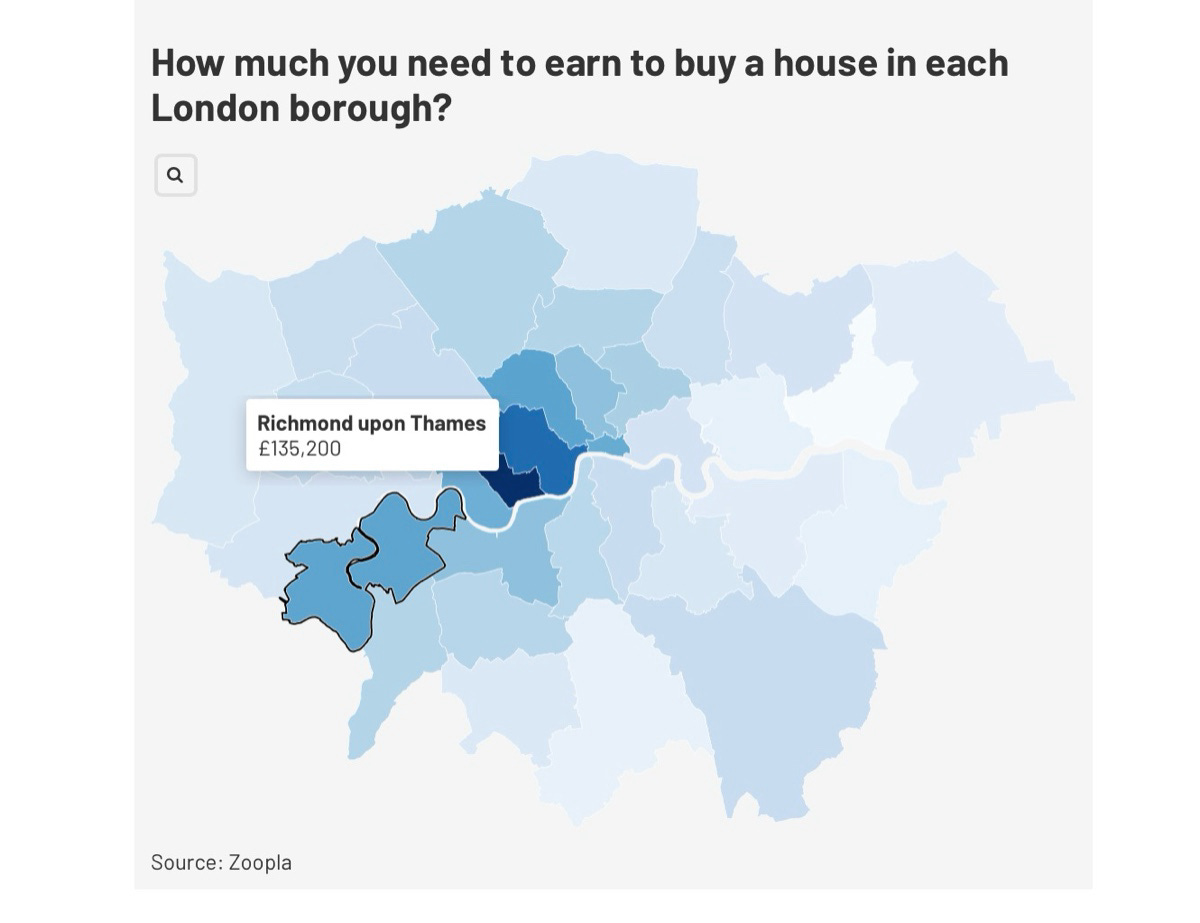
These reports provoke a swirling, conflicting set of reactions
Embarrassment - Are we at risk of creating London’s largest gated community, bordered on three sides by the Thames and on the fourth by a chain of million pound-plus homes? Bridged asks how do we live well? We means all of us, not just me and my family.
Pity - ask the next delivery driver, teaching assistant, or council worker where they live and how long it takes to get here. Is it good so many (all?) have tolive so far away?
Acceptance - there will always be somewhere in any city which is more expensive. Maybe that is the lot of Barnes? If so, what is our responsibility to the rest of London? What can we offer in return for this status?
Guilt - Is it wrong to wish for a systemic price drop? Heresy in SW13 and it would be potentially ruinous for all those with outstanding mortgages. Sometimes this seems the only way to correct the market.
Star Trek and why size matters
Changing house prices will require systemic change. This blog tends to big ideas. Hello, Castlenau Park.
Katharine Hayhoe provided an interesting challenge to this bias towards thinking big. She starts with a Star Trek trope,
When people talk about travelling to the past, they worry about radically changing the present by doing something small.
But barely anyone in the present really thinks that they can radically change the future by doing something small.
Ever the optimist, Hayhoe uses her Hey Change Podcast to reminds us,
It is a magnificent thing to be alive in a moment that matters so much.
My enemy’s enemy
This week’s summary ends with a request for help from Barnes Common. They need help ro survey all the garden ponds in the borough to find out where frogs, toads and newts are successfully living and breeding.
On the basis that your enemy’s enemy is your friend, Bridged loves frogs for their work in culling slugs on the allotment.