
🛠️Inside Bridged: reflecting on progress and an October hiatus
Story 138

This project is rooted in my growing awareness of our changing climate. The world has made progress in mitigating the worst of what was to come. Before the Paris 2015 COP, the we were heading for more than 5°C of warming. Today, if all commitments are fulfilled, temperatures are set to rise by 2.7°C. Still too much: it would profoundly transform life on the Thames, even for those who never leave the borough.
We must do more.
I believe the main change agents are the government and businesses. But we should each do all we can individually. I wanted to age with mischief, grace, and a lighter footprint. Uncertain of how to achieve this, I reverted to type: I set out to answer this question
How do I live my best life in the world’s greatest city during this climate emergency?
I publish my thinking. The act of writing or recording forces me to order my thoughts, and knowing others might read or watch them keeps me honest.
To keep me on the right track, every month I do one of two things:
Learnings: What have I learnt? Have my stories provided useful, actionable answers to that core question?
Inside Bridged: What are the lessons on craft? How am I executing this work, and how can I improve?
Again, I publish these reflections. This article—Story 138— addresses the second question.
This will be the final article for a few weeks. I will not be publishing again in October. This marks my first long break from Bridged in twelve months:
September to December, 2024: paper exercises helped me to prepare.
January to March, 2025: a trial period with a lighter publication schedule.
April to September, 2025: the first six months of the blog, proper.
Time I usually spend researching and rewriting will be dedicated to reviewing how things have progressed and planning the next six months.
My approach
Part of the reason for this break is a result of my working methodology. I am not developing a useful masterplan in a logical way. In my notebook, my approach is often codified as:
EE + LLI + CWR = Always WIP
I like shorthand ‘formulas’. This one translates to,
EE (Everything Everywhere): I address each of the elements in the organising question, but in a random order that reflects the flow of real-world news, my engagement with people, and the emerging shape of my plans. This is also much more enjoyable for me.
LLI (Launch, Learn, Iterate): I learned this from working with software engineers. I launch the kernel of an idea, assess how it fits and feels, and then augment it. I return to my articles regularly to improve them.
CWR (Crawl, Walk, Run): The longer I engage with a subject, the more ambitious I become. This process naturally takes time; I am currently crawling through this first year.
WIP (Work In Progress): The three characteristics above mean the entire enterprise is a continual work in progress. I have a framework, and I am slowly populating it, piece by piece. Occasionally, I realise the framework needs adjusting slightly. Meanwhile, I need a narrative to make sense of the framework and its content. That, too, is a WIP.
Monthly reviews and this longer break are opportunities to step back, look at these moving parts, and tweak anything that can be improved.
Performance
I wanted a simple way of assessing my progress. During the initial testing phase, I had two questions: am I learning and am I enjoying? Answering yes to those lead to a commitment for another year.
I now require a different way to assess my progress, one that incorporates those initial questions. Bridged will probably take several years to succeed, as culture change takes years, not months. So, what would success look like in, say, three years? How would I measure it? I settled on another formula:
Impact=Enablers+Outcomes with Benefits
Enablers are generated insights and ideas. The inputs. They are wisdom codified. Across the 137 stories published to date, they are the comments captured under ‘Notes & thoughts’ and everything published in this section of the blog.
Outcomes are what happens when some combination of those enablers are adopted by me or others. The ideas become real.
Finally, the benefits are the measurable consequences of such change. That might include fewer emissions, more pedestrians, or more happiness.
This approach was developed by a former colleague at BBC Research & Development, Jon Page. He was an expert in assessing how best to assess the value of initiatives. For example, he led on producing this report in response to a UK government request. It focusses on the outcomes and their associated benefits of BBC R&D’s work, as my blog post from the tijme explains.
Let me bring this formula to life for Bridged using my boiler. One of the big surprises of the first year was learning that in Richmond, 46% of greenhouse gas emissions came from homes. At some point, I will need to change our gas boiler for a heat pump. I will need to find suppliers, models, and perhaps planning permission. I am likely to find that managing the heat at home will be done differently. All those factors are enablers. Once installed, the outcome will be a different heating system. The measurable changes are a reduction in emissions and, hopefully, costs eventually—the benefits.
Bridge’s impact is the sum of those changes. Focusing solely on the enablers is not enough.
If I look at the fiscal year to date (April through September), here’s my current assessment of the impact.
There’s a substantive list of enablers:
10 themes, the categories you can see across the website navigation
I published articles on 41 topics
I have established a relationship with BCA Barnes Ponder
I have volunteered for several BCA events
I have attended several public Richmond council events
If the quantity of enablers is encouraging, the quality is inconsistent:
The themes and topics are now established
I am delivering on my targets for this year of ‘.. more than words, more than facts and more than me’. I will be publishing original videos before the year-end to complement the Bridged2050 YouTube channel. The launch of the blog’s Manifesto section—admittedly a lean selection currently—has taken me beyond facts. I am on track to publish my first contributions from experts, in their own words, again before the year-end.
I judge 1 article in every 8 to be very good.
But
I am struggling to pull it all together. The Thames to Thames walk in 2030 is the best effort so far. I think even hoping this reflects the fact my ideas are only partially formed.
And my writing remains .. er, dull. Wooden. I have improved over these 130 articles. But I am hoping practice does make progress.
Unsurprisingly there are outcomes and so no measurable benefits. One hundred and thirty seven stories into this project, this is all about the inputs. Outcomes are for next year, I suspect.
I will return this framework in later production reports.
Key developments
Since the July, 2025 Inside update, I have made several major changes to how I am working.
Update role description
I spent the summer explaining Bridged to people. I ran out of business cards and had to order a new set.
The process of talking rather than just writing about this forced me develop a better, pithier description of the role of Bridged:
Bridged2050 is a mini-think tank for Barnes and Mortlake with a simple purpose: to help all of us thrive in a climate emergency.
It takes local journalism and turns it into practical proposals.
It starts with one question, ‘What should I do?’
In my notes this is version 4 of my pitch. I am sure a year from now I will be on version 8 and all the better for it. Another continual work in progress.
About me
Something else changed as a result of talking to others about Bridged. I realised pne of my published stories—how I came to write the blog—was weak. It missed the key points. It was waffly in too many parts. Again, the rewrite was shaped by how I had been explaining it in conversation. This new version is much better: four drivers brought to fruition by one event.
During these summer conversations, I also realised I needed to share my professional credentials. I had been relying on my LinkedIn profile, but that was too detailed. I created a shorter professional biography.
I started to explain how and why I see the world. This is important because, for you to better understand how I have come to a view, you need to see the world—at least momentarily—in the same way I do. I have pencilled in a series of articles over the next six months that will do this. The first explained why I am a seasoned litter picker.
Manifesto Proposals
A key summer priority has been delivered. I committed to this in my last production update. Across a number of topics, I had sketched the outline for my coverage - the background, significant news updates, and high-level insight. All that was needed was a practical proposal, something to address the main question: so what should be done?
There are only a handful of these at the time of writing, relating to a car-free Hammersmith Bridge, SUV parking charges, a new pedestrian crossing by Orange Pekoe, and the need for daily river buses from a restored Barnes pier.
These articles have had a much bigger impact than I expected. They’ve strengthened the whole project. That logical spine has made sense of a number of hitherto disparate elements. They also provide the means by which you can now see what other proposals might follow. Even better, they are starting to relate to one another, reflecting how we each live in this area.
Topic boxes
This is a dreadful name, but it will do for now. Upon publishing the first Manifesto Proposal, I realised the need to provide a tool for connecting the various parts of the story. A topic box is a navigation tool. This is the example for Hammersmith Bridge:

There are only three of these across the blog. I will update them when I return to the Proposals, which I intend to do every two or three months at least.
YouTube channel
This was another summer priority. I want to use more than words to tell my story. Partly, this is because this is how many (most?) people now learn things. Also, I wanted to learn new skills whilst creating Bridged. Producing video is well outside of my comfort zone.
I started with a curated collection of third-party videos on YouTube. There are so many interesting films from both professionals and informed amateurs from around the world.
I add to the channel’s library, which is themed to match the blog’s navigation, every week. I identified a small number of film that you should watch first. I refresh this list at least every month.
Biking and walking Mortlake
As temperatures peaked, I made a decision regarding the blog's geographical bias. Having narrowed its focus to two areas—Barnes and Mortlake—I was conscious of ignoring the latter. There was so much going on in Barnes, Mortlake only featured because of the Mash-Up, Brewery or (Barnes!) Hospital.
I decided to make Mortlake one of the priorities of the second half of the year. Ahead of that, I wanted to familiarise myself with the area more fully. First, I biked every street in the area, both ways. I realised I knew most of it, but there were one or two streets tucked away that were new to me. I then started to walk every street in Mortlake. I have a few left to complete the process.
I can tell it is having an effect because I took several photographs that have been added to the Bridged stock shot photo library.
Other smaller changes
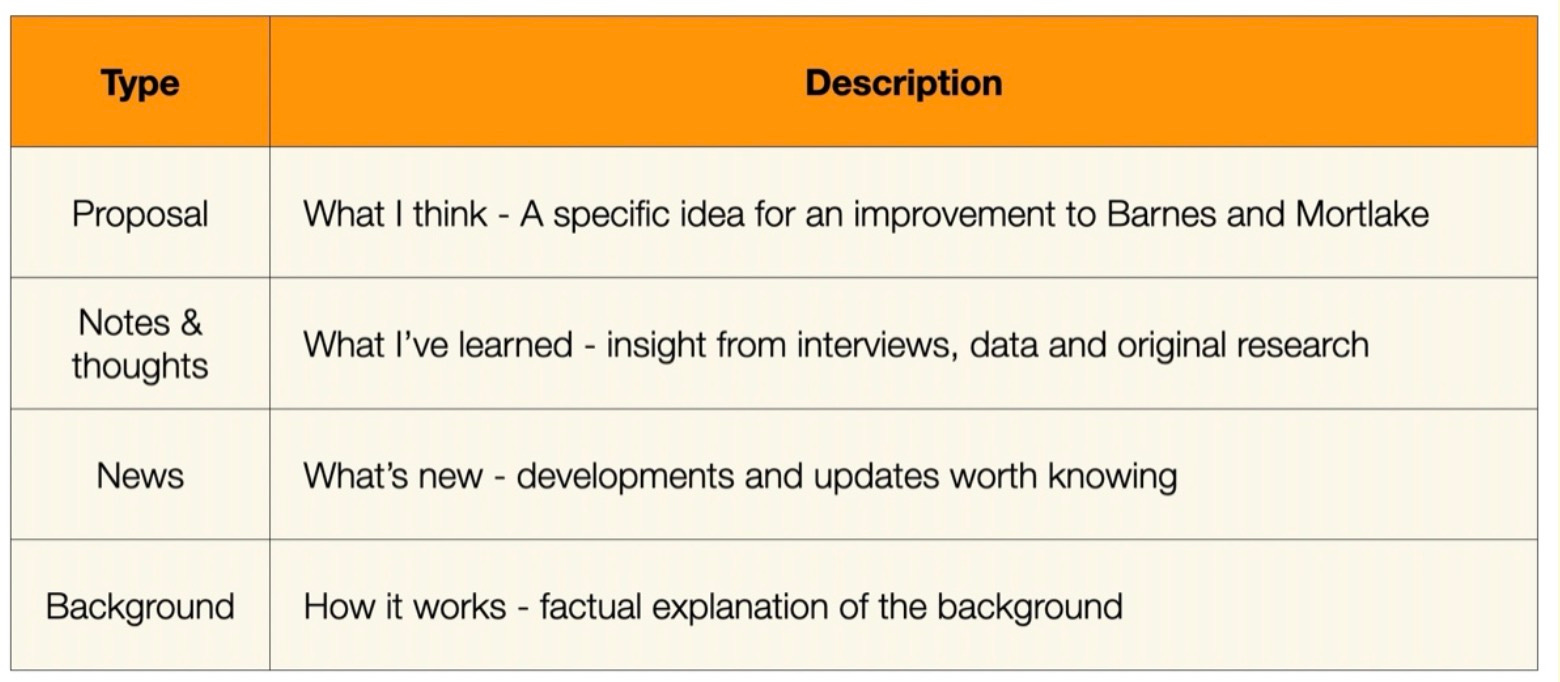
Story type labels, again
I know, I know. I am still tweaking this. As I wrote in my last update
I am trying to create an evidence-backed list of proposals. Eventually I want my thinking on a particular topic, say ‘balcony solar’, to be supported by a factual background description, news updates and relevant insight
So why don’t I used those words to describe the story type?
Done.
More news and more quickly
I have struggled with this on and off since April. There is so much going on. I need to update my understanding of the topics when news breaks. But sometimes there is so much news. I adopted two approaches, and so far they have worked.
For the Richmond council Climate and Nature Strategy, I decided to post a quick story and then return to flesh it out a few days later. I called this P&R—for Post and Return—in my planning notes. I have done this a few times, and it works well. The time gap also allows me to manage the workflow and refine my thoughts on the topic.
The other approach I call News In Brief or NIB. This is a good example. This approach requires minimum effort on my part; I am relying on the third-party source to carry the story. There might be no notes or thoughts from me, but the information provides an important part of the puzzle. The act of creating the story ensures that information is lodged in my brain.
Ai
I am now testing ChatGPT and Google Gemini side by side. My early thoughts:
I enjoy talking to Gemini when I am thinking about a topic. I use the mobile phone app. It helps me get my initial ideas in some sort of order.
I think ChatGPT’s research answers are much better at the moment. I use Open Ai’s deep research functionality to develop 750-1000 word backgrounders.
If I am struggling for the write words, I tend to use Google Gemini. It seems to have captured my authentic better and the suggested rewrites are less clumsy.
I have not managed to use either to generate sufficiently high quality images or video but I suspect that will be the next step.
Priorities for October, November and December
I am going to spend the rest of this month reviewing my existing plans. They will align with my overall ambition for the year
More than facts, more than words and more than me
I don’t want to prejudge that process. More when it is complete.
Finally here’s one of those topic boxes. This time it is about me.
Other stories about the author
Notes & thoughts
Background