
Other things to note this week - avian flu in SW13, regulating e-scooters and e-bikes and living long - and healthily - in Barnes
Story 179

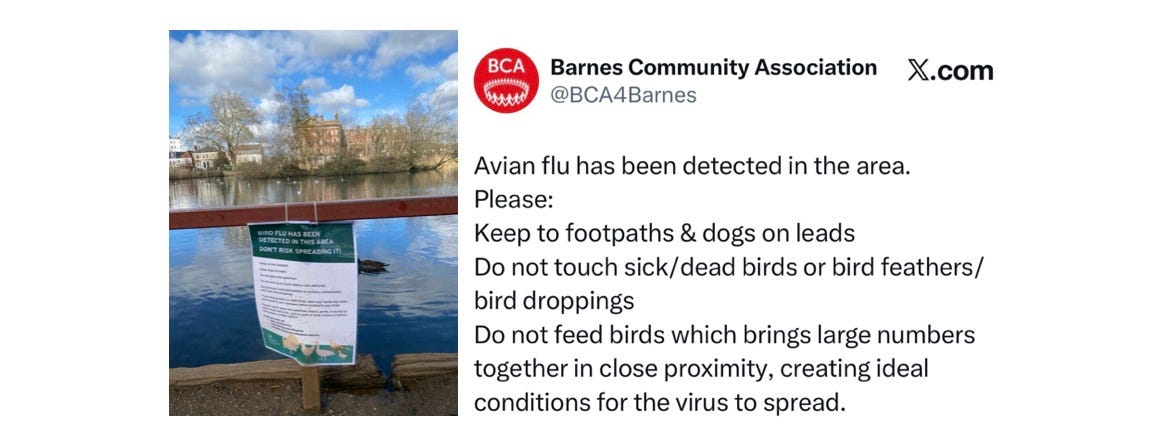
A leaked government letter dominated conversations and emails at the end of the week. But other things were going on, starting with another (unpleasant) surprise lurking by the pond,
Lifestyle - life expectancies
Residents of Richmond borough have some of the longest healthy life expectancies for men and women, with the ages being 69.3 and 70.3 respectively.
The bigger picture is grim, according to The Guardian,
Our healthy life expectancy has been dropping for years; it is now the lowest since 2011, when records began
The searchable map is worth a look. For contrast, Blackpool sits at the other end of the table. There, boys are typically expected to enjoy good health until aged just 50.9.
Researching this topic for a future series has made clear the impact of demographics on the peninsula’s future - housing, health car, jobs. Much more on this.
Transport - e-scooters, e-bikes and e-buses
Bridged believes embracing the Lime bike generation - the under 25s - is key to securing transport mix of the future we need.
It’s thought e-bikes outnumber e-scooters by a ratio of 50:1 - about 50 million e-bike hires compared to one million e-scooter hires each year in London. Both will become subject to a London-wide licensing scheme under the English Devolution Bill. This article raised several useful points including,
Operators want parity between how e-scooters and e-bikes are managed
Extending the e-scooter trial, run by Transport for London for the UK Government has created complications
There’s still to learn from Paris
The Transport Minister explained the London market is materially different from those elsewhere
Meanwhile the BBC published an in-depth report on anti-social parking. You can read or listen to it: it’ll take about 14 minutes. Three things are worth calling out,
Any solution will require compromise: riders cannot expect door to door convenience; drivers will need to surrender some road space; the operators will need to invest in better management processes
It remains to be seen if the the Mayor of London’s expanded role covering both e-scooters and e-bikes will reduce anti-social parking. In Barnes, the Mayor might own the strategy but delivery will largely sit with Richmond council
Some councils might adopt the Copenhagen model - ‘supersize bicycle parks, where thousands of personally-owned bikes and dockless e-bikes are clustered together’.
This is a good introduction to anti-social parking.
‘When it came to the emergence of bicycles in the 19th Century, you saw all this discussion in the Times of London about how bicycles are menaces to society, going too quickly, causing far too much danger. Over time, we get used to it.’
Matthew Lesh, Adam Smith Institute
E-scooters, e-bikes, secure parking and workplace interventions all help people cycle more. Interesting to see large-scale, ambitious infrastructure improvements have far greater impact than smaller scheme. That’s according to the findings of a research review published by Active Travel England.
The number of zero-emission buses is increasing at quite a pace now. As of March 2025, there were about 8,800 buses in London and as of February 2026, 2,800 of them are zero-emission. Maybe time for a few automated smaller ones for Hammersmith Bridge?
Infrastructure - Side Road Zebra, School Streets and the Dutch
Drip. Drip. Drip. Another reminder about the joy of unofficial zebras or side road zebras,
[The side road zebra crossing is] a rare unicorn… effective, popular and cheap. I would like all boroughs to engage with it.
Cllr Max Sullivan, City of Westminster Cabinet Member for Streets
The first School Streets trial in Barnes started this week around Barnes Primary School.
And a splendid week in Rotterdam, Netherlands, reminded me some lessons are universal.
Climate change - Increasing price of food, again?
The UK’s beef farmers, meanwhile, ‘face a double blow’ from climate change as ‘relentless rain forces them to keep cows indoors’, while last summer’s drought hit hay supplies, said the Financial Times (paywall).
Lifestyle - Food waste collection
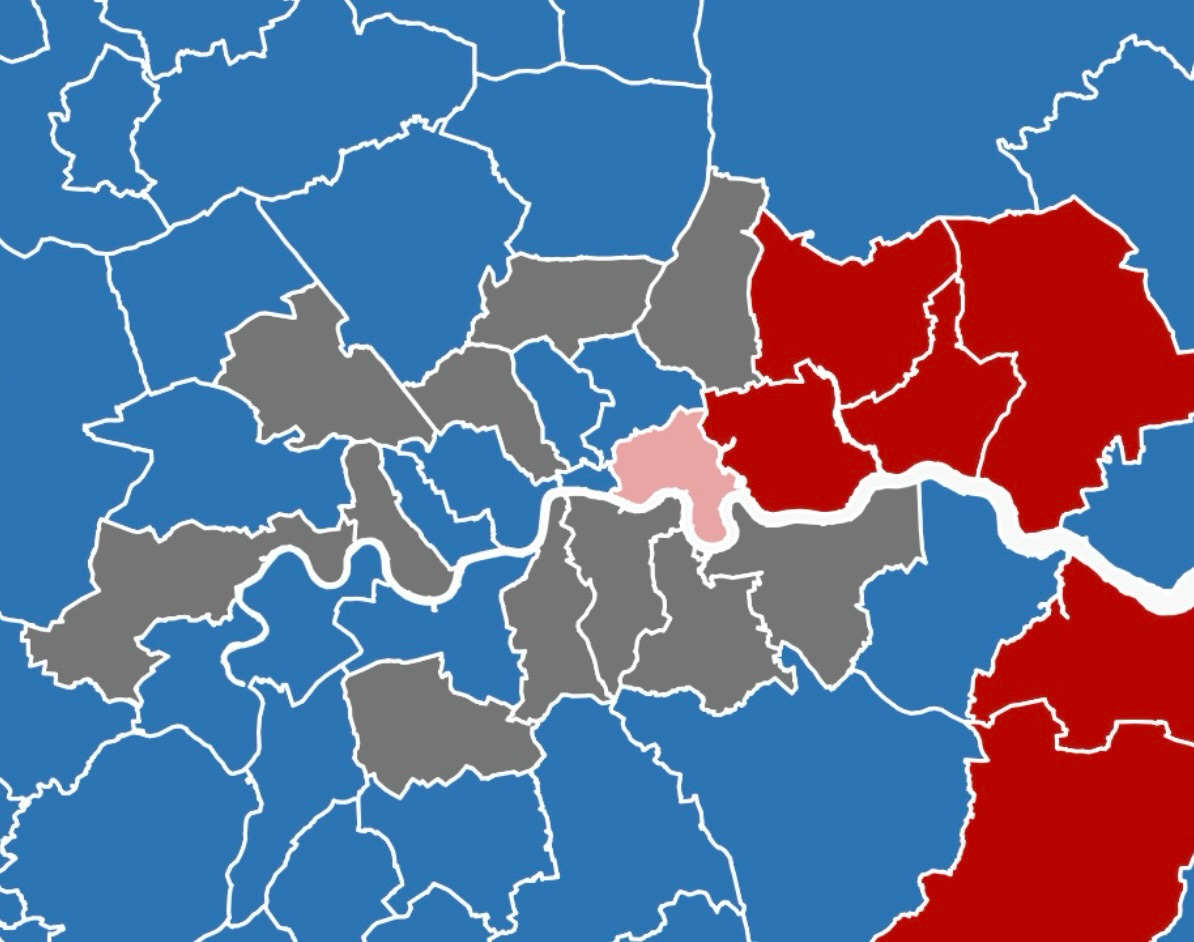
Richmond council fared better than most councils in a new survey by the BBC.
More than a quarter of English councils will miss an official deadline to introduce weekly food waste collections to all homes. Not so Richmond. What surprised me was how many other London boroughs failing to offer this service. On the map below, only blue is good.
Civics - Another south London event cancelled
A small item admittedly, but resonant after last week’s news about the Barnes Food Fair.
Wandsworth Bridge Road Association (WBR) emailed supporters to say it has decided to pause the 2026 Spring Fayre, the single biggest event of its kind in the area. The reasons are familiar - a small group of volunteers; the need for long term funding; and the scale and complexity of the event.
WBR are fellow bridgers.
Governance - Bots and typography
The next story also picked up on a item featured last week - how some councils struggle to cope with the ‘culture war’.
This time a former colleague, Tom Loosemore, wrote on LinkedIn about the possibility of public services being overwhelmed by the next generation of AI agents.
How would Richmond council process activity at the scale Tom describes? Even their current approach of putting petitions behind login accounts would not be sufficient to protect them.
Also on my mind this week, typography. My photo roll is full of street and other signs as research for a story. That is why this Guardian story about Margaret Calvert caught my eye. She is most famous for a font is called Transport. It upset traditionalists of her era but in 1965, after much testing, Transport was so widely adopted, you probably see an example every day. The part about her design process being ‘human centred’ struck a chord.
Finally Barnes, just magnificent
This feature in MyLondon raised a proud smile, especially this line,
Locals said they feel cut off from the rest of London, but in a good way
Every paragraph is an endorsement of this corner of south west London.
And it is all true.
