
Something in the air ..
.. and it's not healthy. Story 163

An evening stroll through Barnes in the winter and you can smell the season.
Woody.
Tangy.
Occasionally, unavoidable.
Wood-burning stoves are popular across the borough, including Barnes, according to Richmond council. That, in itself, is not news. What is less well understood is the damage they do.
Welcome to Bridged2050: ideas for living well in a climate-ready Barnes.
The harm comes from fine particulate matter, known as PM2.5: microscopic particles small enough to penetrate deep into the lungs and pass into the bloodstream. They are linked to heart disease, stroke, asthma, reduced lung function and premature death. You cannot see them. You cannot smell them. But they linger and they accumulate.
In London, transport is responsible for roughly a third of PM2.5 emissions. Yet domestic wood burning accounts for around 17 per cent of PM2.5 emissions, according to 2019 London Atmospheric Emissions Inventory data cited by Richmond council.
Put another way, this is the filth produced by one wood-burning stove measured in diesel cars and HGVs.
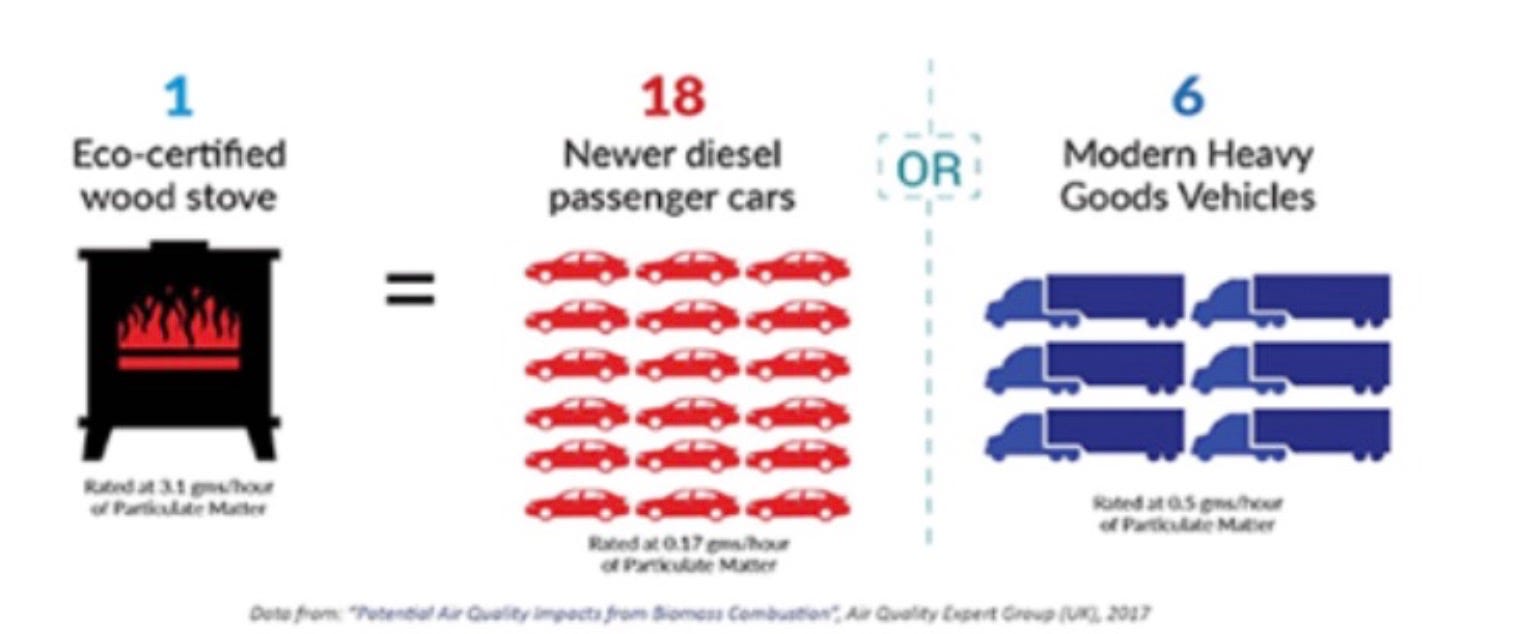
Those figures may understate the issue. Not every stove is DEFRA-approved. Not every household uses kiln-dried wood. Logs are often stored outdoors or in damp conditions; moisture means more smoke, and more smoke means more particulates.
Notes & thoughts
Bridged believes there should be many fewer private cars on our roads on climate grounds and to improve public space and community health. The closure of Hammersmith Bridge proves fewer cars improves air quality.
But transport is not the whole story. Wood-burning stoves are the air-pollution equivalent of passive smoking. On a neighbourhood scale. The effects are involuntary and unevenly shared, borne most heavily by children, older residents and those with existing respiratory conditions.
No household in Barnes in 2026 needs to burn wood. This is a lifestyle choice with public consequences. ‘Good for me, bad for you’
Enough already.
