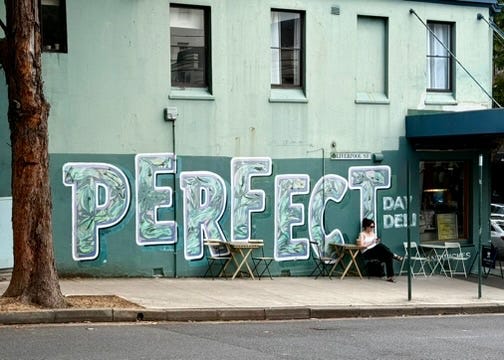
Lessons from a land Down Under
Bridged goes to Australia .. and it feels different. Story 164

Welcome to Bridged2050: ideas for living well in a climate-ready Barnes.
I went for The Ashes: the fifth and final Test in Sydney. Despite the result, it was a fabulous experience
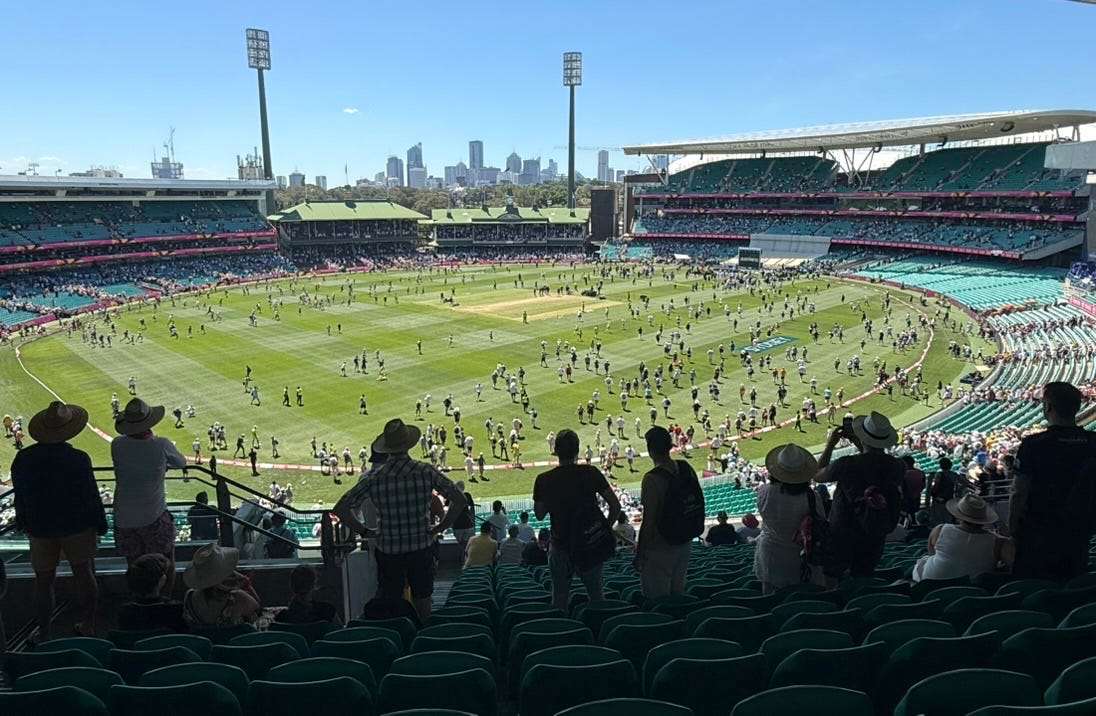
I lived in Australia for nearly two years. I have returned often. This was my first visit since starting Bridged. Familiar places landed differently. An old friend, seen with fresh eyes.
In a moment: Australian ideas worth borrowing - Shared cars, E-[motor]bikes, Shaded pavement, Billboard archive photos, Recycling labels. But first: the grim bits.
Car-first country
Australia’s scale almost demands the car. Distances are vast; settlements thin. Settlements within states can be hours apart, separated by only desert, outback or bush. Within Holden shuttered there are no Australian car manufacturers but ’utes’ are still celebrated. This mindset floods into the cities. Walking Sydney, the dominance becomes tangible.
Two examples.
Pedestrian crossings are strictly policed — what Americans would call jaywalking is an offence. Compliance is high in inner suburbs like Surry Hills and Kings Cross. But the design is unforgiving.
Cars are prioritised. Pedestrians wait a long while, then watch the green flick to amber halfway across. Unintelligent pedestrian crossing. The result is a Central Business District (CBD) that is smaller than the City of London yet slower to cross on foot.
Bikes on pavements
More shocking - literally - was the first time I was nearly knocked over by an e-bike rider.
When walking on the pavement.
Sydney has multiple e-bike providers including Lime, Ario and Hello, but fewer problems with discarded bikes than London.
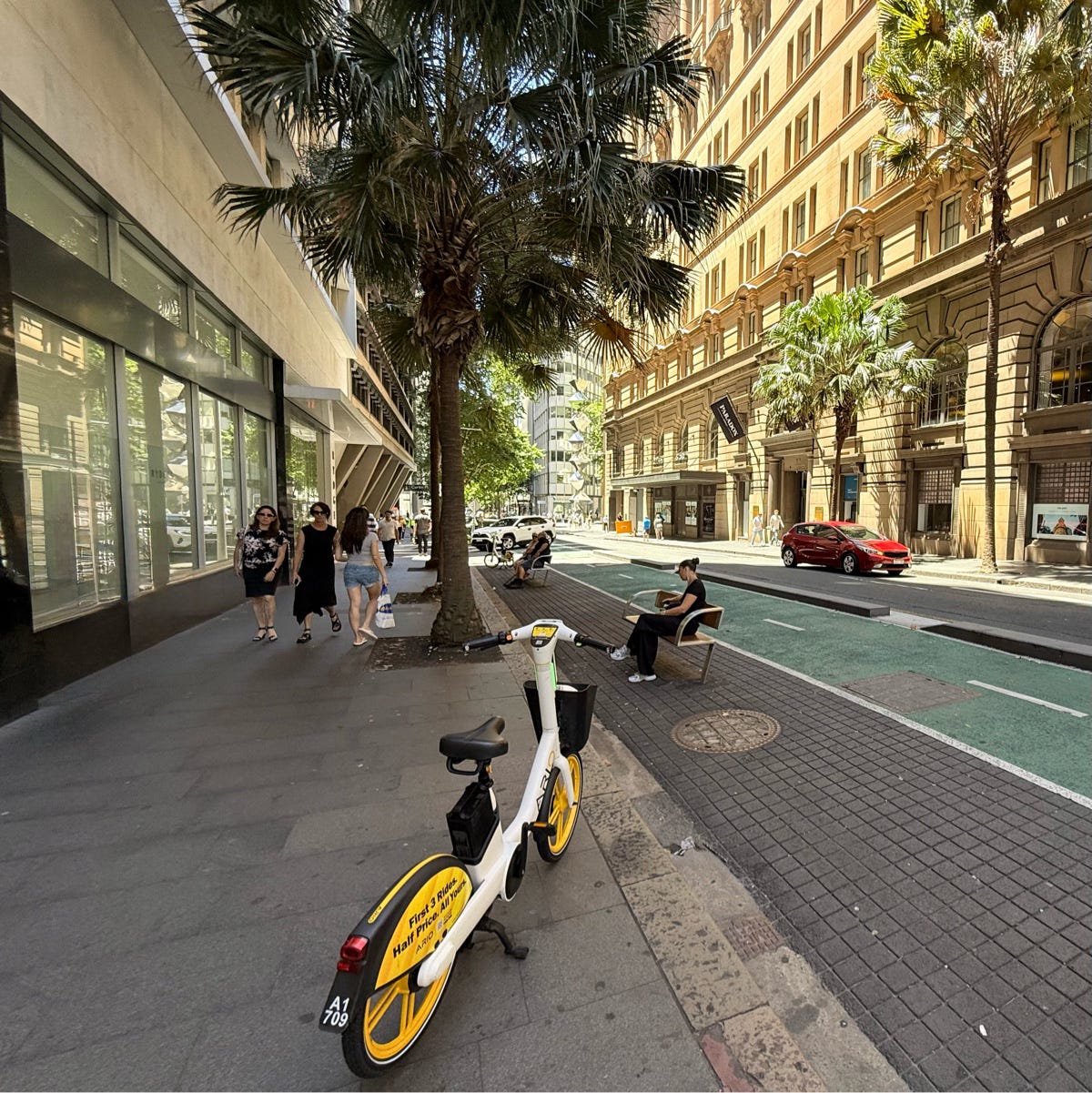
Yet riders consistently explain why they choose pavements: the roads feel unsafe. And anyway, the pavements in Sydney are often suffciently wide. The fact it is illegal other than on designated shared pavements is ignored by most.
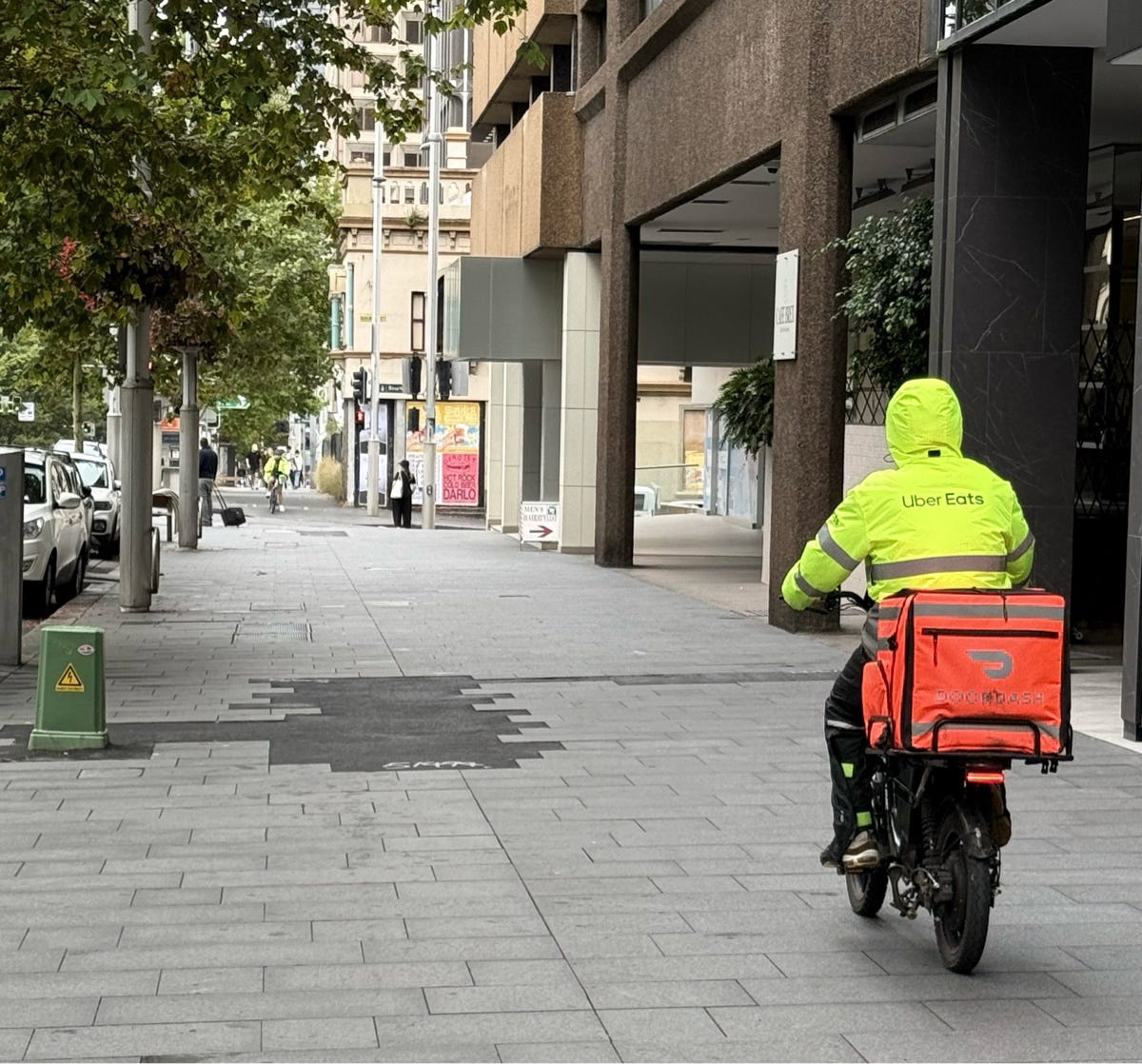
This is a poor photo because I was surpised by the bell-ringing behind. Such a wide pavement why did the Uber rider have to ride towards me? This rider was not making a delivery. I followed him into the distance, on the pavement all the way. If you look to the distance you can see another cyclist heading towards me.
The consequence is predictable. This did not seem like a a city where walking and cycling feel natural, safe, and social. Walking and cycling are set against each other. Neither feels social, relaxed, or quite at home.
Shared cars
These seem much more common than London. On a like-for-like basis, Sydney has roughly three times as many shared cars as London.
Shared cars are either operator-owned similar to what Zipcar used to offer in London or available through a peer to peer service - think ‘Airbnb for cars’ - where Uber Carshare is the dominant player
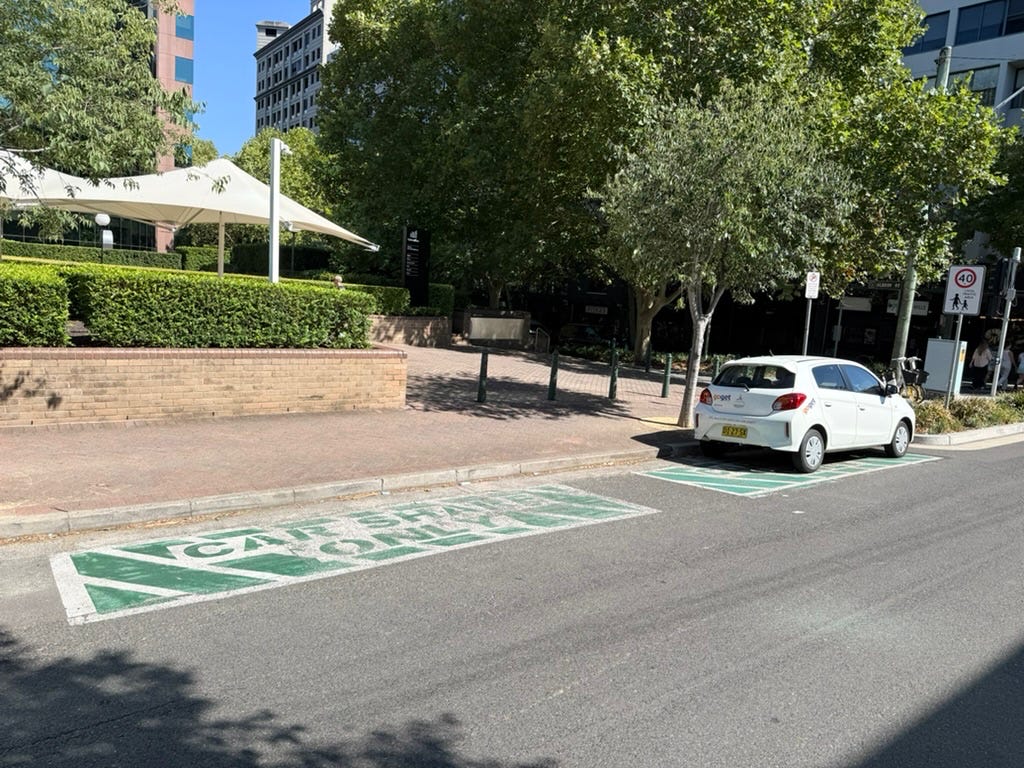
There are three main differences to London:
Kerbside parking is part of the system. Councils treat car share as transport infrastructure: City of Sydney says it’s added more than 800 dedicated on-street car share spaces since 2008
Pricing often mixes time and distance. For example, GoGet explicitly lists a per-kilometre fee for hourly bookings; Flexicar advertises hourly rates plus $/km on some plans
Return-to-bay discipline matters. Aussies call it ‘round-trip’. Councils and operators have rules for what to do if a bay is blocked, etc.
If London is serious about reducing private car dependence, it will need far more shared vehicles, a simplified governance structure and the political will to reallocate kerb space accordingly.
Confusing e-[motor]bike labels
A New Year editorial in the Sydney Morning Herald, under the headline E-bike accidents demand better state regulation, began
The popular rides of our lives have turned out to be the most lethal. Our love of SUVs, so-called tradie trucks and Fatboy e-bikes with top speeds of 60km/h have seen pedestrian deaths spike and young cyclists injured - and some killed - in unprecedented numbers on the roads over the past year.
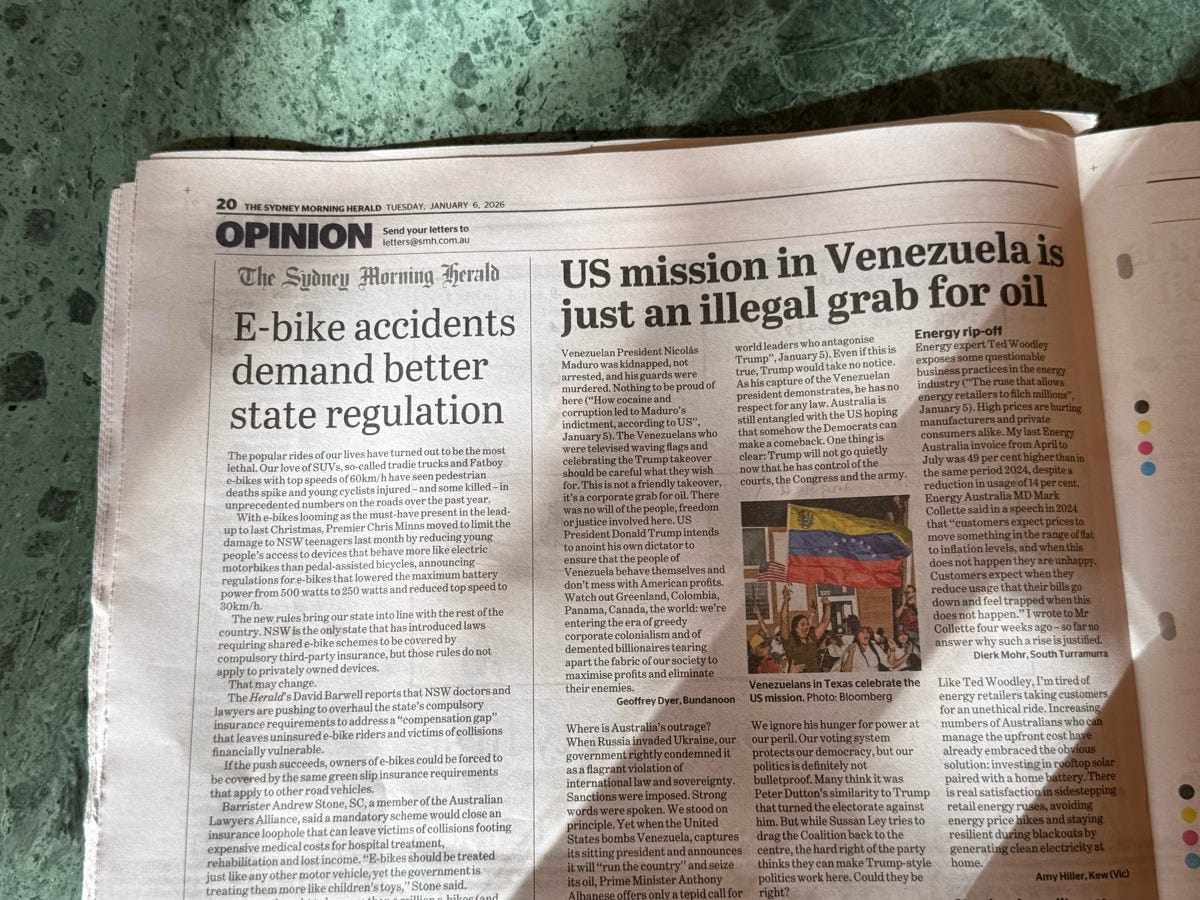
The Herald wants privately owned e-bikes to be ‘covered by compulsory third-party insurance’.
Critically the paper pointed out its target was not pedal-assisted e-bikes but ‘devices that are more like electric motorbikes.’ The Herald like some in the UK, struggled to differentiate, choosing the label them all as e-bikes.
This is unhelpful.
We need to restrict the term e-bikes to those machines, like mine, which are both pedal-assist and speed constrained. The rest are e-motorbikes.
Shaded pavement
While Barnes shivered, Sydney baked. Australia was the hottest place on earth.
Literally.
This was from the final day of the Test Match.
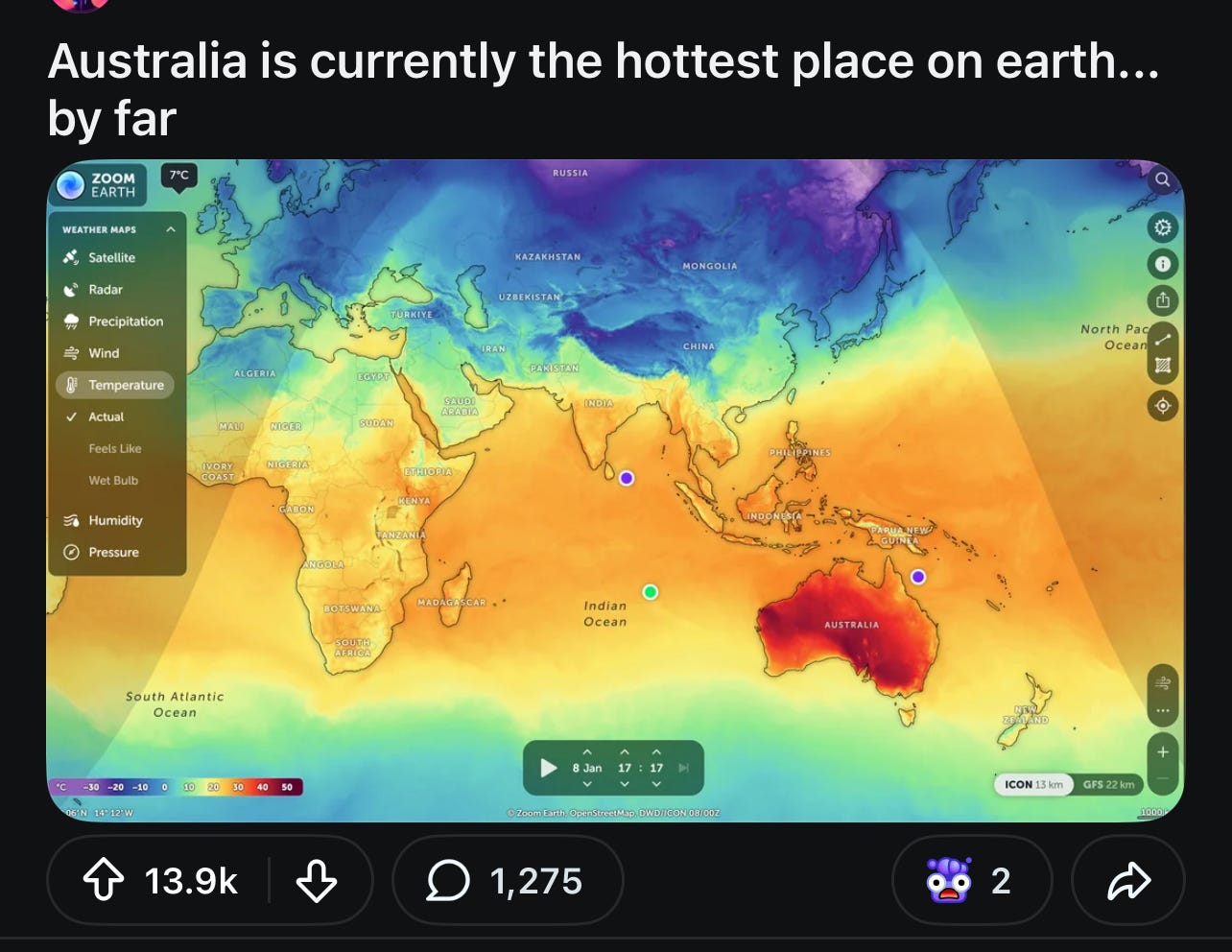
It felt that hot. Two days later and the temperature topped 40º in Sydney.
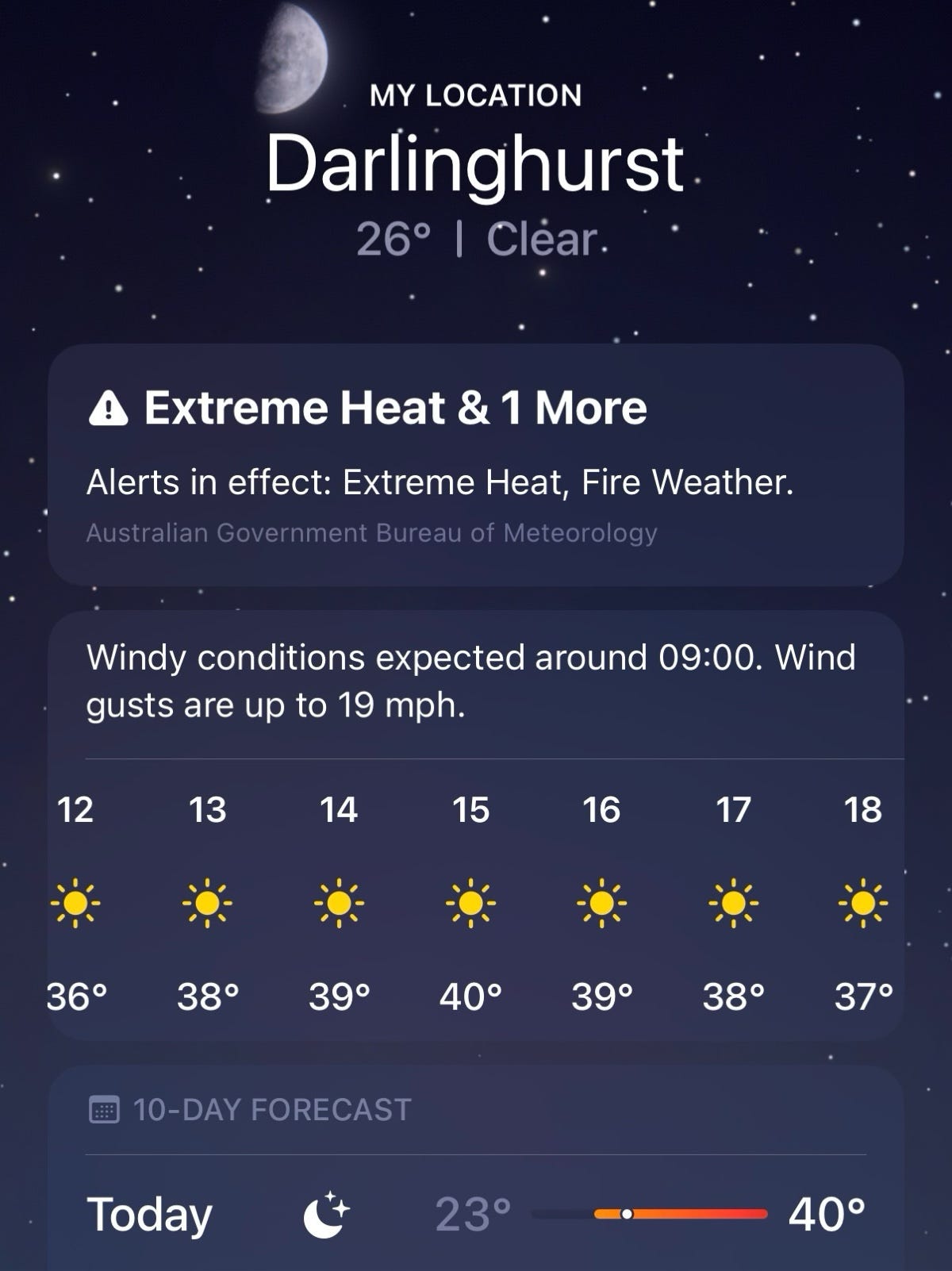
This is increasingly common.
Richmond borough will never be this hot (hopefully) but Met Office forecasts suggest our summers become increasinly hotter because of climate change.
Bridged is concerned ahout heat and water. Water destroys property. Heat kills people. So what can we learn from a city that is practiced in coping with higher temperatures?
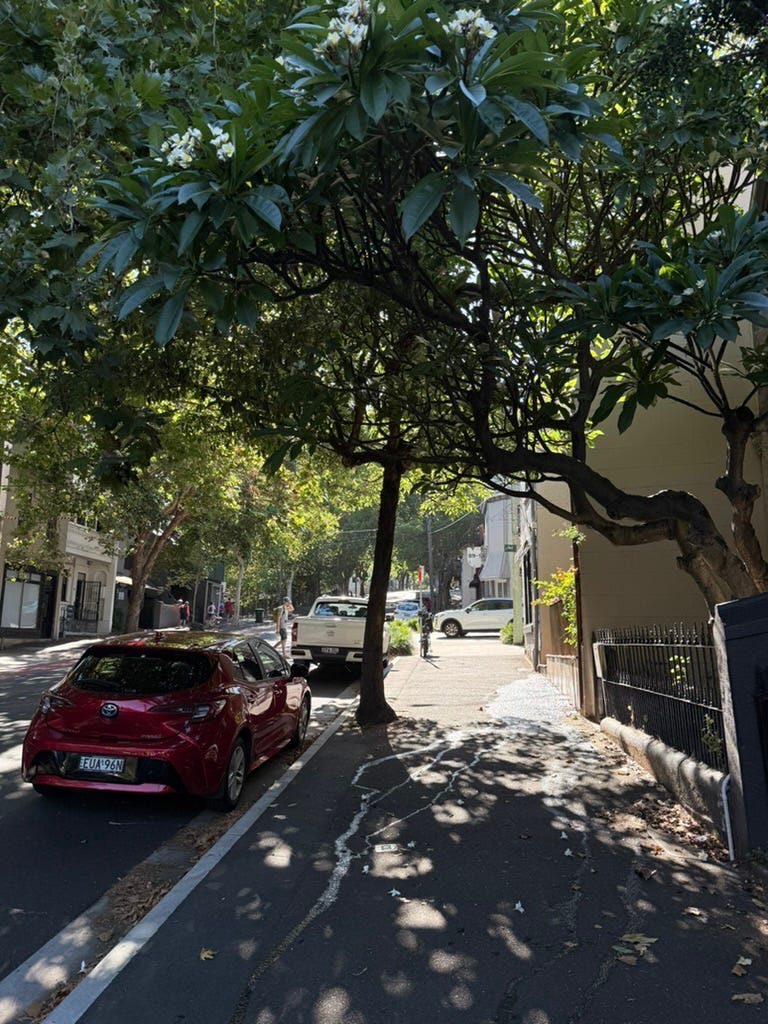
First, there are trees on many streets. This is Albion Street on the walk from hotel to the Sydney Cricket Ground. It is typical of this inner suburb. There was dappled cover nearly all the way up the hill on both sides of the road.
Trees continue on Crown Street, Surry Hills.
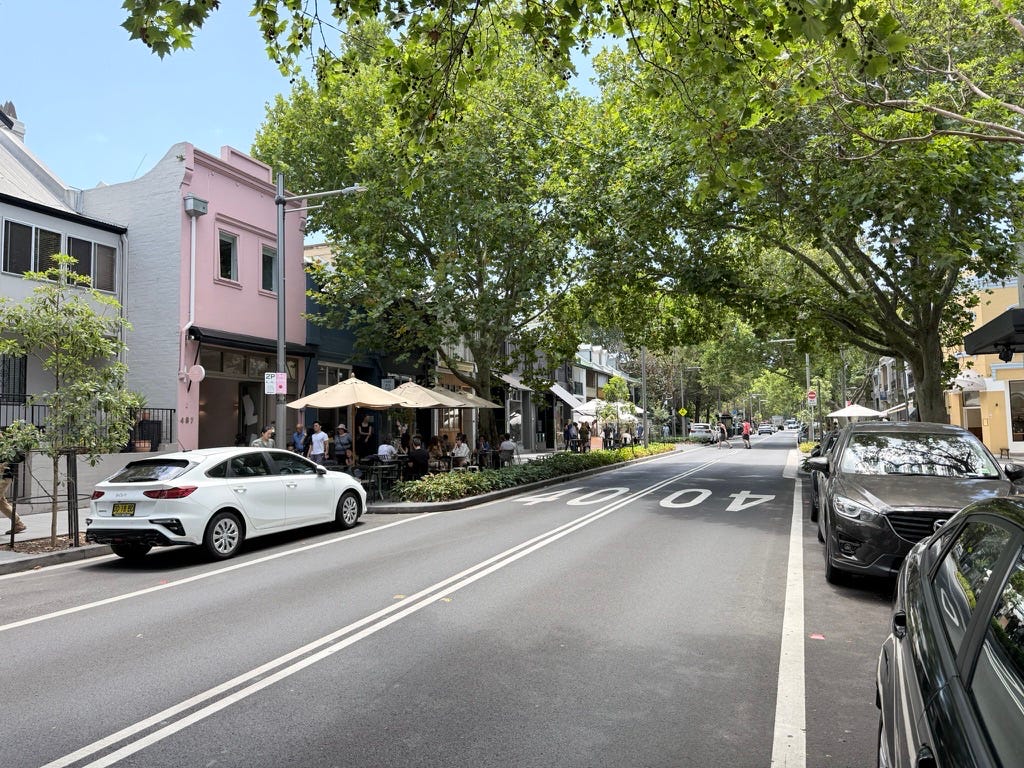
Surry Hills is similar to Barnes. Crown Street is the equivalent of Church Road and the High Street.
Along with trees, Australia boasts many covered pavements.
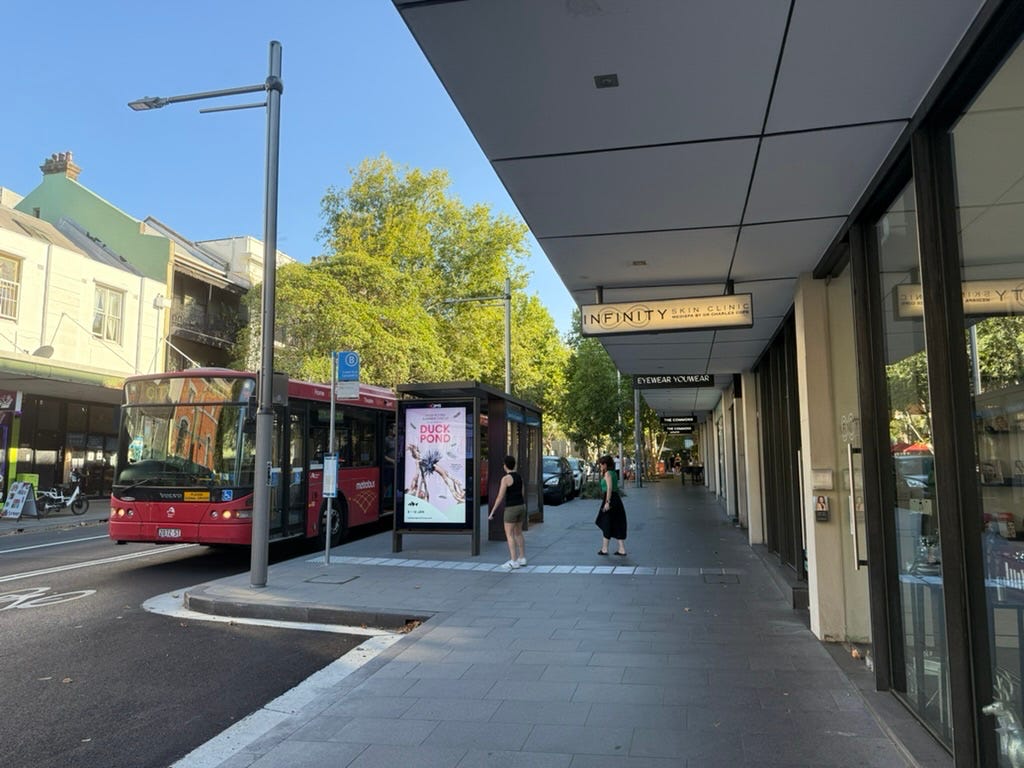
These are found in Australian cities like Melbourne and Adelaide as well as most of the country towns. They provide essential protection from not just the sunshine but the relentlss UV, which is amonst the highest on earth.
This is because
much of Australia sits closer to the equator than Europe.
the atmosphere is thinner and cleaner, so less UV is filtered out.
and the Antarctic ozone hole historically increased UV exposure, particularly in southern Australia.
Summer UV in Sydney regularly reaches 10–14, compared with 5–7 in London. Skin damage arrives in minutes, not half-hours.
We need to start planning for more shade whether natural or manufactured on common pedestrian routes.
Billboard archive photos
Sydney rebuilds constantly. What stands out is how construction sites relate to the streets. These photo billboards were striking and common.
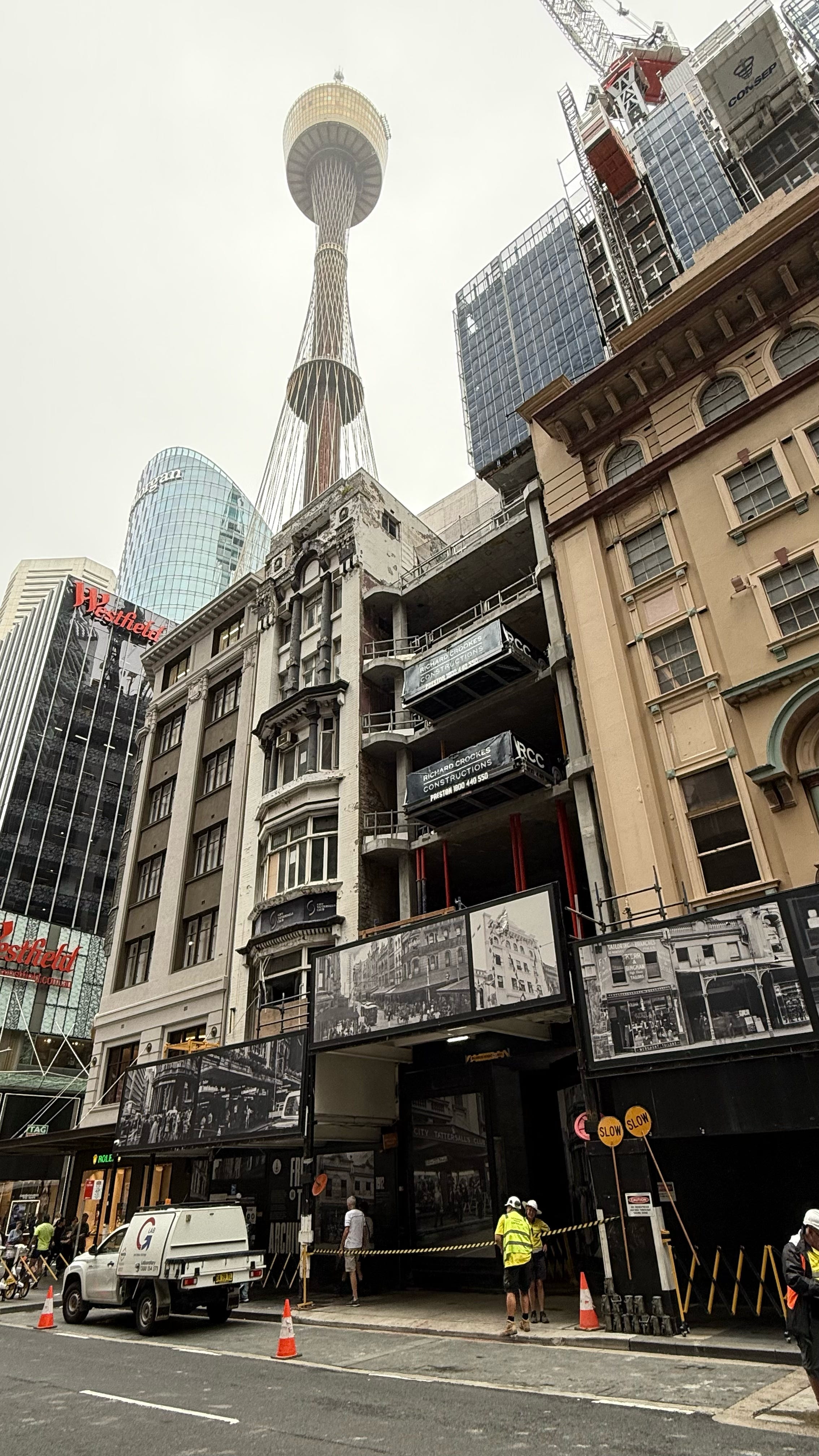
The photo above was taken in the CBD and has the Sydney Tower Eye in the background. The renovation work is protected by these hoardings. The billboards work is because they are formatted: black and white images, against a black background of the area under the development complete with information panels.
The overall affect is to bring a greater harmony to the street environment. They suggest the city is enabling the building rather than the city being slowly disaggregated by a different businesses and organisations.
Recycling labels
This distinction featured throughout the city.
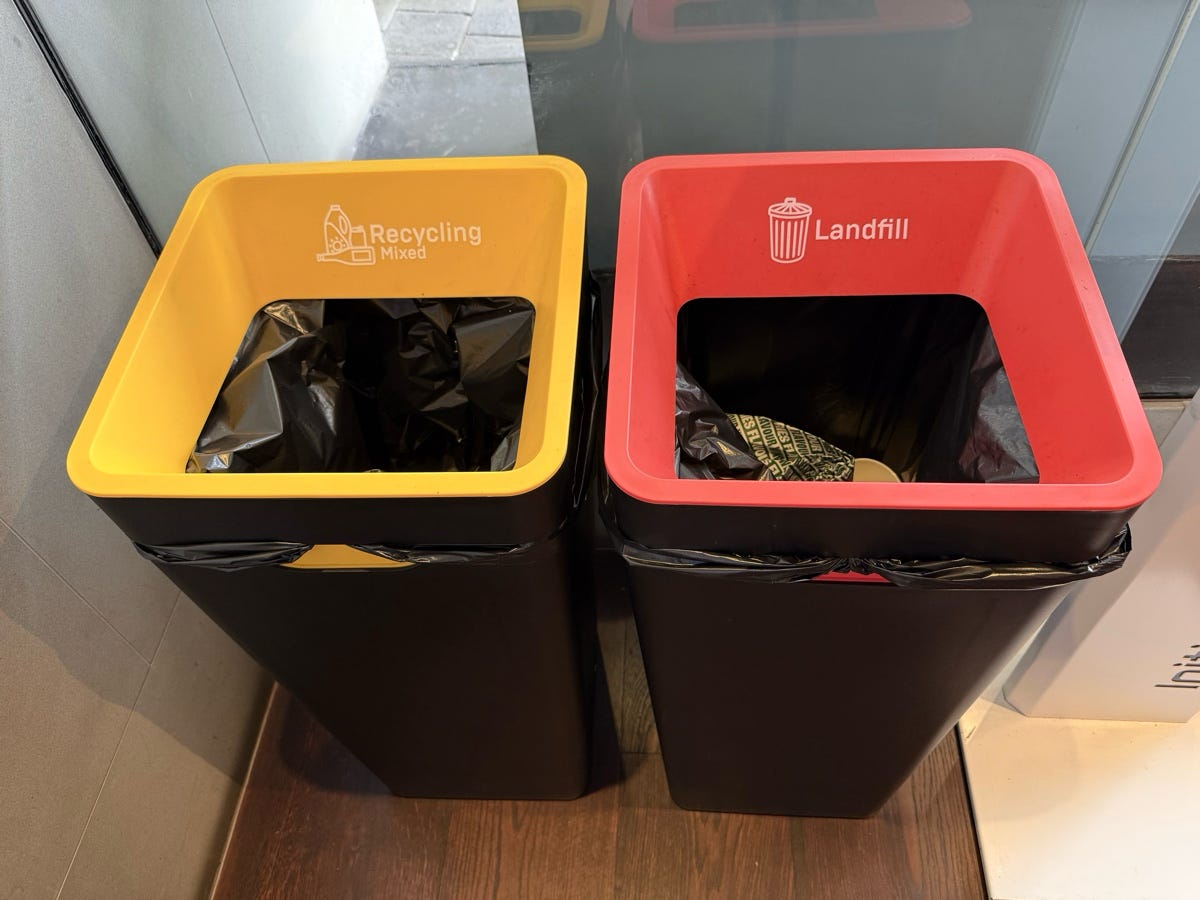
Landfill is a good description. It is as simple as recycling. Likewise, using the colour red emphasises this is the bad option.
A meaningful lesson form Down Under?
They are doing someting right. New South Wales, the state that includes Sydney, reported that about 48% of domestic waste from households was recycled in 2022/23. By comparison only around 32.7% of household London waste was sent for recycling or composting.
New cycling bridge
Well, nearly. Ther new cycling ramp onto the Sydney Harbour Bridge is only 170m long but it it saves cyclist from using 55 stairs. It transforms access.
Notes & thoughts
Sydney surprised me. Or rather my reaction to it surprised me.
I thought I ‘got’ Australia. I have visited the NSW state capital several times. It felt familiar.
And yet, I kept finding myself looking and then looking again.
I realised I was holding two versions of the same city at once. The Sydney I remember from a decade ago: confident, world-class, coherent. And the Sydney I’m seeing now: many of the same ingredients, but with tensions I didn’t notice before.
That is the Bridged effect.
For years I took a whole set of ‘normal’ urban choices for granted — above all, the idea that cars belong at the centre of everything. That cars-as-default mindset decided what I noticed, and what I simply edited out.
Not anymore.
I’m still more curious than qualified. But I’m starting to see the logic — and the consequences — of the way our cities are put together.
And coming back here made the contrast stark.
That is the reaction I want to see in others walking around Barnes: the familiar, suddenly seen afresh. A place where we notice — properly, and without looking away — what helps people live well, move easily, and linger comfortably as the climate changes around us.