💡Boat Race pedestrian pop-up pilot - WIP Proposal
Story 191: Next part of growing Barnes Open Streets network

Welcome to Bridged2050, a place-based futures project exploring how Barnes might thrive in a climate-ready future
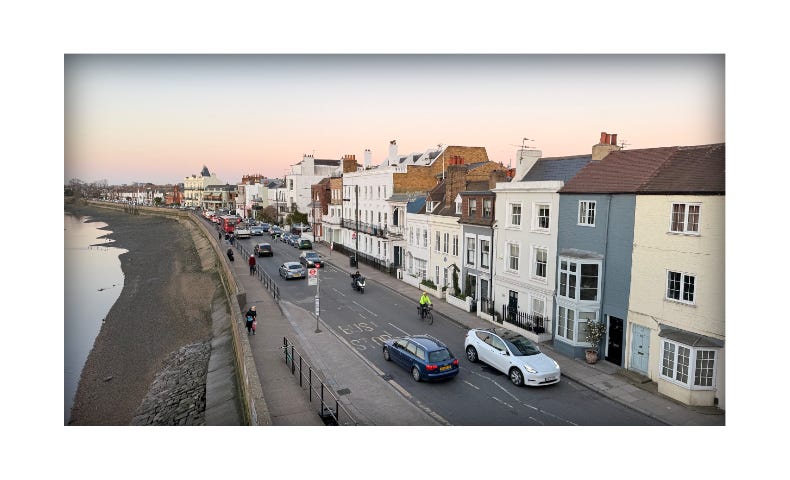
The Terrace should be closed to motor traffic for part of Boat Race day,
Instead of HGVs, cars and buses, there would be space to promenade: to stroll, pause, meet friends, and perhaps stop at a food or drinks stall set up on the road beside the embankment.
Barnes has no shortage of community events — Christmas lights, the children’s literature festival, the duck race. But two stand apart for scale: the Boat Race and Barnes Fair.
Bridged2050 believes both offer an opportunity for pedestrian pop-ups. This article deals with the first.
At the heart of the idea is a simple question: at the right moments, could this road do something more valuable than serve as a traffic corridor?
This would be a pilot: exploratory by design. The point would be to if this feasible in the real world. The logistics, the behaviours, the benefits and the unintended consequences all need to be better understood.
The Barnes Fair version would be different. That would be a trial, because roads around the fair have been closed before. In that case, the basic idea already looks workable; the question becomes how well it works, and at what cost.

This article first sets out the case for the pop-up pilot, then explains how it might work.
The Terrace today
The Terrace is an important part of the Barnes transport network. But it also has the potential to be more than a traffic corridor, particularly one so often used by larger wagons. That is why Bridged2050 has argued for its reclamation for everyone, not only drivers.
This proposal sits within a broader shift in how road space is used. Across London, more space is being sought for people walking, wheeling, cycling and using public transport.
Barnes feels that pressure in a particular way because of its geography. There is little scope to add any more roads or streets on the peninsula. So if the area is to meet changing needs, space has to be used differently.
Roads here have already been closed for special purposes.
Recently Barnes Primary School began a School Street trial.
And the Coronation of King Charles III saw street parties in several parts of the peninsula.
This proposed pedestrian pop-up would build on that history, but apply it to Barnes’s two biggest recurring public events.
Case for change
There’s a compelling case for this pilot. It rests on six ideas:
Pedestrian-first Barnes
Aligns with council strategy
Experiment with purpose, regulearly
Belonging in Barnes
Economic benefits
One Barnes
Pedestrian-first Barnes
Barnes in 2050 should be designed for all people, not only for drivers.
The benefits are multiple. In Pedestrian Pound (2024), Living Streets argues that better walking environments can contribute to happier and healthier people, stronger communities and a more resilient environment.
That broadly fits the direction of both the Mayor of London and Richmond Council: more walking, cycling and public transport, and less dependence on private cars.
A pedestrian-first Barnes means looking again at old habits and inherited assumptions.
It would probably look different from today’s version:
more shade on pavements
more places to sit
more room for pedestrians
easier movement along the routes people actually want to use
And it would show more respect for moments when people choose to gather together.
The Boat Race in spring and Barnes Fair in summer are two of the biggest such moments. They invite a fair question: how might this part of Barnes become more welcoming when so many people - residents and visitors - are already on foot?
Fit with Richmond council’s plans
Richmond council has agreed to a package of of quick, practical upgardes for The Terrace. Their ambition was to make The Terrace
.. more accessible, sustainable, and welcoming public environments.
Similarly after 1,000 residents signed a petition, the council agreed to look into reducing the maximum weight limit for vehicles on The Terrace and the High Street.
The direction is clear enough. Richmond council recognises the importance of this stretch of road and has started to act on it. A pedestrian pop-up would complement those moves.
Experiment with purpose, regularly
Closing The Terrace - even for a few hours out of the 8,760 in any year - would be a significant change.
That is exactly why it should be tested.
A temporary pilot turns an abstract argument into something visible. Residents can judge what actually happens, rather than fear what might.
Discussion matters. Modelling matters. Professional judgement matters. But none of them quite matches the value of seeing how people respond under real conditions.
A pilot would help answer practical questions.
How disruptive would the closure be?
How would visitors use the space?
Would local traders benefit?
What would organisers find difficult?
How much time, cost and stewarding would it require?
How would residents away from The Terrace experience the change?
Those are the right questions. A pilot would not answer them perfectly, but it would answer them better than theory alone.
It would also test a larger civic idea: can a road beside a major event create more value, for a limited time, as public space than as a traffic route?
That is the promise of pop-ups. They can reveal hidden demand for walking, meeting, lingering and informal street life — all the things normal traffic conditions suppress.
They also give public bodies and communities permission to learn quickly, adapt visibly and change course if necessary.
A pilot is not policy. It is a way of finding out whether policy might be worth pursuing.
This proposal fits that logic. It is short-term and modest in scale. The aim is not certainty. It is insight — qualitative and quantitative.
Belonging in Barnes
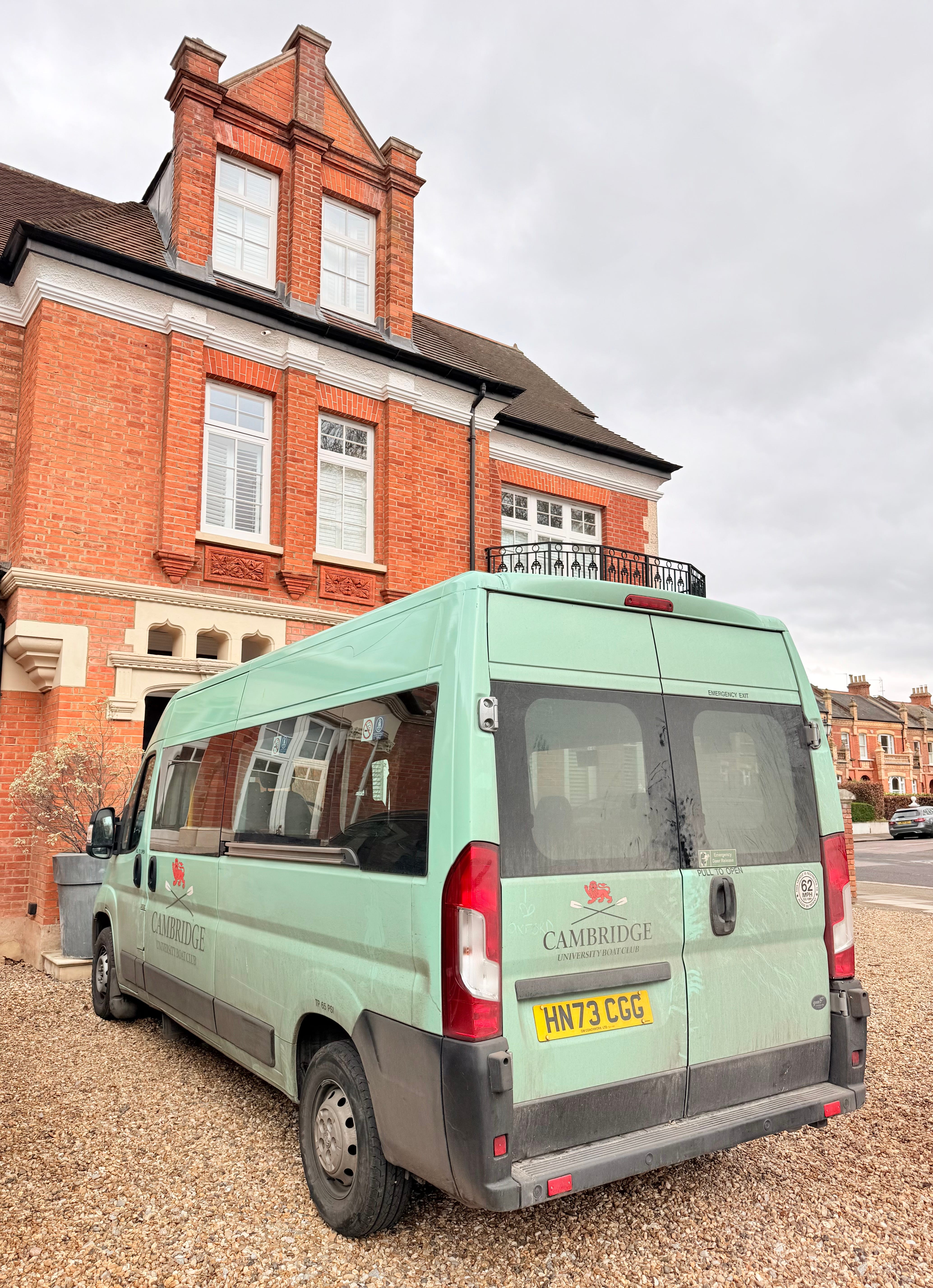
For Barnes residents, The Boat Race is more than dark or light blue. Although, some of the Cambridge teams take up residence in Barnes ahead of the weekend.
It is the thrill of standing among hundreds of other people at a major public event. It is the picnic optimism that sometimes ends with the flotilla wash taking out the blankets and the plastic champagne flutes of first time visitors. It is the cheerful absurdity of it all.
That feeling is familiar to anyone who has ever stood in a crowd at a sporting or cultural event. Individual moments matter. But what lingers is often the shared experience.
Many places would have to invent an event of this scale. Barnes does not. Much of the heavy lifting has already been done. The Boat Race regularly attracts crowds of more than 200,000 along the river.
So the challenge is not promotion. It is hospitality. What could Barnes offer all those people and each other, beyond a glimpse of the crews passing by?
These occasions add a layer of communality to everyday life: bumping into friends on the High Street, swapping stories at the school gates, gossiping on the allotment, then suddenly finding the whole place stitched into a much bigger public moment.
Economic case
One likely beneficiary of a pedestrian pop-up would be local traders. Not only pubs, cafés and restaurants, but other shops too.
The Boat Race itself offers some of the strongest evidence. An Arup study of the 2017 event estimated that it brought 50,000 additional day visitors to London, with a direct net impact on the local economy of £2.1 million to £2.9 million and a wider net benefit of £2.8 million to £3.7 million. The same report found a simple but important pattern: the longer people stayed, the more they spent.
There is supporting evidence from elsewhere too.
The High Streets Task Force argues that footfall is the most important indicator of high-street vitality and viability, because busy places are more likely to attract confidence and investment over time.
In Winchester, festival research found that 32 per cent of food and drink businesses and 35 per cent of accommodation businesses reported some increase in turnover linked to festivals and events.
In Finsbury Park, research on major events estimated just under £3 million of additional expenditure in nearby businesses, most of it in eating and drinking.
And in a more recent London example, the GLA’s 2025 “This is Oxford Street” event reported a 45 per cent uplift in footfall, while 62 per cent of surveyed West End stores said sales were similar to or higher than on a typical Sunday.
That does not prove the same outcome on The Terrace. Oxford Street is not Barnes. But it does suggest that crowd-friendly street activation can translate into trading benefits.
The Pedestrian Pound (2024), published by Living Streets, is focused mainly on high streets. Even so, its wider point is relevant here: places that make it easier and more attractive for people to spend time often perform better socially and economically.
The report distinguishes between the physical hardware of a place — pavements, crossings, seating — and the social software that gives people a reason to come. Events matter because they can drive footfall, support local trade and strengthen social capital.
It provides several examples of creating an ‘experience economy’ by driving driving huge footfall, boost local trade and encouraging repeat visits.
In Bognor Regis, themed markets and live music events have attracted as many as 20,000 visitors. Similarly, the “Wheels of Nairn” classic car rally in Scotland attracts over 10,000 people annually
Events can dramatically increase consumer spending. In Shrewsbury, events and music helped create an experiential high street where sales growth was 25 percentage points higher than in non-pedestrianized areas. In Swansea, monthly markets attract up to 3,000 people, providing a “massive boost” to nearby permanent cafes and shops
Events have a lasting impact on town reputation. Over 80% of people surveyed at a Nairn BID event stated they would return to the town even when no special event was taking place. In Swansea, 77% of visitors said the market gave them a more positive view of the local area.
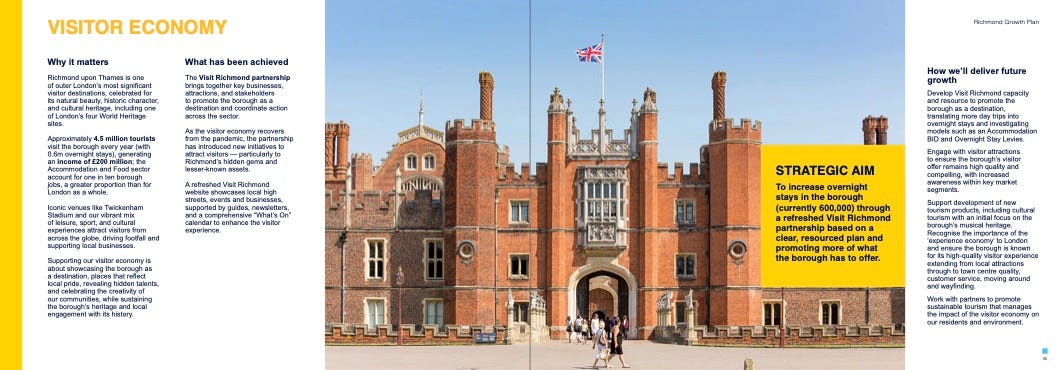
Incidentally, Richmond council has also identified the visitor economy as one of the borough’s growth drivers in its 2026 Growth Plan.
None of this means benefits are automatic. A market linked to a major event is likely to increase footfall, dwell time and local spending only if it sits where people already move and linger.
That is the local case for The Terrace. Visitors arriving by bus, train or bike are likely to pass through the High Street, White Hart Lane or The Terrace itself.
One Barnes
These may be the most challenging two words in this article.
They ask something of everyone in the area. They challenge assumptions about neighbours, habits and needs.
For example, around three in ten households in both Barnes and Mortlake & Barnes Common council ward had no car or van at the last census. They are not car-first.
Of course, ‘One Barnes’ does not mean everyone wants the same thing. Change to the usual pattern of life will bring both expected and unexpected consequences.
That is why the spirit matters. Everyone affected by a pilot like this would need to hold onto the same broad ambition: making Barnes an even better place to live.
That can be hard when a familiar route is closed, a journey takes longer or a crowd blocks the way. But Barnes has been shaped since 1086 by repeated decisions about land, streets and public life. This would be one more such decision, explored rather than imposed.
There is something else here too. Streets that prioritise people offer one increasingly scarce thing: the experience of being somewhere outside with others. Together, in real life.
That matters.
It is one small contribution to a culture that too often narrows our field of vision and weakens trust between strangers.
Detailed proposal
The possible scale of a pedestrian pop-up on The Terrace ranges from small and short to large and long:
The Terrace from the White Hart or Barnes Bridge to the High Street
The Terrace from Small Profits Dock on Lonsdale Road
And the inclusion of the High Street junction with Station road
And the duration could vary too:
Five hours, around the two main races
All day
Bridged2050 believes the first pilot should be small and focussed.
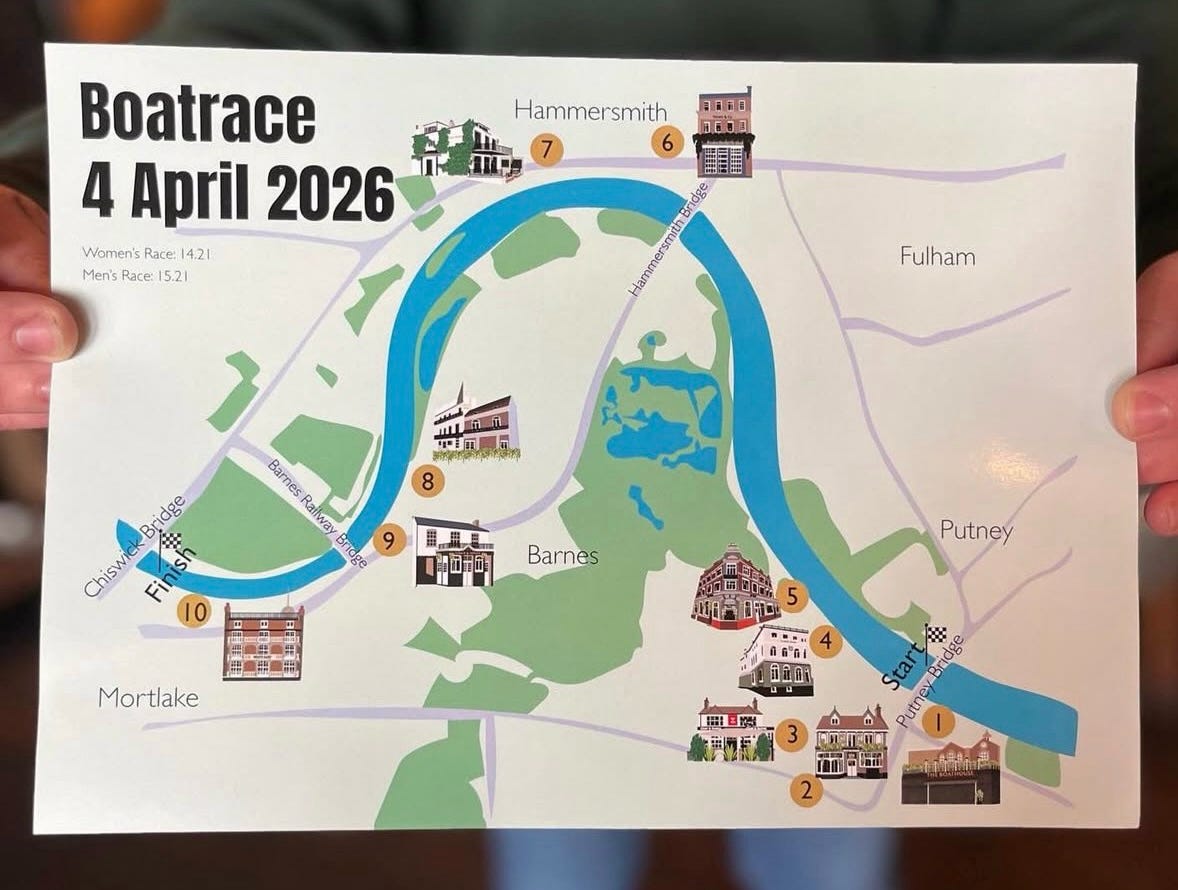
If the pop-up had operated in 2026, it would have covered The Terrace from Barnes Bridge to the High Street roundabout and run from noon until 5pm. The women’s race is scheduled for 14:21 and the men’s for 15:21.
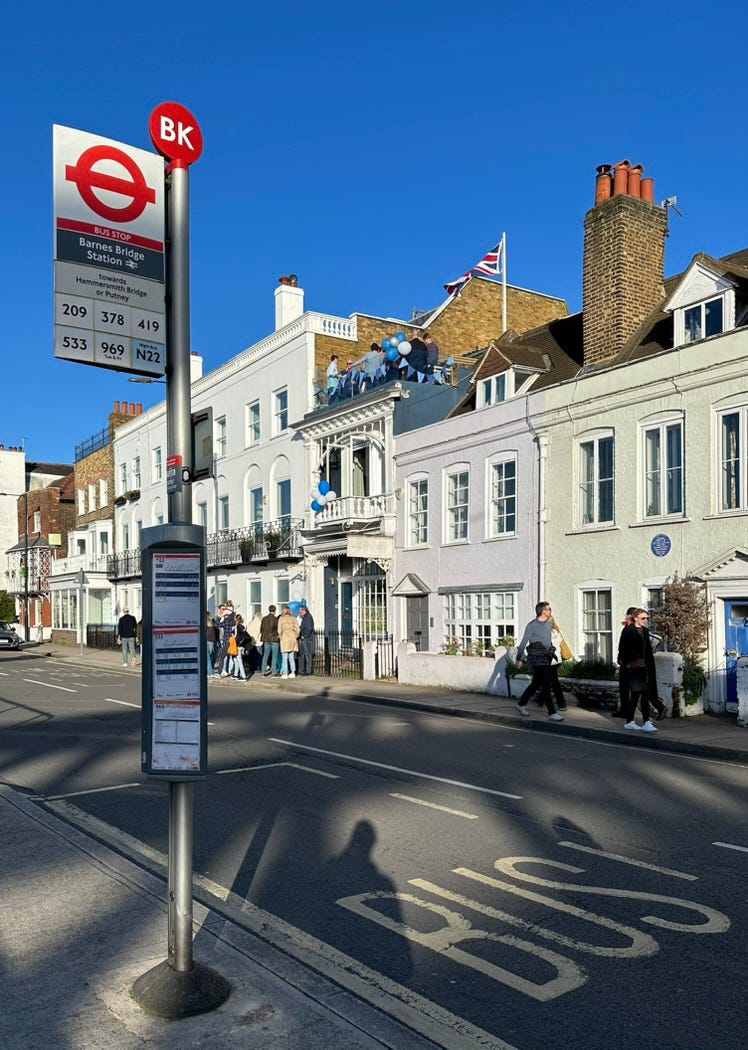
All motor traffic would be excluded during that period, including buses, commercial vehicles and private cars. With The Terrace closed, motor access to the peninsula would be concentrated via Rocks Lane and Station Road. Parts of bus routes would need temporary amendment
How to best use the space
As with the closure itself, the use of the space could be scaled.
Options include:
devoting The Terrace entirely to walking, wheeling and cycling
hosting a Boat Race fair with stalls
mixing movement, trading and viewing space
Maybe Channel 4, now the host broadcaster after decades of BBC association, could establish another anchor point for its coverage. At present, the main outside broadcasts are centred on Hammersmith and the finish.
And yes, at the risk of leaning into stereotype, a neat row of prosecco and champagne stalls might not be the worst way to celebrate race day on this stretch of road. Some houses on The Terrace are already halfway there.
Essential research
The point of the closure would be to discover whether it is feasible to close such an important road, and on what terms.
That means research before, during and after.
Useful data would include:
footfall
traffic displacement
air quality
dwell time
public sentiment
business impact
It is important to say this plainly: the pilot might show that the idea does not work.
That would still be useful. Failure, clearly measured, is better than assumption.
If the pilot did work, it could then be upgraded to a fuller trial the following year. At that stage, the benefits and mitigations would need to be much more clearly defined.
Practical considerations
This proposal can only sketch the outline of how a pilot might work. A real scheme would require much more detailed work: barriers, planting, signage, stewarding, legal orders, diversion routes and communications.
There would also be many people to consult.
Richmond council, as highway authority, would need to decide the conditions of any closure and re-opening. It may be, for example, that one-way arrangements before or after the key hours would make access easier and crowd dispersal safer.
Local traders should be asked what kind of presence they would want.
Special attention would also have to be paid to e-bike parking. When restrictions lift at 5pm, the aim should not be to create a vast dockless bike park on The Terrace. This could be a useful test of geo-fencing and parking controls.
Residents likely to be adversely affected would need a proper route into the process. Work on Terrace proposals through the Barnes Community Association travel group has already shown that there are organised and thoughtful residents in the Mansion House blocks south of Barnes Bridge. There are likely to be similar voices elsewhere nearby.
More broadly, this proposal needs to stay honest about who might lose out.
The Twickenham & Richmond Tribune, writing recently about a possible Richmond festival, made the point well:
For residents with flexible schedules, for homeowners whose relationship to the high street is recreational rather than transactional, (such a) transformation can feel like enrichment.
For shift workers reliant on predictable bus routes, for carers navigating crowded pavements, for independent traders beyond the immediate footprint whose margins depend on access rather than ambience, the calculus is different.
A street recast as a playground may be welcoming in principle yet excluding in practice.
That is precisely why this idea should be piloted first.
Through all of this, it is important to remember the prize.
A Boat Race pedestrian pop-up pilot would sit alongside the Barnes Primary School Streets Trial and the pedestrian and cycle access on Hammersmith Bridge as part of growing network of people-first spaces: Barnes Open Streets.
One of Barnes’s most important roads, on one of its biggest days, is exactly the right moment to test a different idea of the future. A people-first view of the future. Not in theory, but in public, in real time, with the whole village able to judge the result for itself.