
Better Barnes buses, please TfL
Story 155

Welcome to Bridged2050: ideas for living well in a climate-ready Barnes.
Transport for London (TfL) recently consulted on changes to Barnes bus services. I submitted comments at the time, then promptly disappeared into my October break. Consider this the delayed public version.
TfL proposals
The bus proposals affect the main services in Barnes,
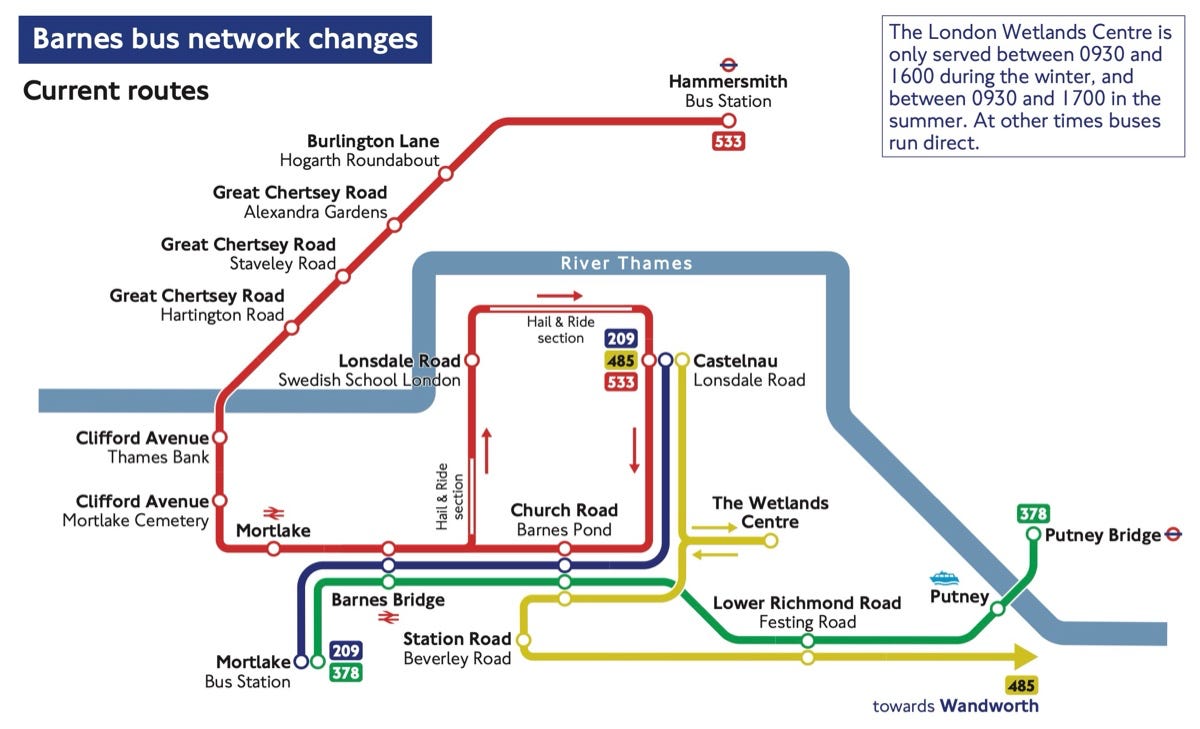
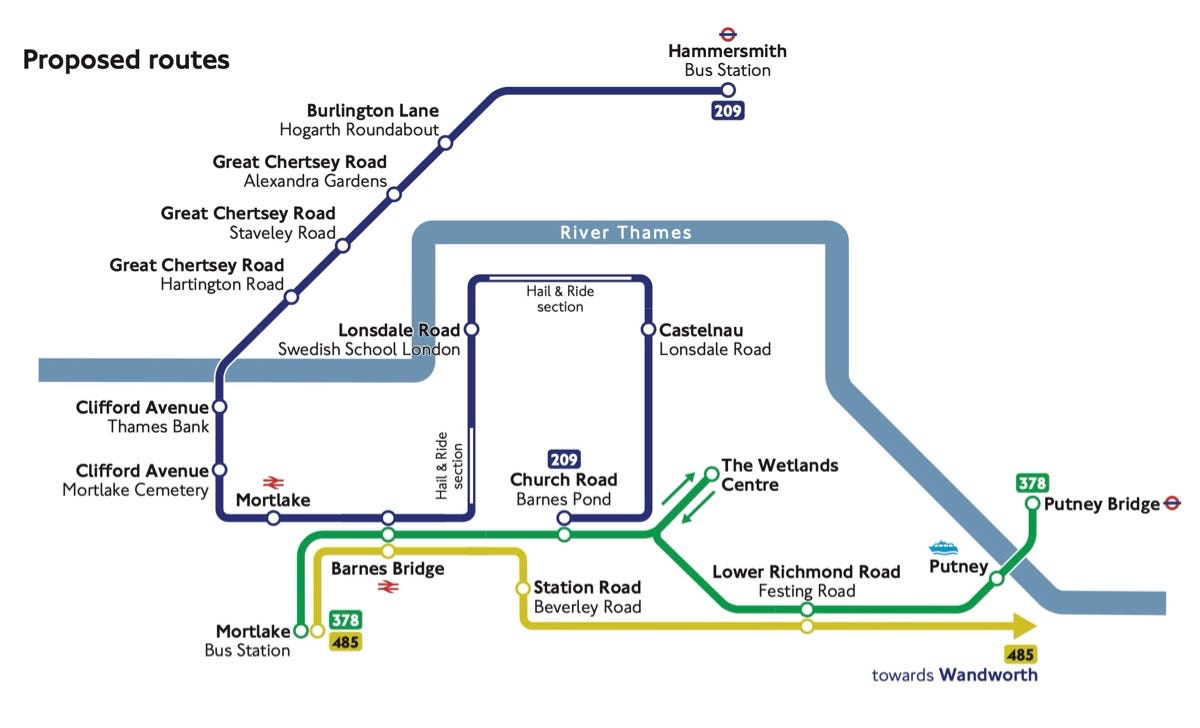
We are proposing changes to route 209, 378 and 485, and to no longer run route 533, which was introduced as a temporary measure following the dosure of Hammersmith Bridge to vehicles in 2019.
We are proposing to maintain direct bus links between Hammersmith and Castenau by extending route 209 to cover the majority of the 533 route.
In addition, we are proposing some changes to routes 378 and 485.
We are not proposing changes to any other bus routes in the area as part of this consultation.
TfL provided before and after illustrations.
Theses are the proposed new routes.
There’s a longer description of the changes from Barnes Community Association (BCA).
Notes & thoughts
I’m an occasional bus rider. Most weeks my transport hierarchy is bike first, train second, bus third — and I use buses as often outside Barnes as on the peninsula.
That might explain why I was so surprised to learn over 1,000,000 trips were made on the 533 route in 2023/24.
That’s not a rounding error. That’s a signal.
Another topic to add to my list of things to start covering in more depth in 2026k joining housing and the green environment.
My bus principles and assessment
When I looked at these proposed bus changes, I keep coming back to four tests:
Evolving - routes should change as rider demand shifts
Simplicity - working out what route to take should not feel like a tough quiz
Integrated - buses should connect with trains, other buses and key pedestrian routes
Availability - seats should meet rider demand
My assessment of the TfL proposal:
Good to see them changing the service again. TfL might not change things as often as they should, but the services do evolve and after consultation. This is the latest in a series of changes since Hammersmith Bridge closed in 2019. The other emergency services did the same. As a result, according to Nick Maini, the London Ambulance Service said, they have ‘never released any information about the closure impacting response times’. And The London Fire Brigade data shows no increase in 999 response times in Barnes.
The new routes are simpler. Looking at the new map you see fewer, more logical routes. Some need to be extended but broadly they are correct.
Integration is not as elegant. TfL’s proposed 209 turning point at/near Essex House is a poor fit with the reality on the ground: busy roads, heavy footfall, GP hub, the Farmers’ Market, and a key pedestrian desire line. Barnes doesn’t need buses manoeuvring across a walking pinch-point. It needs safer crossings and calmer movement. Bridged’s view remains: we should be designing a pedestrian crossing here, not adding turning movements.
It is hard to judge whether the new distribution of seats versus demand is better. At first glance, the overall pattern looks like a reduction in service. Maybe that’s justified; maybe it isn’t. But if TfL expects trust, it needs to show the working: riders vs buses vs seats and by time bands
BCA Travel Barnes opinion
I contributed this to the BCA Travel Barnes discussion. Others - more insightful on buses in barnes - added other points. Eventually the group identified these key issues:
There remains an urgent need for a direct public transport link from Putney BridgeTube Station across Putney Bridge to Barnes—this is not addressed in current proposals. The 378 bus should be allowed to drop off and pick up directly outside Putney Bridge Tube Station, improving east–west connectivity and safety.
The proposed reduction of buses using the Howsman Loop from 11 to 7 per hour (5 a.m.–1 a.m.) is insufficient.
The proposed 209 turning point outside Essex House (main GP hub and farmers market) is considered unsafe for pedestrians, especially at a busy crossing already under review by Richmond Council.
The overall reduction in bus services to Barnes is not ideal, given ongoing disruption from the Hammersmith Bridge closure and people needed to travel be connected.
Frequency of the 209 between Barnes and Hammersmith should be increased, not reduced, compared to current levels, with reliability improved by the provision of bus lanes in Hammersmith and Mortlake.
This is the full BCA response to Transport for London.
TfL are due to respond early in the New Year.