
Barnes: bringing you the future since 925AD
Story 196

A selection of stories from the week’s news that offer a glimpse of the future.
Transport - AVs means Way mo’ cars
The headline is from StreetblogNYC and is borrowed because it makes the point in six words.
Bridged2050 likes brevity.
It felt pertinent this week. Waymo, part of the Alphabet group alongside Google, said it is moving to fully automated driving on London’s streets. Until now, a human has been doing the driving while the company’s sensor-laden cars learned the city and gathered data. In this next phase, the human remains in the vehicle, but in a supervisory role while the car does the driving, London Centric reported.
Waymo has 100 cars in test mode on London’s roads and is still on track to launch its self-driving taxi service on the capital’s streets by the end of this year.
That is one version of the story: the technology improving, the supervision receding, the future edging closer. StreetsblogNYC points to another. It quotes an Uber corporate presentation,
Between Uber and its competitor Lyft, there are around 80,000 licensed app-based taxis currently in New York City. It’s clear from Uber’s investor materials that the company sees autonomous taxis entering the market as a chance to expand its footprint.
In other words, Waymo means way mo’ cars.
Uber points to its experience in Austin TX and Atlanta GE. According to the company, adding Waymo to a city where Uber already operated did not replace existing Uber trips. It increased them. In San Francisco CA, meanwhile, authorities have begun responding to the growth in autonomous vehicles on the streets.

Why it matters
The claim that AVs could prove safer than human drivers remains one of the central arguments for the technology. That case was set out by McKinsey in 2019. A later piece from the Brookings Institution shows how that debate has matured, and how much uncertainty remains.
What looks increasingly plausible, however, is that the awkward phase may be the one in which these vehicles arrive not instead of existing traffic, but in addition to it. Whether that congestion would be temporary or long-lasting is not yet clear. The technology is still too immature, even in the United States, to settle that question.
In Barnes, where Ubers are a familiar sight, the prospect is not of fewer vehicles but of another layer of them.
Welcome to Bridged2050 is a place-based futures project asking, how do we make sure Barnes, the place and its people, are thriving and climate-ready by 2050?
Transport - Walking and cycling should be friends
One of the more tiresome habits of transport debate is to pretend that pedestrians and cyclists are natural enemies. They are not.
Tensions between pedestrians and cyclists are not inherent to walking and cycling, but the product of street design.
BikeIsBest neatly summarises a new report, Cycling and the Relationship Wth Pedestrians. It argument is simple:
With the bulk of streetspace allocated to motor vehicles, everyone else is forced to share the remaining space, often on pavements.
The report’s answer is equally simple. Treat walking and cycling as
.. proper transport, and not anm afterthought. And keep pavements for pavements, ideally.
Why it matters
This is real.
The tension surfaces in coffee-shop conversation and pops up in WhatsApp groups too.
The harder question is what to do about it on roads in an area like Barnes where space is genuinely tight. On somewhere like The Terrace, meaningful change might require a wider rethink of the local traffic system. A one-way arrangement, perhaps. Now there is a thought.
Landscape - What we can learn from the end of market gardening
Mike Hildesley enteritained a typically large History Sociey audience at St Mary’s with his talk on market gardening and Barnes.
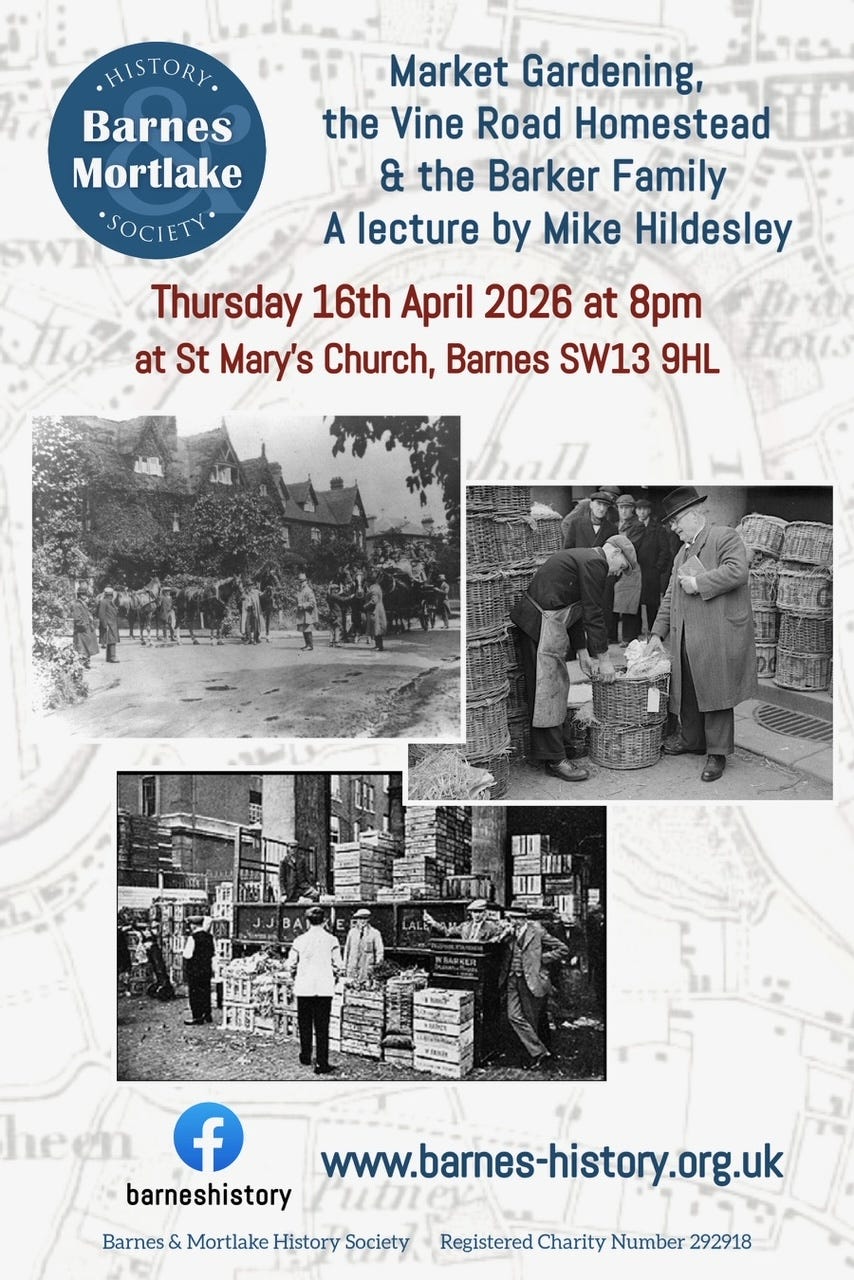
Why it matters
The deeper point was not nostalgic. Barnes has changed repeatedly, sometimes slowly, sometimes abruptly. Opposition to change can feel permanent when you are in the middle of it. But more than 1,100 years of local history tell a different story.
Take one example shared by Mike. The arrival of the railway in 1846 helped upend market gardening. A way of life that had endured for centuries was reshaped by a single intervention. That is a useful thought to hold in mind when today’s arguments start sounding as if the latest arrangement must be the natural and final one.
Also this week
UK government’s Structures Fund is open for bids. It part of a record £1 billion total package to enhance England’s roads. It may yet provide one possible route to restoring vehicles to Hammersmith Bridge.
The average price of a new electric car in the UK is now lower than that of a new petrol car, The Guardian reports
London’s e-bakes anti-social parking is a policy failure not a market failure, say s CAPX. ‘This is a market missing its most basic ingredient: clear rules.’
According to The Telegraph, Richmond borough is one of the UK’s closest things to a ‘Blue Zone’ – places where people regularly reach 100.
Bridged2050 will never tire of watching, hearing and reading others saying, Barnes is brilliant.
