
Richmond council progress on sustainable travel stalling?
But the borough continue to lead the outer borough’s performance - story 135

Since the Mayor’s Transport Strategy was published in 2018, Transport for London (TfL) has been tracking progress. Each year’s assessment since has the same refrain: the city is falling short of its top goal — reducing car use.
Another lens on the same problem is the Healthy Streets Scorecard (HSS), an annual audit compiled by a coalition of transport, health, road safety and environmental groups. Also published since 2019, the scorecard blends TfL and other official data with campaigners’ own research, creating a borough-by-borough map of London’s struggle to shift travel behaviour.
The methodology differs from TfL’s but the challenge is the same: how to make London more liveable.
Assessing the boroughs’ performance
The HSS report is focussed on the 32 London boroughs and the City of London, that run 90% of the city’s roads. To do this they assess ten key indicators.
Six are inputs directly under borough control:
There are also four outcome indicators:
London’s scorecard
Each borough is scored out of ten. The higher the number, the lighter the colour on the London map.

The overall results this year:
Overall Winner - City of London
Best inner borough - Islington
Outer borough - Waltham
Most improved - Newham
Richmond: steady, not surging
Richmond’s dedicated scorecard page puts the borough at 17th out of 33 city-wide, and 4th among Outer London boroughs.
Its overall score dipped slightly to 4.45, down from 4.57 in 2024. That may sound marginal, but the message is clear: progress has plateaued.
Richmond remains one of the stronger Outer London performers … That said, its overall Healthy Streets score has decreased slightly, suggesting headline performance has stalled.
There is a lot of movement in the borough ‘league table’
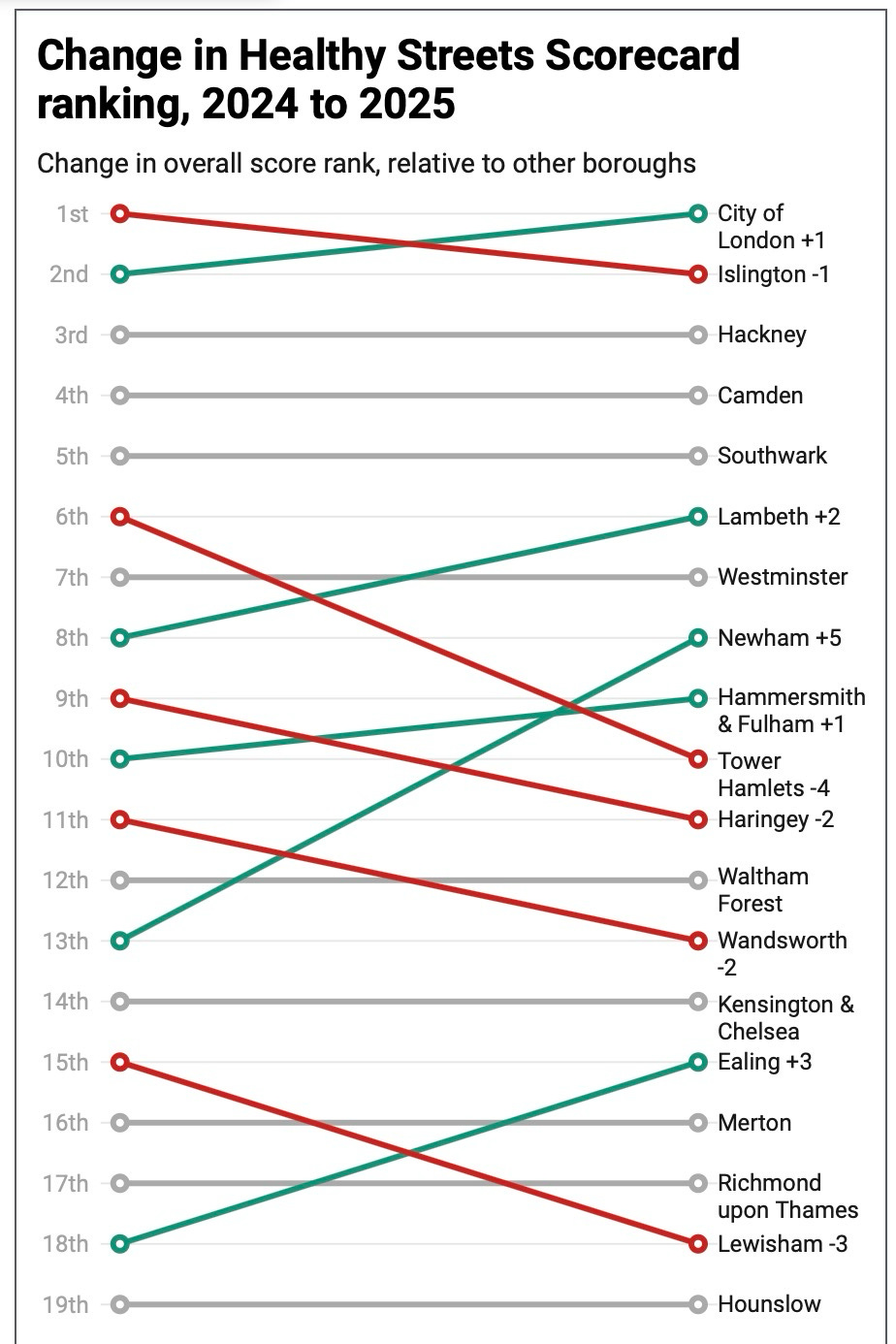
There are some details on the Richmond score which are worth noting:
Sustainable modeshare fell, driven by more car trips.
Richmond was a key contributor to the growth of School Streets, being one of seven councils that delivered 70% of the more than 100 new schemes across London..
Walking and cycling both rose. Richmond is one of 13 boroughs to post a 1-point increase in weekly adult cycling, and now records the highest cycling rates of any Outer London borough — ahead of several inner ones.
This is despite just 2% of road length being covered by protected cycle lanes.
HSS summarise their view of Richmond as,
Richmond (council) should match its residents’ demand for cycling with protected cycle tracks, accelerate LTNs, and push CPZ coverage past 50 %.
Extending Bus priority corridors and revitalising an ambitious Travel for Life programme will reinforce non‑car travel, helping the borough press for a top‑three Outer‑London ranking.
Notes & thoughts
Outer and inner profiles
There is a sense with both these results and the TfL assessment of the Mayor’s Transport Strategy, that the impact of the Covid are still working through. By 2026 the longer-term trend will be clearer.
There is a sense that the most western part of the borough - Barnes - feels like an inner borough. Meanwhile, the most eastern section - Hampton - feels like an outer borough. This is particularly true with transport provision. It would good to see if more granular data could be found to validate this. Until then, we have to live with averages.
Controlled parking zones
This is the first time this topic featured on this blog. HSS assess the area of Controlled Parking Zones (CPZs) as a proportion of the total area appropriate for CPZs. In the case of Richmond borough, allowing for the likes of the Thames and Richmond Park that amounts to 45% of available land, below the London average is 49%.
HSS treat CPZs as one of the core levers for reducing car dominance in London neighbourhoods.
They aren’t the headline metric in the way modal share or road safety are, but they sit in the set of “enabling policies” that councils can act on quickly.
CPZs are a way of reclaiming scarce public space - kerbs. Streets shouldn’t be used as free long-term car parks when that space could be supporting walking, cycling, greenery, or safe crossings. Similarly CPZs can discourage multiple-car households, long-distance commuters parking in residential streets, and unnecessary car ownership.
CPZs are a divisive topic. For example, Mortlake with East Sheen Society (MESS) no longer comments on the topic,
.. ever since it undertook a questionnaire survey of its membership to determine whether they were in favour of the Council’s proposed blanket CPZ for Parkside (the area between the Upper Richmond Road and Richmond Park) in 2019 and the result was 50/50.
There will be more on this topic.