
It starts with a flick
Story 186: And ten years later, we’re still living with the consequences

Welcome to Bridged2050: ideas for living well and responsibly in a climate-ready Barnes
I have noticed a change in the litter I collect in my patch.
For years the gutters were full of cigaratte butts. Then for nearly two years, vape cartrdiges seemed to take over. Now, the cigarette butts are back.
The labels ‘butt’, ‘end’ and ‘stub’ are all used, though ‘butt’ is the common term in much environmental writing.
There are so many of them and they are fiddly to collect. Out litter-picking this week, I realised I could no longer properly remember why they were so bad.
The answer, it turns out, is bleak. This tiny pellet of litter leaves a toxic legacy long after the cigarette has gone out.
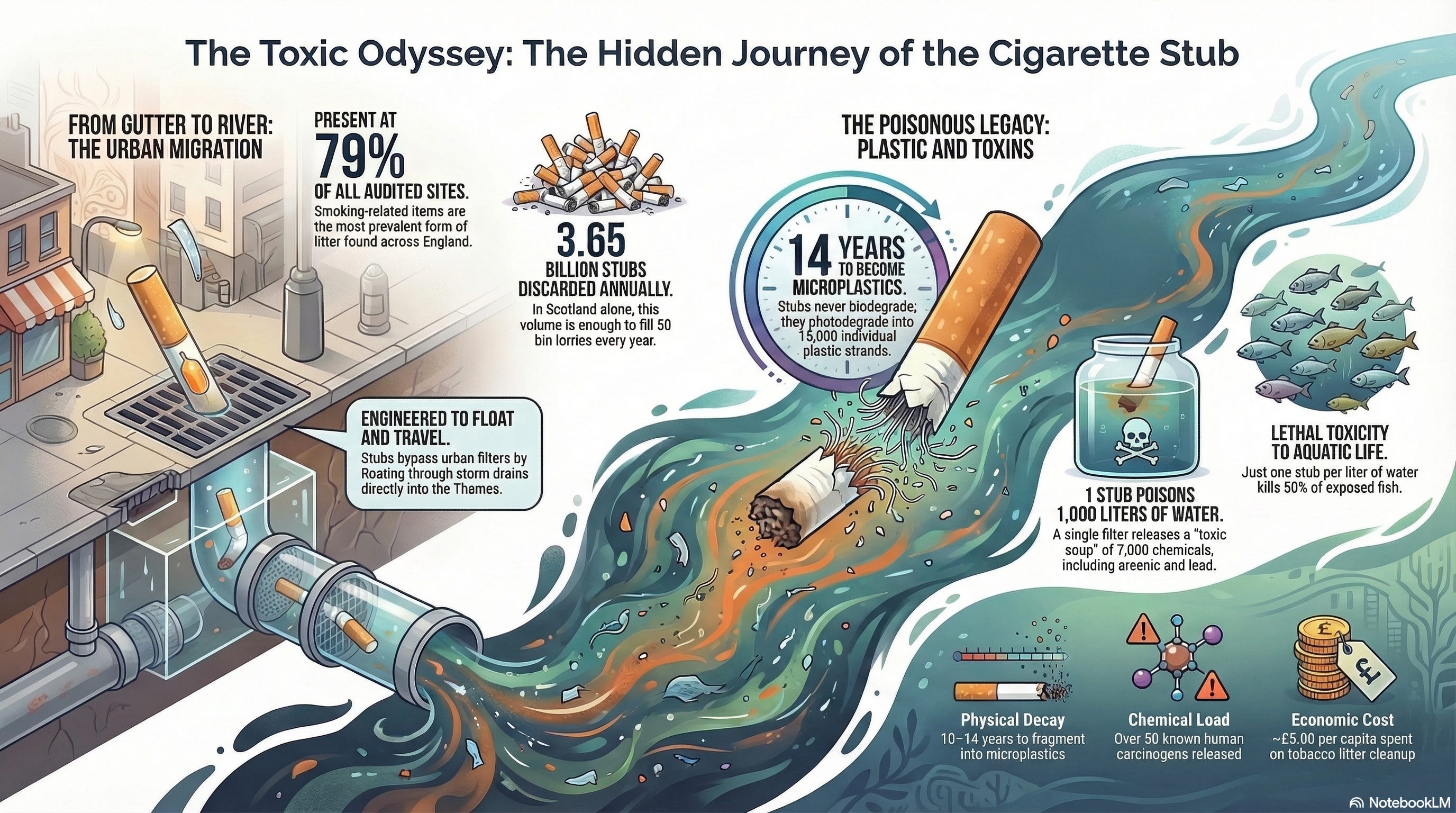
Notes & Thoughts
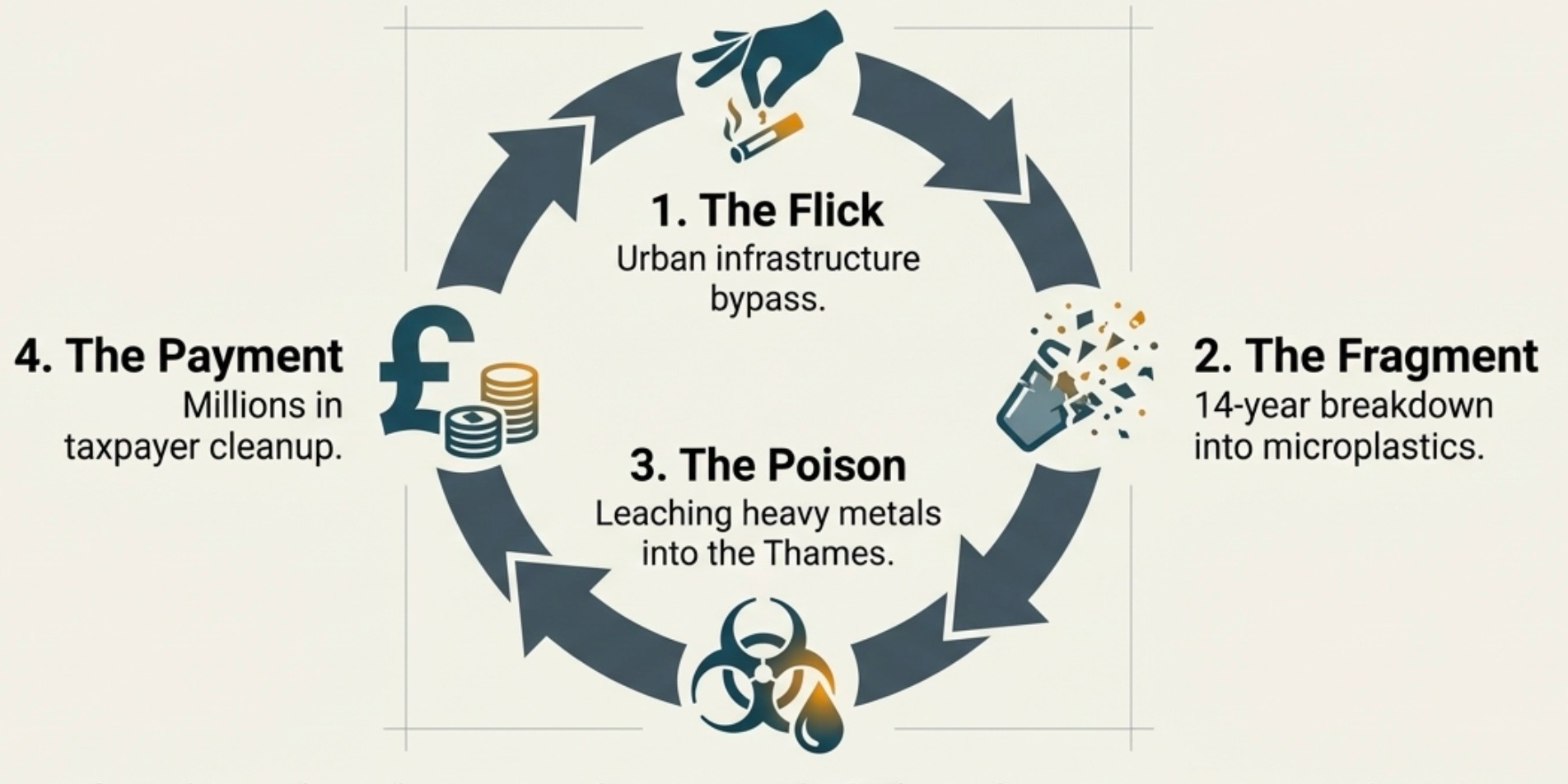
This ‘environmental plague’ starts with the flick
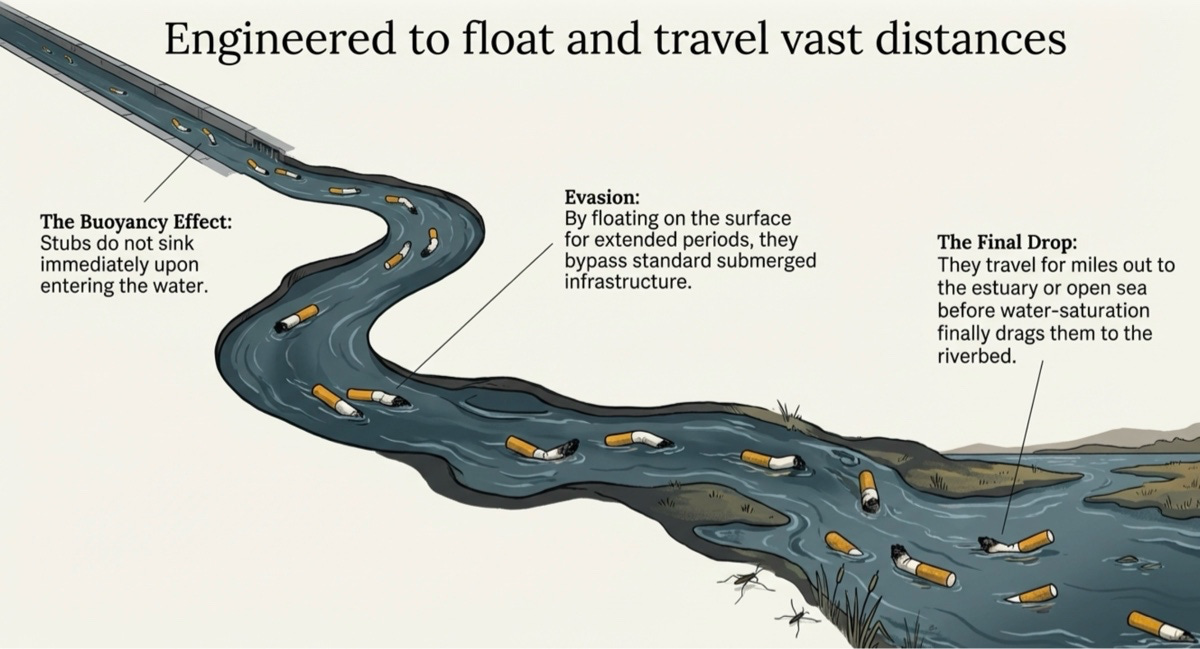
The butts are built to travel.
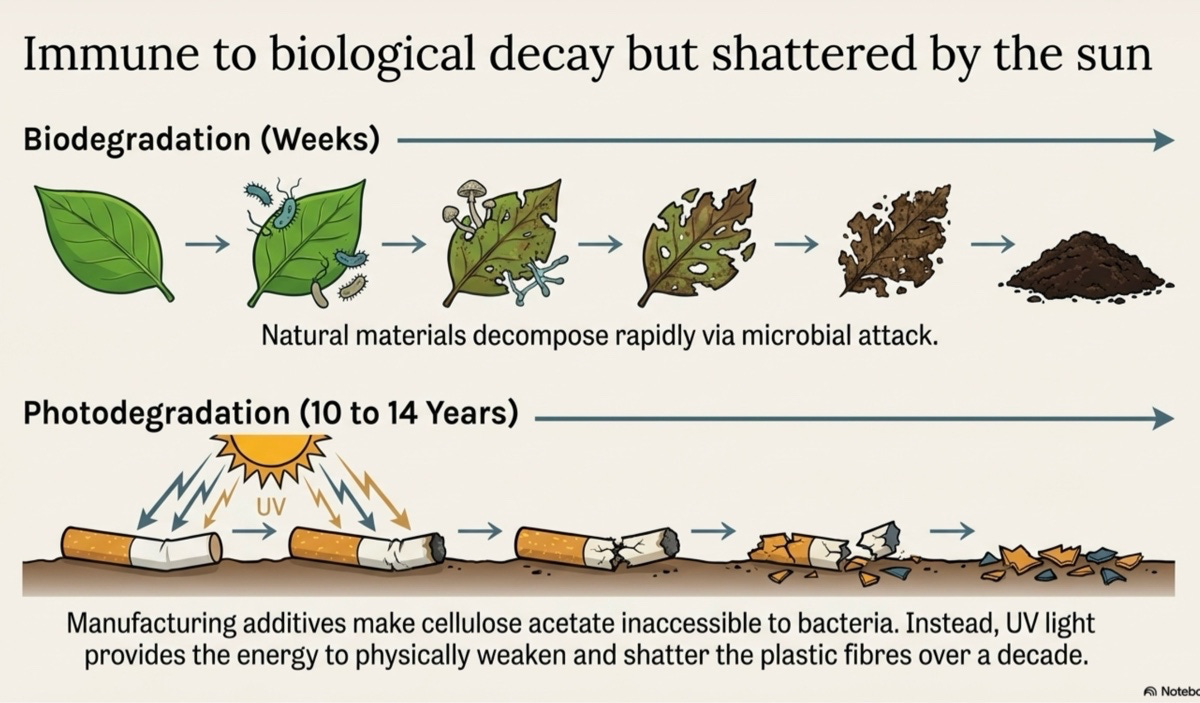
The scale of the damage is startling. A single butt may contaminate up to a thousand litres of water. As the filter breaks down over many years, it can release microplastics into the wider environment.
In my litter patch, builders often means butts - cigarette butts. Since the start of 2026, four teams working on homes in Westfields Avenue, which sits within my patch. Most of the butts I am collecting are outside those properties.
Maybe I should speak to the homeowner? Ask him or her to make some provision for the worker. A simple butt bin is better the gutter.
UK government guidance is that cigarette butts should go into general waste, not onto the street or down drains. In west London, that waste will generally go to energy-from-waste incineration, which greatly reduces the risk of chemicals leaching into drains, soil and waterways.
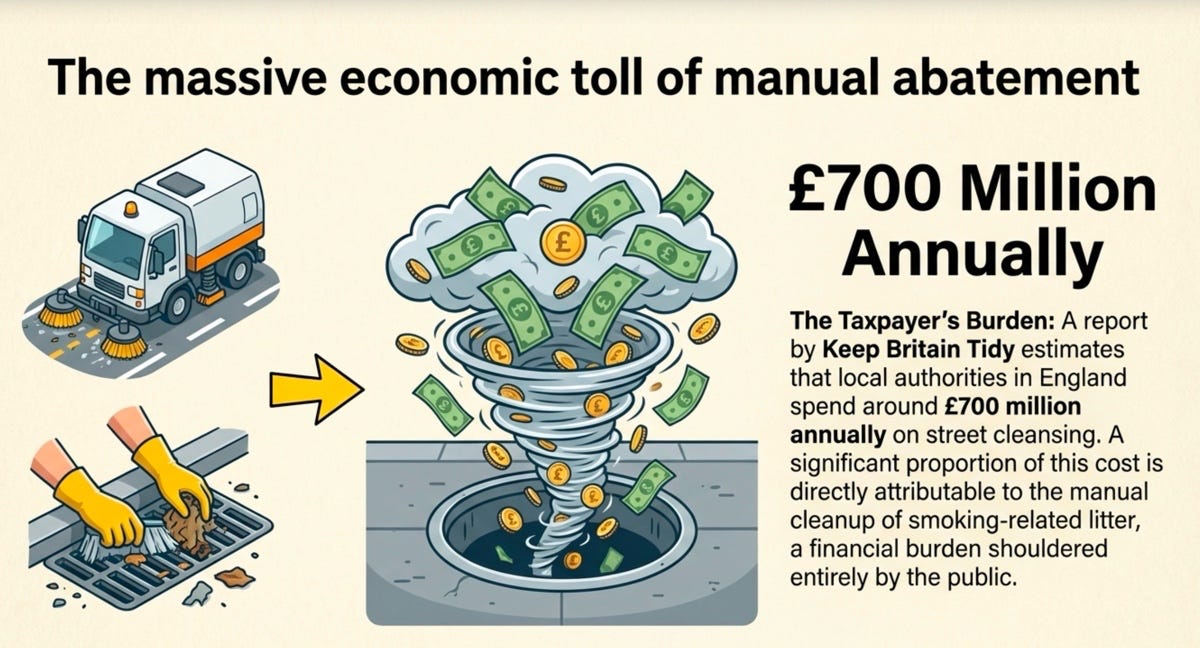
Cigarette butts are a simple manifestatio of me versus we, one of my generation’s defining challenges. At the end of a cigarette, a smoker faces a small but consequential choice: secure it in the general waste, or start a chain of pollution that can affect far more people and wildlife than the person who discarded it.
Production note on use of Ai
Bridged2050 has used Ai for a year to do three things
research a topic
acting as editor, advising on sentence flow, word choice and overall style
and generating addition content such as this Ai podcast
This article adds another two outputs types - Ai infographic and Ai slide deck. Both are produced by NotebookLM’s studio.
Bridged2050 does not possess its own editorial guidelines around the use of generative Ai. Until it does, The Guardian’s explanation of its approach has been useful.
For this article, the original idea was mine. It came while I was standing in a nearby road with my litter-picking kit, looking at what I had collected.
I drafted an article.
I used ChatGPT to flesh out this story.
I check the key facts with Google.
I completed a draft then asked ChatGPT to fact-check and suggest stylistic improvements
Once that was done, I put the draft into NotebookLM as an anchor source. I looked for others and selected another dozen.
I then used the chat window to query that newly created database. I refined the answers through further questions and saved the results as notes in NotebookLM.
I moved those notes into the Source window, deselected the rest, then returned to Studio and asked AI to generate an infographic.
This need some minor tweaks. That involved refining Notes, going through the cycle again and reviewing the output.
Once that was complete, I asked Studio to generate a slide deck. I assumed — correctly, as it turned out — that if I could remove the rough edges and inaccuracies from a single-page infographic, I could also reduce the errors in a longer slide deck.
The slide deck, including the images used in this story, took another six cycles.
NotebookLM’s output is very good — well beyond what I would be capable of creating on my own. But the extent of my control and engagement means this is AI-enabled rather than AI-authored content.
You can find all the illustrations in this slide deck, which you are welcome to download and share.
