
💡Reclaiming The Terrace - WIP Proposal
Story 96: What could be improved and why it matters

Welcome to Bridged2050, a place-based futures project exploring how Barnes might thrive in a climate-ready future
The Terrace should be renewed for walkers, wheelers and cyclists.
One of Barnes’s most beautiful stretches is still treated mainly as a traffic corridor. It should become a calmer, greener and more generous link between the best parts of the village.
Bridged2050 has been interested in improving The Terrace since this blog began. That interest started with my experience as a cyclist. I think it the most unpleasant stretch of road for cyclists in Barnes. I receive more abuse there, and more close passes, than on any other local road.
But cyclists are not the main focus of these proposals. This is chiefly about the pedestrian experience.
Of all the key streets that thread through this corner of southwest London, The Terrace offers the greatest potential for change. It is more than a road to drive through as quickly as possible. It should be the missing link that connects the best of Barnes for anyone walking the area.
I tried to bring this to life by imagining a walk from Thames to Thames. If you have not already done so, I suggest starting there.
What follows is a set of proposed changes. Some would be easy to deliver. Others would take more time, money and political will. Together, though, they add up to a different way of thinking about this beautiful stretch of riverside.
Richmond council has begun to recognise the importance of The Terrace.
In November 2025, it approved a project the improve the walkability of this area with 10 short term changes and the possibility of three more in the medium term. Many of those ideas overlap with the list below.
Then in March 2026, they responded positively to a petition from the Barnes Community Association asking for heavy goods vehicles to be banned from Barnes High Street and The Terrace.
This proposal is part of a wider Manifesto for a better Barnes: a collection of ideas grounded in local insight, climate responsibility and a people-first approach. You’ll find the full list of proposals, along with the thinking behind them, throughout this section.
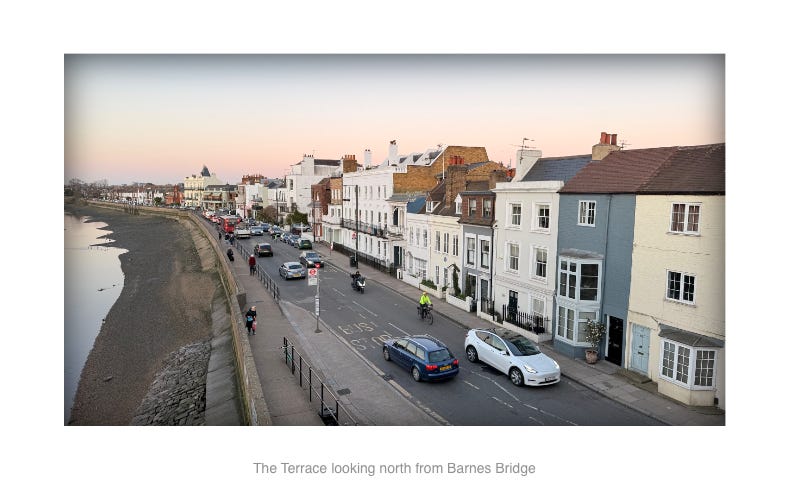
Why change the Terrace?
Encouraging walking
Let’s start with the most important. Richmond council’s long term goal ong-term goal is to increase the share of sustainable travel — walking, cycling and public transport — from 61 per cent to 75 per cent by 2041. Progress is slow.
In Bridged2050’s view, walking is the single most important form of transport for our future.
There are always chances to make small improvements to the pedestrian experience. Big opportunities to encourage more walking are much rarer. Barnes already has one in the new Hammersmith Bridge, serving only pedestrians and cyclists. The Terrace could be another.
Changes here would mainly benefit local residents. Transport for London’s profile of walkers across London is probably not far off what happens in Barnes. Renewing The Terrace would serve those everyday needs locally, making it easier for more people to enjoy leisure, local shops and the riverside on foot.
Climate change
Given Richmond council’s Richmond council’s own forecast for the changing climate, this is a chance to make an important part of Barnes more climate-ready. By reducing traffic volumes and changing the traffic mix, greenhouse gas emissions and other pollutants could probably be reduced too.
The river should also be easier to access, offering cooling relief in hot weather.
Barnes has an older age profile than London, with a relatively high share of residents over 45. Older people are more vulnerable to higher temperatures and should not be left isolated in their homes as heat becomes more common.
Ugliest main road in Barnes, visually and experientially
Walk north from The Watermans Arms and the contrast is extraordinary. On your right is one of the grandest rivers in the country; on your left, some of the loveliest houses in London. Straight ahead is a tribute to 20th-century municipal road design: concrete, rusting iron and a general air of neglect.
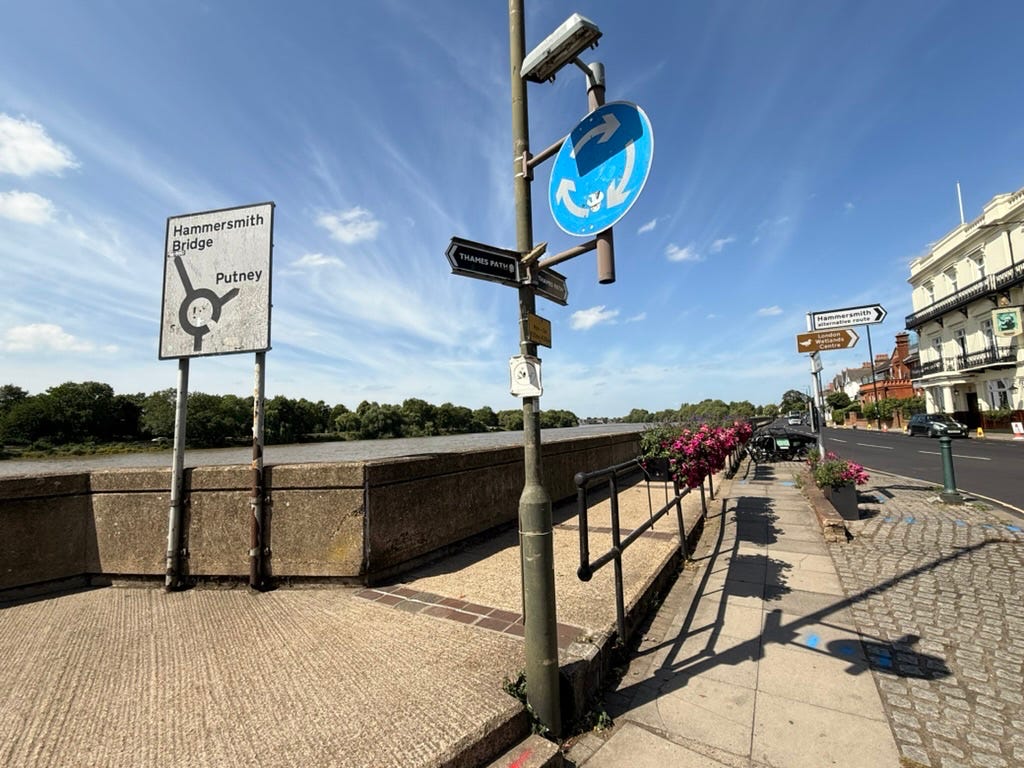
The clutter does not help. Signs, poles and bits of roadside apparatus have accumulated over the years, attaching themselves to walls and posts like barnacles. Much of it is ugly. Some of it is barely useful.
Removing hostile environment for pedestrians
The riverside path between Barnes Bridge and the White Hart has no lighting from dusk.
At the White Hart, the off-ramp from the riverside path drops you on to a sliver of pavement beside traffic that is often accelerating away.
And then there is the crossing. The layout encourages confusion. Someone coming up from the river and wanting to get to Orange Pekoe or The Crossing could reasonably assume that the dropped kerb marks a crossing point. Drivers plainly do not see it that way. In practice, the layout nudges pedestrians towards the zebra crossing by Rick Stein’s and then back again. That is awkward at best and unsafe at worst.
Reducing hostility to cyclists
I receive more abuse, and endure more close passes, on The Terrace than on any other road in Barnes.
Heading north from the White Hart, drivers often accelerate to overtake a cyclist and then have to pull back in sharply because of the bridge or oncoming traffic.
Heading south from The Watermans Arms, there is a different pattern: relief at having cleared the High Street, a quick burst of speed, a bus stopping, a cyclist filtering through, and then the commentary from frustrated drivers through open windows.
To be clear, I ride on The Terrace because I do not think cyclists should yield the road to motor traffic. And when I feel threatened, I will sometimes ride in the middle of the lane.
Reducing traffic volume
Traffic feels much heavier than it did a few months ago. Bridged2050 has not yet found public data sufficiently granular to prove this.
This issue is not confined to The Terrace itself. It is also about what happens further south — at Chalkers Corner, Sheen Lane and White Hart Lane. Drivers keep choosing left and ending up on The Terrace, with the great majority then turning right into Barnes High Street.
Changing the traffic mix
Bridged2050 has logged traffic using The Terrace several times, most recently in March 2026.
The pattern has been strikingly consistent
18-tonnes heavy goods lorries (HGV) are common: never less than five in any daytime hour
7.5-tonnes to 18-tonnes lorries are as common
Visitor or tourists coaches - in other words not school-related coaches - appear regularly throughout the afternoon
Most of these larger vehicles appear to be through-traffic
on two occasions it was possible to talk to the drivers as they queued
occasionally it is possible to trace the likely origin of a vehicle through its livery.
majority of cars have only driver
Making (walking) Barnes great again
Correcting the balance between cars and pedestrians on The Terrace would strengthen the improvements already made elsewhere in Barnes. A reclaimed Terrace would become the thread connecting some of the best bits of communal Barnes:
Wetland Centre
Church Road
Barnes Green
High Street
The Terrace
Footbridge
White Hart Lane
Proposals for improvements
There’s a great deal that could be done here:
Wider footpaths
More trees for shade
More shaded benches for resting
A richer visual and tactile experiences for pedestrians
New lighting for the riverside path
Improved tunnel lighting
A zebra crossing between Orange Pekoe and the White Hart
A ban on heavy vehicles, backed by proper enforcement
Traffic calming along The Terrace
More e-bike storage
Measures to encourage cyclists to use the road rather than the Thames Path
Decluttering of road signs
Better waste management
Wider paths
The wider the path, the better. Proper promenading needs room.
From The Watermans Arms to the bridge, Barnes could learn something from Fulham Football Club’s approach at Craven Cottage.
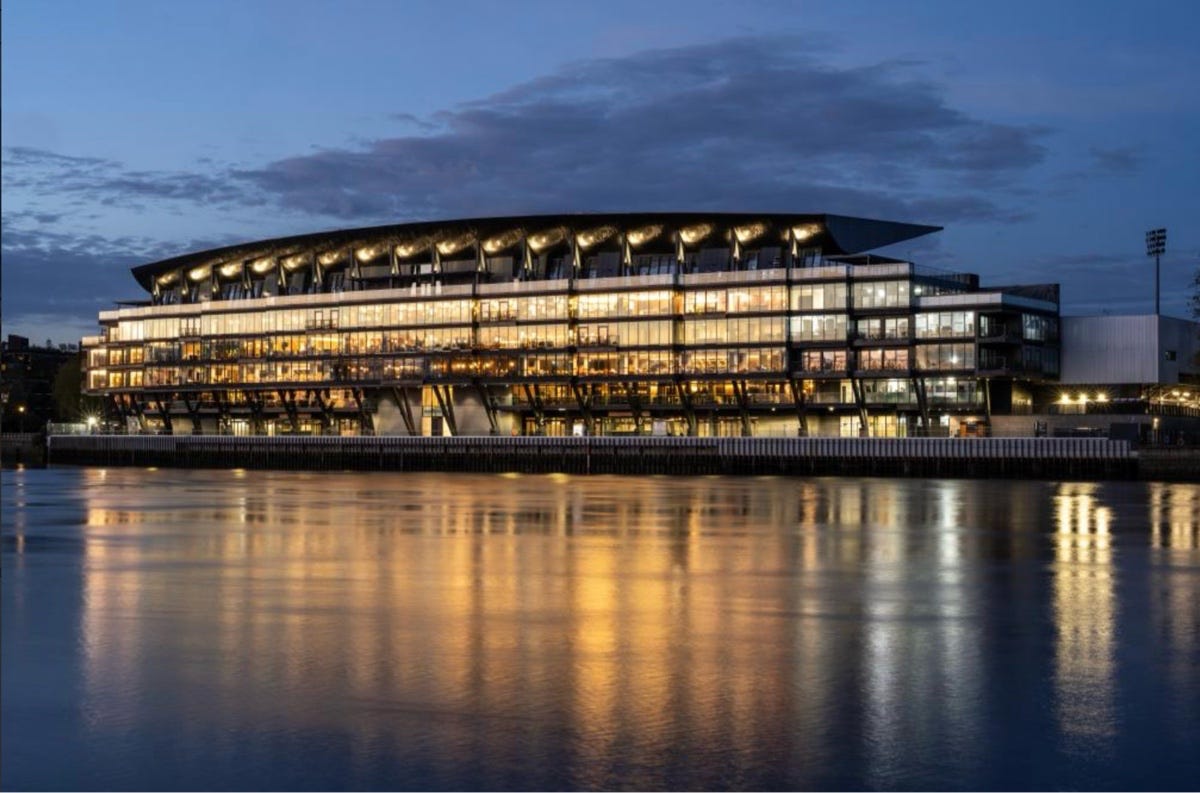
There, public access has been expanded by building out into the river channel on piles, while leaving the river wall itself in place.
With the river wall, it was important to maintain the actual hydrology of the river, you can’t go around changing river walls because you never know if you’re going to have a knock-on implication further downstream. So the riverside deck is actually suspended out over the river on piles, but the river wall itself is not in a different location.
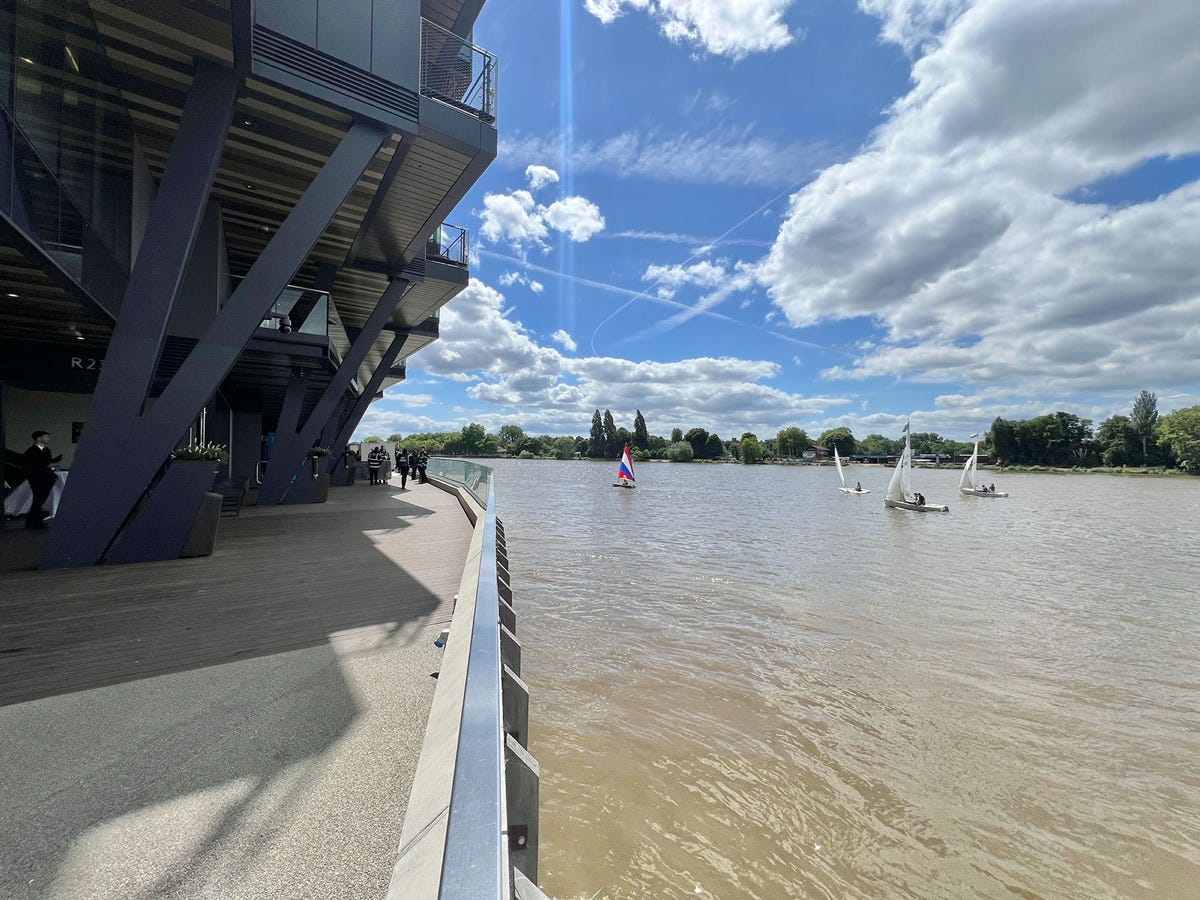
That exact solution may not be right here. But the principle is useful: respect the river, while making far more of it for people.
There could be another small viewing platform over the water, similar to the one at the end of High street
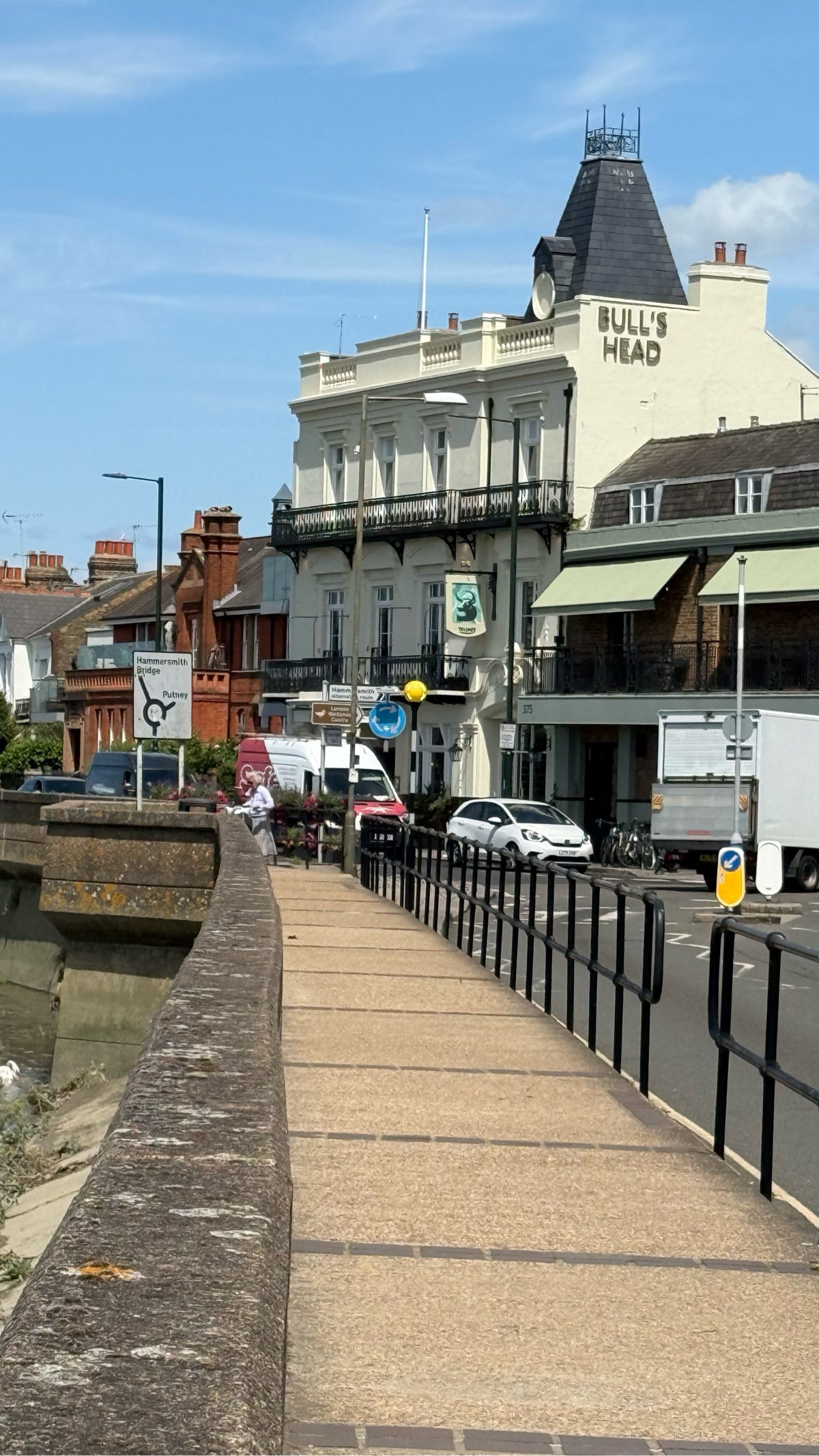
Or the path could be widened over the spare ledge that already runs along the edge of the road. It varies from about four feet to two feet wide. Narrowing the carriageway slightly would also help calm traffic.
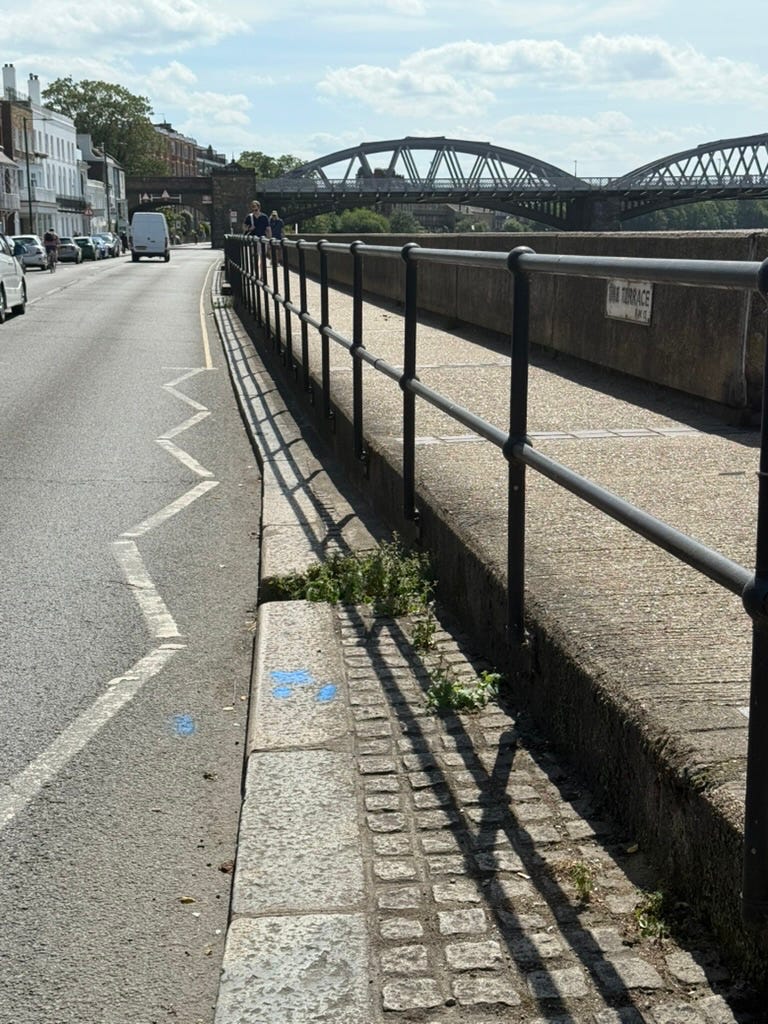
From the bridge to the White Hart, the restored paths are a big improvement on the mud that came before. But they were essentially like-for-like replacements. Even an extra foot of width would make a huge difference.
More trees for shade
Water damages property. Heat kills people. Every major walking route should offer proper shade.
The trees between the White Hart and the bridge, where they exist, are welcome. There should be more of them, and they should be chosen with shade in mind.
The harder question is what can be done, even in sections, between The Watermans Arms and the bridge. But that question is worth asking.
More shaded benches for resting
The plain benches by bus stops across Barnes are popular. Spend an hour near one and you can see the evidence for yourself.
At present there is one bench near the High Street junction and then three more between the bridge and the White Hart.
There should be more, ideally every 50 to 75 metres, and they should be more inviting, with natural shade in summer where possible.
And they need maintenance. This cannot be a one and gone change.
A better visual and tactile experience
This should be a statement project for Barnes.
A mile upstream, the Stag Development will create a new neighbourhood with a clear riverside expression based on medium-rise housing. Renewing The Terrace offers Barnes a chance to make a similarly strong public-realm move — but one that feels true to Barnes rather than imported from somewhere else.
The public elements along this stretch should relate to one another aesthetically:
a renewed Terrace
The View at Barnes Bridge
Dukes Meadow Footbridge
Allowing for procurement and tendering, Moxon Architects may be well placed to help shape that language. They designed the footbridge and also contributed to The View.
Extend the path’s usefulness with lighting
The built environment gives the game away. The road for cars has lighting. Even worse, some of it is on the riverside. The path for people has none.
The aim should be simple: extend the sense of safety, and therefore the usefulness of the path, by another two or three hours each day, through to dusk.
That does not mean planting a line of bulky lamp-posts.
What is needed is a discreet, Barnes-sensitive solution — perhaps something closer to floor lighting, activated by low light and powered by solar energy.
Bridge tunnel lighting
Cars do not need lighting here. Pedestrians do.
The Barnes Community Association mural is an improvement on what went before. But we could do more.
In Berlin and Paris last year, I was struck by the way artful lighting can lift dark tunnel spaces. Not harsh white strip lighting, but subtle colour and rhythm: enough to create a waypoint, improve confidence and turn a gloomy spot into something briefly memorable.
A new zebra crossing between Orange Pekoe and White Hart
The current pavement design is poor. It invites pedestrians to assume that traffic will stop.
A new zebra crossing here would make an established walking route safer. It would also work as a traffic-calming measure.
There is more on that idea here.
Managing traffic volume
Trying to understand and manage traffic without enough data is close to impossible.
There are three places where volume could be influenced for northbound traffic:
before the White Hart, where The Terrace begins
on The Terrace itself
at the northern end, by The Watermans Arms
The priority should be to shape traffic before it reaches the White Hart. Add to that more traffic calming on The Terrace and the High Street, and the character of the road could change significantly.
Reduce vehicle weight limit on The Terrace
The weight limit for The Terrace and Barnes High Street should be reduced to 7.5 tonnes.
There would, clearly, need to be local exemptions.
And any new rule would need proper enforcement.
As of November 2025, Barnes Community Association are campaigning for this.
Traffic calming between the White Hart and The Watermans Arms
We need fewer vehicles on The Terrace, and all of them moving more slowly.
That means introducing more calming measures along the full length of the road, so that traffic remains slower even on a quiet day.
Building out the pavement north of the bridge would help to cramp the road slightly.
“Bike the crest, not the gutter” should be the message. Cyclists should feel entitled to ride in the middle of the lane on The Terrace when conditions require it. That is legal. It would also tend to hold speeds down. Legal e-bikes stop providing power at 15.5mph.
Road surfaces could also be changed at obvious acceleration points, especially after the White Hart and after the bridge.
Change the priority at the zebra crossing by the bridge
At present, if you press the button by the bridge, you wait. Then you wait some more.
The balance should change. Pedestrians matter more here.
In future, pressing the button should trigger a much quicker sequence to amber and then red. That would help walkers and calm traffic at the same time.
Shared e-bike storage
If the council’s current review of shared e-bike licences results in more bikes, there will need to be better parking provision. The Terrace would be a sensible place for some of it.
At least one on-street parking space should be reclaimed.
And the dead space north of the bridge should be examined properly.
Encourage cyclists to use the road, not the Thames Path
There should be clearer signage and a more obvious route from before the White Hart on to the main carriageway.
A new zebra crossing here would also mean slower-moving traffic at the point where cyclists leave the path environment.
Then there should be an easier way to rejoin the path after The Watermans Arms.
Declutter road signs
Some signs are required, often for legal reasons. But not all clutter is equal, and some of it can certainly go.
A proper audit should ask a simple question: which of these signs are genuinely necessary?
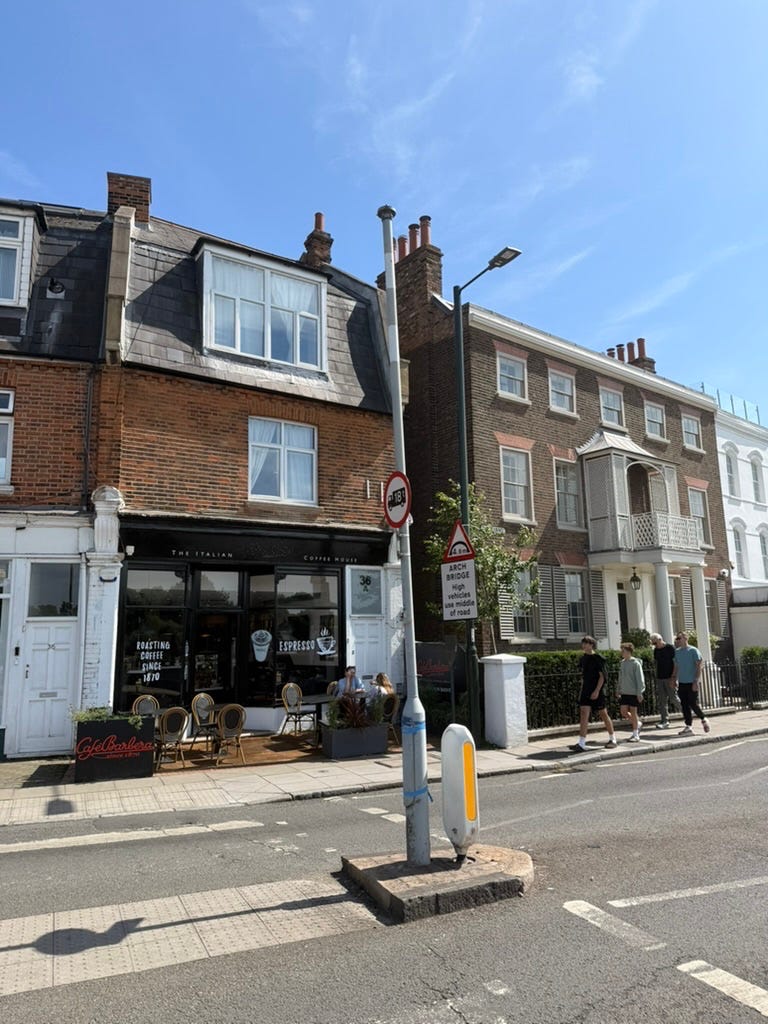
The same goes for smaller clutter. Consider the pole by the coffee shop, carrying a sign not much bigger than a mobile phone to indicate the 18-tonne rule. It is hard to imagine anyone noticing it in time.
Pedestrian pop-up trial
Barnes has several major public events each year — Barnes Fair, the Boat Race and the Barnes Children’s Literature Festival. Bridged2050 believes more could be done to support them.
The Terrace should be closed on the afternoon of the Boat Race and given over to food, activity and entertainment.
That would be a significant change. Which is precisely why it should first be tried as a trial rather than treated as a settled idea from day one.
Empty public bins more often
More people means more rubbish.
That is not a philosophical insight. It is simply a practical one.
Practical considerations
Some changes are already under way. Richmond council’s decision in November 2025 to improve walkability addresses several of the ideas above. If the council also decides to restrict heavy goods vehicles, and enforces that properly, it would be another step towards reclaiming The Terrace.
But Barnes should aim higher than that.
If The Terrace is left as it is, it is hard to imagine Barnes becoming the climate-ready place it needs to be by 2050. Reclaim it though, and this awkward traffic corridor could become one of the village’s great connecting spaces.
Updates to this page
This proposal is a work in progress.
It will be reviewed and improved on a regular basis.
The article was originally published on 04 July 2025.
It was last updated on 17 March 2026. This new version includes,
Improved the structure of the argument to make it more compelling
Simplified and numbered the proposals
Updated with the latest news of relevant LBRT initiatives
Removed some eccentric elements such as ideas rejected
Brought the article into line with Bridged2050 house-style