
💡 Hammersmith Bridge Pod Pilot - WIP Proposal
Story 119

Welcome to Bridged2050, a place-based futures project exploring how Barnes might thrive in a climate-ready future
Automated pods should operate across Hammersmith Bridge.
Small, electric ‘people-movers’ should restore a basic public transport link across Hammersmith Bridge for residents who cannot comfortably walk or cycle the span.
In an ideal world, the service would connect Barnes with Hammersmith’s Tube and bus interchanges and with Charing Cross Hospital, the everyday destinations that matter most when you are older, less mobile or unwell
This post is one of a pair.
The first made the case for keeping Hammersmith Bridge open to pedestrians and cyclists, but private cars, permanently.
This second post is about the awkward part: how to manage the worst consequences of that change — whether it lasts a few years or becomes a generation-long settlement — for those who cannot use the bridge as it is currently configured.
The proposal
The Barnes Bugle explained the challenge of using the Bridge currently,
Currently, Hammersmith Bridge has a maximum weight limit of 1.5 tonnes. That’s because there is concern that heavy vehicles put a concentrated load on weak points of the bridge.
A car or van puts most of its weight through four small tyre contact patches into a narrow strip of deck, creating high local stresses.
Pedestrians and cyclists weighting cumulatively more than 1.5 tonnes are allowed to cross the bridge and that’s because a crowd of people spreads the same or greater total weight across many metres of deck, which the structure is designed to carry.
So, pedestrians can walk across safely but even a single car with one driver crossing the bridge solo is deemed to be too dangerous a stress for the bridge to withstand ..
Indeed Boat Race crowds remain banned from the Grade II*-listed sructure on race day.
The opening, then, is obvious: if heavy, concentrated loads are the problem, the opportunity is a smaller, lighter form of public transport that can operate safely — and predictably — within whatever limits the structure can bear.
These ideal vehicles are often described as pods, though they are closer to a very small shuttle bus. They carry many fewer than a typical normal London single-decker bus, sometimes only four people. They have an electrical power unit. Often they are automated.
Their size means they are much lighter in weight, although as will become clear, this remains an issue. Unsurprisingly, pods are cheaper to buy and run than a bridge.
The campaigning group, Possible was the first to suggest pods. The artwork below - taken from their website - shows how the service might look when operational.
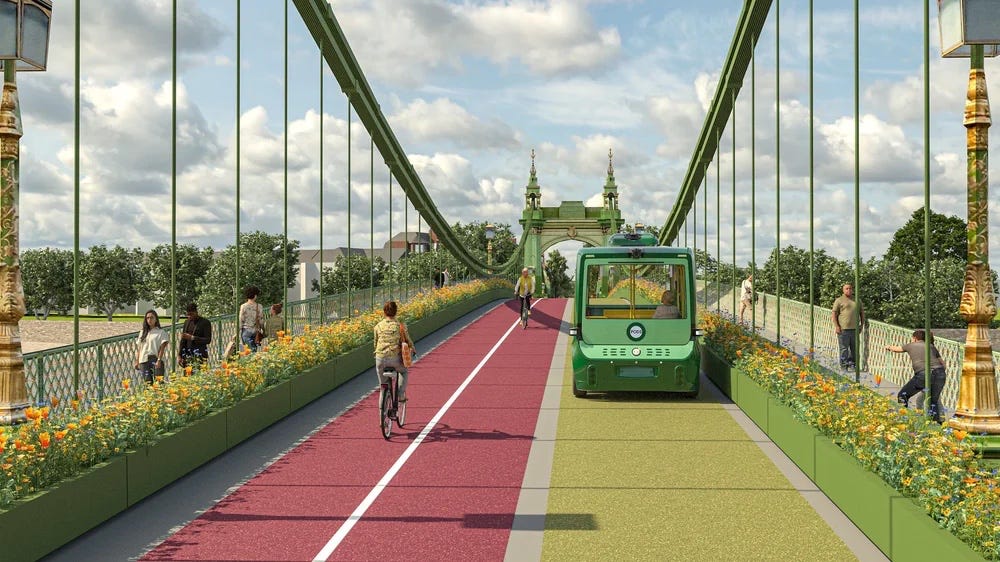
(Full disclosure, this was the project that set this blog in motion. By 2020 I felt the Bridge should remain open to pedestrians and cyclists, but a better mobility option was needed for those most disadvantaged by the loss of bus services. Possible offered the first credible path forward. I still donate to them.)
Possible envisaged pods running every two to three minutes, carrying up to 10 passengers. That’s roughly 250 passengers an hour. In their ideal model, the service would be part of the Transport for London network, usable with Oyster, with the Bridge providing generous walking space, protected cycling, and a dedicated pod lane.
Possible’s pods were also autonomous, based on those from Ohmio, a New Zealand company whose vehicles have been demonstrated and deployed in multiple settings internationally.
A contemporary UK example is the Solihull and Coventry Automated Links Evolution (SCALE) project, which is operating self-driving, all-electric shuttles on a 7 km route linking Birmingham International station, the NEC, and Birmingham Business Park. The service runs Tuesday to Thursday, 10am to 3pm.
There have been a number of pod trials in the UK,
Inverness - Airport auto-pod pilot, 2024
Greenwich - the GATEway Project, 2018
Milton Keynes and Coventry - UK Autodrive pods, 2018
These examples typically involve smaller pods than those in Possible’s illustration. Many carry four passengers. Aurrigo has been a notable player in Milton Keynes, with repeated trials and deployments.
Meanwhile, Waymo and Wayve have signalled intentions to trial autonomous taxi services in London in 2026.
One pod system has been operating for years: Heathrow Pod Parking. It transfers passengers around the Terminal 5 area via a dedicated 3.8 km guideway. The vehicles are battery-powered and driverless, carrying up to four passengers plus luggage. It is a premium service — and priced accordingly.
This proposal is not about novelty. It is about everyday life: helping neighbours get to the places they need, without turning a car-free bridgeinto a bridge that only the fit can properly use.
The Barnes Bugle made the point in practical terms:
If [these smaller pods] took passengers from the last bus stop in Castelnau to Hammersmith Tube, they could carry between 40-50 people per hour in each direction in round trips varying from 14 to 8 minutes depending on how conservative or optimistic you might be about boarding speed, charging time etc.
This proposal also sits within a wider Manifesto for a better Barnes: a collection of ideas grounded in local insight, climate responsibility and a people-first approach. You’ll find the full list of proposals, along with the thinking behind them, throughout this section.
Case for change
The case for pods is sixfold
The truly disadvantaged need help
They need help now
There is a low-cost solution
It is a reversible
London could learn from the experience
We need to properly test the idea of a new Barnes by 2050
(Truly) Disadvantaged need help
Hammersmith Bridge closed to motor traffic in 2019. Since then, residents, political leaders and local media have repeatedly highlighted the impact on those who cannot walk or cycle across the river.
Possible reported,
Over half of residents in lower income areas of Roehampton do not have access to a car, and a third of residents in some parts of Barnes.
North Barnes has one of the oldest populations in London; almost a fifth of residents are pensioners who may be less able to use active travel to get around.
Our focus groups with Age UK in Barnes found that reaching appointments at Charing Cross hospital has become more arduous than before for some of Barnes’ most vulnerable residents.
Nick Miani makes similar points in wide-ranging essay on teh Bridge,
Elderly and disabled residents have been significantly disadvantaged, having lost direct bus routes across the river to Hammersmith with its step-free Tube access, retail outlets and major hospital.36 Low-income residents have been disproportionately affected. They’re less likely to own cars or bikes, cannot afford taxi detours, and have lost affordable public transport options.
The Barnes Community Association (BCA) recognised the need early, trialling a tuk-tuk service in the immediate aftermath of the Bridge closure.
Since then, nothing.
Bridged has not found a definitive study quantifying the number of people now struggling to cross the bridge on foot or by bike. A rough estimate1 suggests the number could be in the hundreds each day.
Providing essential transport for those without alternatives is meant to be the starting point of public policy, not an optional extra. Mayor of London commitments on inclusion make the principle clear.
A lightweight shuttle service would be both a tactical fix and a strategic signal: this is a city that intends to work for everyone, not only the mobile and confident.
One note on language. ‘Truly’ matters.
Many people will say they are disadvantaged by the bridge closure. Many are not. They have been inconvenienced — often temporarily — and they have adjusted.
Official data obtained through FOI requests and reflected in council discussions suggest that up to 9,000 daily car trips have disappeared from south-west London. Traffic evaporation in the jargon.
That is progress, and it aligns with the direction of the Mayor’s transport strategy.
Pods may benefit some of the formerly car-dependent too — perhaps even nudging a few away from driving — but the moral case begins with those who have no good alternative.
Help is needed now
The mobility problem has existed since 2019.
Nearly seven years.
Even if funding is secured to restore the Bridge, Fleur Anderson MP (Labour, Putney) has suggested that won’t happen until 2035 at the earliest. That would be another ten years.
Sixteen years, all in.
And that assumes the restored Bridge receives funding in 2026.
It is entirely possible this stalemate continues if the UK government - the only credible funder at the necessary scale - defers a final decision, again.
In that case, the struggle for some could go on for many more years yet.
The denial of a basic public transport option has been a choice — or, more precisely, a series of choices — by politicians across parties at local, regional and national levels. They have repeatedly chosen not to make it available.
Oddly, given the criticism TfL has received in Barnes, TfL has at least adjusted other services since 2019 to reflect demand and disruption.
After the 2026 local elections, the newly constituted borough councils should meet with the Mayor of London and TfL and agree a practical funding route for a time-limited pod pilot.
Low cost solution
It is easy to establish the need for this service. Easy to say such a solution solves immediate issues and aligns with current strategy, but at what cost?
It turns out, not a lot.
For context the Lower Thames Crossing, downstream, is forecast to cost upto £10billion.
The most recent estimate for restoring Hammersmith Bridge is £250m (2024 prices)
Stabilising the Bridged has cost about £48m to date, February 2026. Creating new bike and pedestrian routes
By comparison Possible estimated the cost of setting up and running a larger pods could be around £10m (2023 prices).
Even better, Nick Maini’s second essay about the Bridge suggest how this service might be funded by The City Bridge Foundation.
A workable public transport link for those without alternatives is available in principle. It is not free but nor is it remotely in the same order of magnitude as rebuilding, retrofitting, or waiting.
Reversible solution
Lightweight vehicles offer another advantage: reversibility.
If this or a future government funds a full restoration, the pod pilot can be wound down and any dedicated infrastructure removed. The pods are an operational layer, not a permanent reconstruction.
This does not need to be a temporary service in spirit but it can be temporary in practice, if the politics finally move.
London could learn from this
Barnes should be a living laboratory for twenty first century life in London. Its distinctive circumstances means it a near-perfect environment for pilots and trials.
the Thames frames the peninsula and creates natural boundaries for experiments. Its community is diverse — broadly well-off, with lesser-known pockets of hardship — which means trials can produce results that actually travel.
Barnes also has form. Whether it was the Wetland Centre or more recently Kitson Road, the area has been open to innovation.
The Mayor of London and Richmond council should look at what might be learnt from this area.
More smaller buses generaly making connections within and beyond the peninsula?
Very small electric buses zipping across the Bridge?
The pod service is not a stopgap. It should be a live test of one aspect of future mobility beyond zone 1.
Political leaders should treat this pod shuttle service as a time-limited trial with measurable outcomes. If it works, expand it. If it doesn’t, close it.
But not trying at all is the least defensible option.
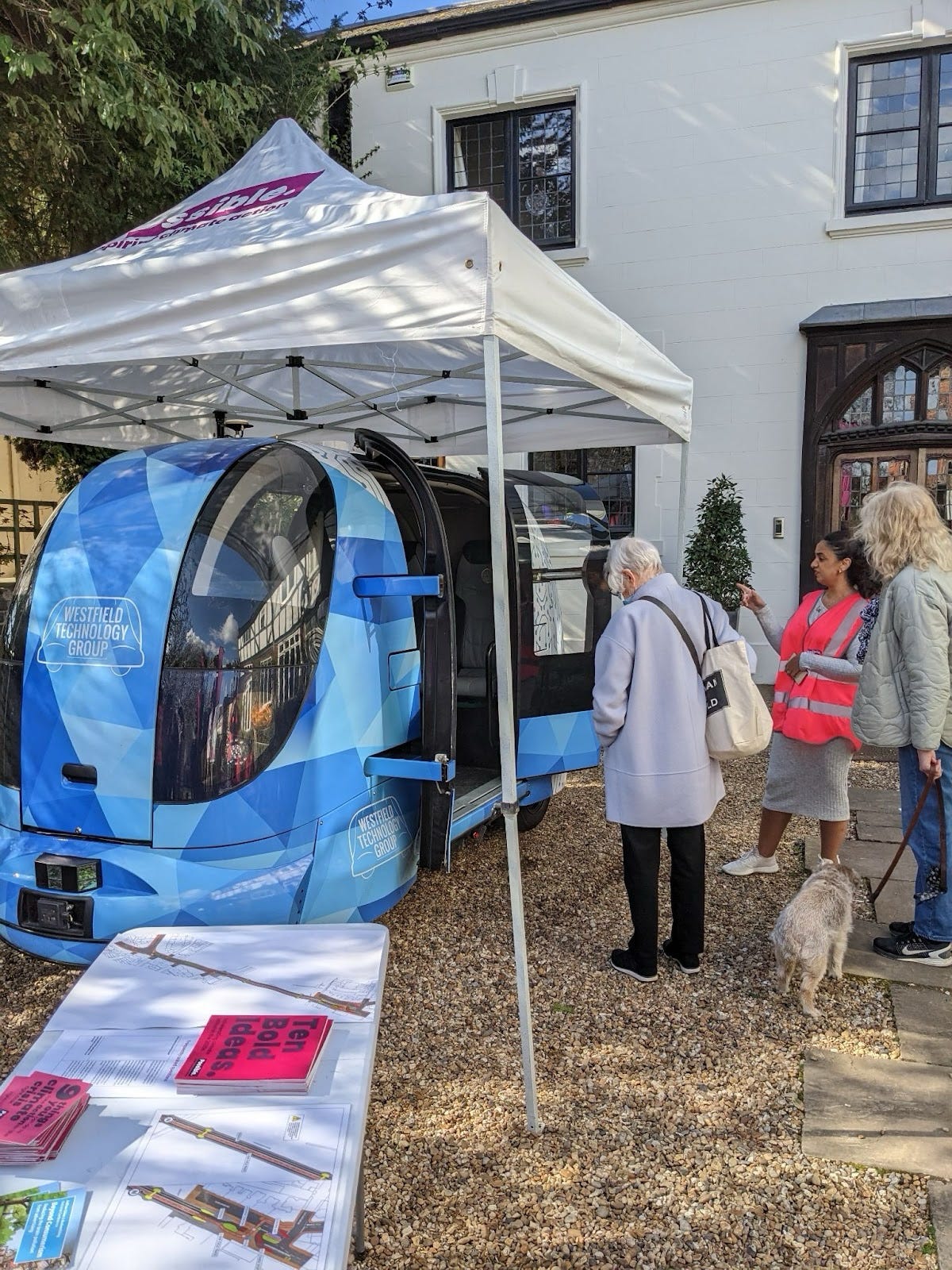
Build for when - 2019 or 2026 or 2050?
Local politicians, judged by their actions and words, appear fixated on two futures.
Return to 2019.
Lock in 2026.
The 2019 restoration would see at least 20,000 car returned to the Bridge, providing it was toll-free.
The 2026 lock-in proects the acres of asphalt south of the Bridge. A tribute in tarmac to political stalemate
But there is a third option.
Barnes deserves leaders willing to explain, in plain language, what it might look like to build for the future. How this would look, feel, work and belong 2050 and what trade-offs that implies.
All major infrastructure should be designed with one eye on the medium term: 25 years plus. £250 million counts as major, by any measure.
The challenges and opportunities of the mid-twenty-first century will be as distinct from today as today is from the nineteenth century rail era or the motorway dreams of the 1960s.
As Solihull Council put it while framing its own autonomous vehicle work:
From bikes to autonomous buses — how we move in the future is likely to be different to how we move today.
This blog exists to imagine that future in a grounded way: not steam-punk fantasy, not sci-fi escapism, but practical, lived possibilities on a peninsula organised around people rather than cars.
Local political leaders need to fess up to the real choice - 2019, 2026 or 2050?
A pod pilot would be one step towards a climate-ready Barnes for 2050. It may not work. But we will not know until we try.
Practical considerations
There are two major problems with this proposal - weight and will.
Two governing groups can unlock these.
Hammersmith & Fulham council, who own the Bridge, has spent approximately £48 million on bridge stabilisation since 2020 and has maintained a 1.5tonnes weight restriction on safety grounds.
As matter stands, none of the services described above would be able to use the Bridge. Maini believes,
The most likely bridge-specific challenges such as weight certification, vibration testing, structural approval are procedural requirements, not engineering barriers.
He quotes a Hammersmith & Fulham council reply to a Freedom of Information request as saying,
Following the Stabilisation Works, consideration will be given to the interim reopening of the road carriageway to special vehicle(s) which, at the time of writing, would be restricted to 3T GVW.
(LBHF Freedom of Information request, 16 May 2022)
In other words: there is a pathway, at least in principle, for limited special vehicles, though Hammersmith & Fulham councilhas not indicated if or when that consideration will be concluded.
The UK government remains the only actor capable of providing the public funds required for full restoration. The Department for Transport has contributed almost £13 million since 2020. The Roads Minister has also said Hammersmith Bridge would be a good candidate for the new Structures Fund. More detail is expected soon.
Two other government bodies matter, but differently.
Richmond council has no formal control in this discussion despite the fact, as Possible highlighted in April 2024, that
Data shows that LBHF residents rarely drove over Hammersmith Bridge prior to its closure.
Like Hammersmith & Fulham council they want the Bridge fully restored, although some choose to present this as restoring ‘blue lights and buses’.
The Mayor of London has made clear, once again in February 2026, in his 2026/27 budget that restoring Hammersmith Bridge is not a priority. Through Transport for London, the Mayor has provided £2.9 million as of December 2024 towards the Bridge’s upkeep.
Local elections in May, 2026 may be complicating the process to resolve this. Once over, the leader of Hammersmith & Fulham council and the Secretary of State for Transport, need to end this stalemate. The 2026 tarmac lock-in can and should end.
As Private Eye said,
The money and the technology are available to bring Hammersmith Bridge into the 21st century, retaining its 19th-century style, with lightweight public transport alongside people on foot and with bicycle
This proposal is a work in progress.
It be reviewed and improved on a regular basis.
This story was last updated on 03 March 2026.
You can find all the current proposals listed here.

Updates to this page
The original version of this article was published on 12 August 2025. You can read it here.
This new version includes,
more detail on other pod services across the UK
estimate of how residents struggle crossing the Bridge in 2026
a recast case for change incorporating new data, especially from Nick Maini whose work on Hammersmith Bridge still represent the best single summaries of the broader situation in 2026
How many elderly and disabled now struggle to cross the Bridge?
This is a rough calculation.
Six bus routes used to cross Hammersmith Bridge each day — the 33, 72, 209, 419, 485 and 609.
6 routes × 2 directions = 12 crossings per hour
12 crossings × 18 hours = 216 crossings per day
Assume single-decker buses carry about 20 passengers on average:
216 crossings × 20 passengers = 4,320 passengers per day
Assume 12% of the UK population is disabled:
12% of 4,320 ≈ 520 people per day
Obvious flaws: there were likely more crossings than this, and ’20 passengers’ is a blunt average that smooths peaks and troughs. The point is not precision. The point is scale: the number is plausibly in the hundreds each day.